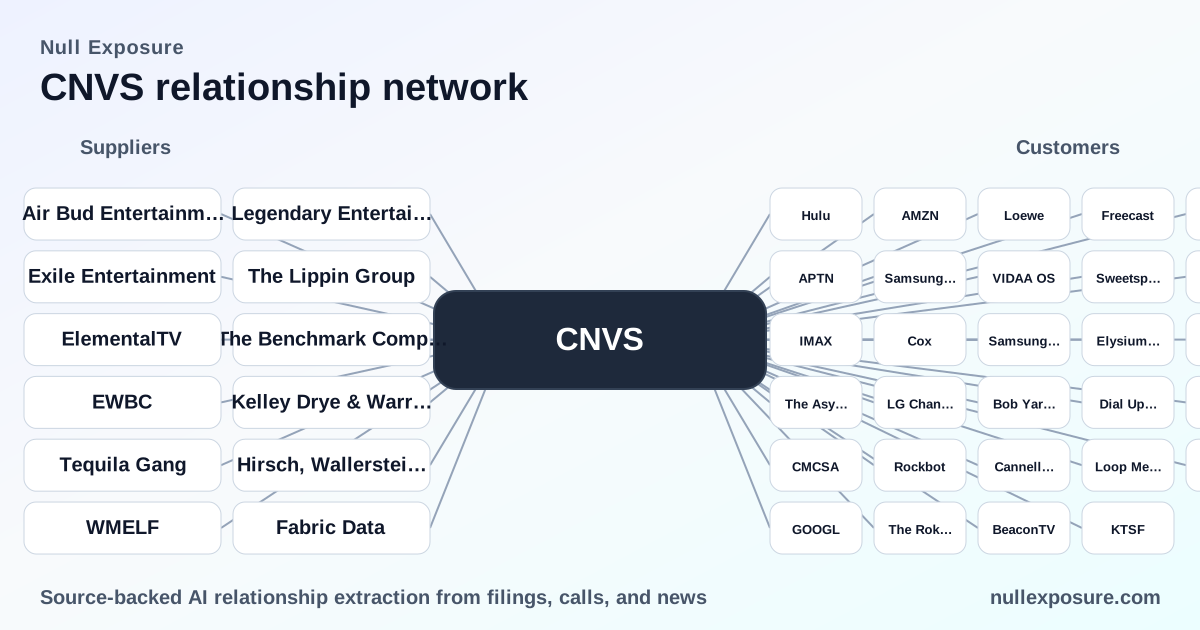
Cineverse (CNVS) — Customer Relationships That Drive Content Distribution and Platform Revenue
Cineverse operates a dual business model: a content studio that licenses and distributes film and TV IP, and a technology platform (Matchpoint® and recently acquired IndiCue) that powers over-the-top (OTT), FAST, AVOD and SVOD distribution for third parties. The company monetizes through content licensing and royalties, subscription and ad-supported channel deals, and platform services that are a mix of subscription and usage-based fees tied to distribution and ad monetization. For an investor-focused view of customer exposures and commercial concentration, see the consolidated work at Null Exposure.
How Cineverse converts content and tech into revenue
Cineverse generates cash from three complementary streams: (1) licensing and single-title sales to large streamers and SVOD/TVOD partners; (2) platform fees and service contracts for Matchpoint Dispatch/Blueprint used by FAST/AVOD operators and CTV app owners; and (3) ad-revenue share and connected-TV monetization following the IndiCue acquisition. This structure gives Cineverse a pathway to higher-margin recurring revenue from platform customers while preserving transactional upside from content deals.
If you want a quick gateway to customer-level exposure mapping, visit Null Exposure.
Operational constraints and company-level signals investors should weight
- Contracting posture: Payment terms vary and are typically short-term (net 30–90 days), which favors cash turnover but increases renewal frequency and sales effort.
- Revenue mechanics: Contracts are a mix of subscription and usage-based models; Matchpoint provides SVOD/AVOD/TVOD capabilities that support both recurring fees and per-stream monetization.
- Geographic reach: Cineverse positions itself as a global distributor and platform provider with distribution arrangements across multiple international CTV ecosystems.
- Concentration and materiality: The company disclosed that two customers represented ~30.2% and 22.9% of consolidated revenue for the year ended March 31, 2025 — a meaningful concentration risk for revenue stability.
- Role diversity: Cineverse functions across multiple roles — licensor, distributor, seller and service provider — which gives cross-sell levers but also exposes the company to competitive dynamics at each stage of the content value chain.
Catalog of reported customers and what they purchase from Cineverse
Below is a concise, source-linked summary for each customer relationship reported in public coverage for FY2025–FY2026.
- Hulu — Secured streaming rights for Cineverse’s title The Toxic Avenger, demonstrating Cineverse’s function as a licensor of premium content to major SVOD platforms (Sahm Capital / Barchart, Mar 2026: https://www.sahmcapital.com/news/content/hulu-acquires-streaming-rights-from-cineverse-for-the-toxic-avenger-to-debut-on-the-platform-january-8-2026-2026-01-06 and https://www.barchart.com/story/news/36911251/hulu-acquires-streaming-rights-from-cineverse-for-the-toxic-avenger-to-debut-on-the-platform-january-8-2026).
- 800 Pound Gorilla Media (Gorilla Comedy+) — Launched a new FAST/streaming service powered by Cineverse’s Matchpoint® platform, a commercial technology partnership for channel distribution (Sahm Capital / Intellectia, Apr–May 2026: https://www.sahmcapital.com/news/content/800-pound-gorilla-launches-gorilla-comedy-streaming-service-with-cineverse-2026-04-21 and https://intellectia.ai/news/stock/cineverse-prices-public-offering-of-15-million-shares).
- Revry — Adopted Matchpoint Dispatch for automated content management, delivery and metadata enrichment across 100+ platforms, reflecting Cineverse’s role as a service provider for niche streaming networks (Investing.com / Simply Wall St, May 2026: https://m.ca.investing.com/news/insider-trading-news/cineverse-chief-motion-pictures-officer-buys-60000-in-shares-93CH-4463084 and https://simplywall.st/stocks/us/media/nasdaq-cnvs/cineverse/future).
- IMAX — Listed among IndiCue’s customer roster after Cineverse acquired the connected-TV monetization platform, signaling distribution/monetization relationships with premium media brands (PR Newswire, Mar 2026: https://www.prnewswire.com/news-releases/cineverse-acquires-profitable-connected-tv-monetization-platform-indicue-in-transformational-deal-expanding-high-margin-infrastructure-that-powers-modern-content-distribution-302687412.html).
- Freecast — Named as an IndiCue customer, indicating Cineverse’s expanded reach into monetization partners for CTV publishers (PR Newswire, Mar 2026: https://www.prnewswire.com/news-releases/cineverse-acquires-profitable-connected-tv-monetization-platform-indicue-in-transformational-deal-expanding-high-margin-infrastructure-that-powers-modern-content-distribution-302687412.html).
- Cannella Media — Included in the IndiCue customer list, a relationship that supports Cineverse’s ad-monetization and distribution capabilities (PR Newswire, Mar 2026: https://www.prnewswire.com/news-releases/cineverse-acquires-profitable-connected-tv-monetization-platform-indicue-in-transformational-deal-expanding-high-margin-infrastructure-that-powers-modern-content-distribution-302687412.html).
- Loop Media — Cited among IndiCue customers, reinforcing Cineverse’s footprint in AVOD/FAST monetization (PR Newswire, Mar 2026: https://www.prnewswire.com/news-releases/cineverse-acquires-profitable-connected-tv-monetization-platform-indicue-in-transformational-deal-expanding-high-margin-infrastructure-that-powers-modern-content-distribution-302687412.html).
- KTSF — Appears on the IndiCue roster, representing local and specialty broadcasters in Cineverse’s distribution mix (PR Newswire, Mar 2026: https://www.prnewswire.com/news-releases/cineverse-acquires-profitable-connected-tv-monetization-platform-indicue-in-transformational-deal-expanding-high-margin-infrastructure-that-powers-modern-content-distribution-302687412.html).
- Dial Up Media — Listed with other monetization partners, supporting Cineverse’s revenue diversification via third‑party publishers (PR Newswire, Mar 2026: https://www.prnewswire.com/news-releases/cineverse-acquires-profitable-connected-tv-monetization-platform-indicue-in-transformational-deal-expanding-high-margin-infrastructure-that-powers-modern-content-distribution-302687412.html).
- SCREAMBOX — Cineverse’s proprietary horror streamer; signed exclusive streaming windows for titles like Silent Night, Deadly Night and hosts exclusive premieres, illustrating Cineverse’s owned-channel monetization (Sahm Capital, Jan–Apr 2026: https://www.sahmcapital.com/news/content/cineverse-announces-blood-curdling-new-programming-for-horror-streamer-screambox-2026-01-29 and https://www.sahmcapital.com/news/content/cineverse-celebrates-halfway-to-halloween-with-harrowing-holiday-horror-flick-silent-night-deadly-night-exclusively-streaming-on-screambox-2026-04-01).
- Samsung TV Plus (including Germany) — Hosted Cineverse channels including The Bob Ross Channel and Dog Whisperer, showing Cineverse’s international FAST distribution (Sahm Capital / MarketScreener / StockTitan, Mar–Jun 2026: https://www.sahmcapital.com/news/content/cineverse-brings-happy-little-trees-or-glckliche-kleine-bume-to-samsung-tv-plus-germany-with-the-bob-ross-channel-auf-deutsch-2026-03-05 and https://www.marketscreener.com/news/cineverse-corp-files-for-resale-of-up-to-21-8-million-shares-of-class-a-common-zqtf0mius9uy.html).
- Comcast / Xfinity — Carried Cineverse channels and apps on Comcast’s Xfinity platform and Xumo devices, expanding pay-TV and streaming distribution corridors (Sahm Capital / Simply Wall St, Jan–Apr 2026: https://www.sahmcapital.com/news/content/cineverse-announces-blood-curdling-new-programming-for-horror-streamer-screambox-2026-01-29 and https://simplywall.st/stocks/us/media/nasdaq-cnvs/cineverse/future).
- Prime Video (Amazon) — Listed as a distribution destination for Cineverse channels and content, reflecting traditional licensor relationships (Sahm Capital, Jan 2026: https://www.sahmcapital.com/news/content/cineverse-announces-blood-curdling-new-programming-for-horror-streamer-screambox-2026-01-29).
- YouTube TV — Identified as an availability channel for Cineverse’s owned streamers, broadening reach into live/linear streaming bundles (Sahm Capital, Jan 2026: https://www.sahmcapital.com/news/content/cineverse-announces-blood-curdling-new-programming-for-horror-streamer-screambox-2026-01-29).
- Cox — Carried Cineverse streamer content, extending distribution into cable operator platforms (Sahm Capital, Jan 2026: https://www.sahmcapital.com/news/content/cineverse-announces-blood-curdling-new-programming-for-horror-streamer-screambox-2026-01-29).
- LG Channels (incl. Australia & NZ) — Licensed multiple Cineverse FAST channels (The Bob Ross Channel, Dog Whisperer, Yu‑Gi‑Oh!), showing OEM app distribution and channel carriage (Sahm Capital, Nov 2025 / Mar 2026: https://www.sahmcapital.com/news/content/cineverse-technology-group-signs-four-new-customers-for-its-matchpoint-media-supply-chain-platform-2025-11-13 and https://www.sahmcapital.com/news/content/cineverse-to-launch-new-streaming-channel-featuring-jay-mohr-and-witz-podcast-networks-mohr-stories-2026-03-27).
- WITZ Podcast Network — Partnered with Cineverse for podcast distribution and cross-promoted CTV channels such as Mohr Stories, indicating audio-to-CTV cross-distribution (Sahm Capital, Mar 2026: https://www.sahmcapital.com/news/content/cineverse-to-launch-new-streaming-channel-featuring-jay-mohr-and-witz-podcast-networks-mohr-stories-2026-03-27).
- VIDAA OS / Loewe / Toshiba / Hisense / TOSBF — Cineverse’s CINESEARCH feature went live on VIDAA-supported smart TVs (Toshiba, Hisense, Loewe), signaling OEM partnerships for app placement (Sahm Capital, Dec 2025: https://www.sahmcapital.com/news/content/leading-into-ces-cineverse-unveils-new-branding-ctv-voice-features-for-cinesearch-powered-by-matchpoint-2025-12-22).
- Xumo — Hosted Cineverse channels and supported device-level distribution for AsianCrush and RetroCrush launches (Simply Wall St, Apr 2026: https://simplywall.st/stocks/us/media/nasdaq-cnvs/cineverse/future).
- Xfinity — Partnered for AsianCrush and RetroCrush launches on Xfinity streaming devices, extending channel reach into pay‑TV ecosystems (Simply Wall St, Apr 2026: https://simplywall.st/stocks/us/media/nasdaq-cnvs/cineverse/future).
- Walmart — Announced exclusive Bloody Disgusting merchandise distribution at select Walmart locations, showing physical retail and IP merchandising channels (Simply Wall St, Jun 2026: https://simplywall.st/stocks/us/media/nasdaq-cnvs/cineverse/future).
- Lights Out Sports TV — Launched the GPro Channel with Cineverse, indicating niche sports/vertical channel activation (Simply Wall St, Oct 26 listing: https://simplywall.st/stocks/us/media/nasdaq-cnvs/cineverse/future).
- APTN — Licensed Matchpoint Dispatch for content delivery, showing public/broadcaster uptake of Cineverse’s tech (Sahm Capital, Nov 2025: https://www.sahmcapital.com/news/content/cineverse-technology-group-signs-four-new-customers-for-its-matchpoint-media-supply-chain-platform-2025-11-13).
- The Asylum — Licensed Matchpoint Dispatch to deliver TVOD and AVOD content, reinforcing Cineverse’s role as a distribution service provider (Sahm Capital, Nov 2025: https://www.sahmcapital.com/news/content/cineverse-technology-group-signs-four-new-customers-for-its-matchpoint-media-supply-chain-platform-2025-11-13).
- BeaconTV — Signed for channel distribution, adding to Cineverse’s portfolio of genre-specific channel customers (Sahm Capital, Nov 2025: https://www.sahmcapital.com/news/content/cineverse-technology-group-signs-four-new-customers-for-its-matchpoint-media-supply-chain-platform-2025-11-13).
- Elysium Media — Engaged Matchpoint services for documentary and reality programming distribution (Sahm Capital, Nov 2025: https://www.sahmcapital.com/news/content/cineverse-technology-group-signs-four-new-customers-for-its-matchpoint-media-supply-chain-platform-2025-11-13).
- Sweetspire TV — Licensed distribution services, expanding Cineverse’s presence in regional and niche FAST channels (Sahm Capital, Nov 2025: https://www.sahmcapital.com/news/content/cineverse-technology-group-signs-four-new-customers-for-its-matchpoint-media-supply-chain-platform-2025-11-13).
- Bob Yari's Magenta Light Studios — Entered distribution agreements, highlighting Cineverse’s relationships with independent producers (Sahm Capital, Nov 2025: https://www.sahmcapital.com/news/content/cineverse-technology-group-signs-four-new-customers-for-its-matchpoint-media-supply-chain-platform-2025-11-13).
- Rockbot — Added channels such as Real Madrid TV through Matchpoint, showing non-home-theatre digital placements (Sahm Capital, Nov 2025: https://www.sahmcapital.com/news/content/cineverse-technology-group-signs-four-new-customers-for-its-matchpoint-media-supply-chain-platform-2025-11-13).
- The Roku Channel UK — Carried Cineverse programming like Dog Whisperer and Yu‑Gi‑Oh!, indicating regional streaming carriage (Sahm Capital, Nov 2025: https://www.sahmcapital.com/news/content/cineverse-technology-group-signs-four-new-customers-for-its-matchpoint-media-supply-chain-platform-2025-11-13).
- Waypoint (WYPH) — Licensed Matchpoint Dispatch for content delivery, another example of broadcaster uptake (Sahm Capital, Nov 2025: https://www.sahmcapital.com/news/content/cineverse-technology-group-signs-four-new-customers-for-its-matchpoint-media-supply-chain-platform-2025-11-13).
- Philo — Launched Cineverse FAST channels such as Land of the Lost and So.Real, showing OTT MVPD distribution (Simply Wall St, Apr 16, 2026: https://simplywall.st/stocks/us/media/nasdaq-cnvs/cineverse/future).
- Va Media — Entered a distribution and monetization agreement for YouTube channels, expanding Cineverse’s digital video monetization footprint (MarketScreener, Mar 2026: https://www.marketscreener.com/news/cineverse-corp-files-for-resale-of-up-to-21-8-million-shares-of-class-a-common-zqtf0mius9uy.html).
- XPER / TiVo OS — TiVo expanded OS availability and added Cineverse as a content partner, supporting device-level content integration (BroadbandTVNews, Jan 2026: https://www.broadbandtvnews.com/2026/01/06/tivo-expands-os-availability-and-content-partnerships/).
(Entries above consolidate every customer record reported across FY2025–FY2026 sources cited.)
Investment implications — what this customer map means for investors
- Revenue diversification through platform and monetization assets reduces single-source content risk but does not eliminate concentration exposure given the disclosed large-customer shares in FY2025.
- Short-term payment terms and mixed contract models mean revenue is sensitive to churn and pipeline; recurring subscription fees and ad-share monetization from IndiCue are positive margin anchors.
- Global OEM and operator distribution (VIDAA, Samsung TV Plus, LG Channels, Xfinity/Xumo, Roku, Philo, TiVo) provides scale but requires continuous content supply and product investment to retain placement.
Bottom line
Cineverse combines content licensing with a growing platform and monetization stack that sells to both global aggregators and niche publishers. The business model’s strength is cross-selling content into owned channels while monetizing third‑party distribution through Matchpoint and IndiCue; the key investor risk is customer concentration and the short-term nature of many commercial arrangements.
For further customer-level exposure analysis and to map counterparty concentration across portfolios, visit Null Exposure.