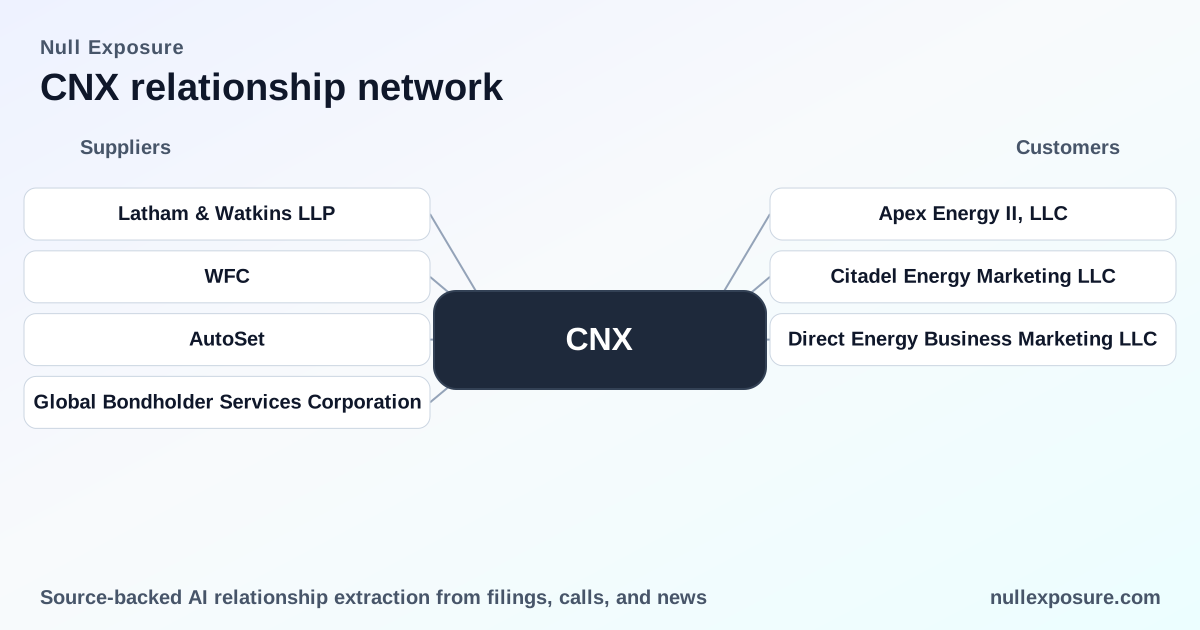
CNX’s Customer Map: Who Buys Its Gas, Who Matters, and What That Means for Investors
CNX Resources is an Appalachian-focused natural gas producer that monetizes by selling produced gas to gas marketers, industrials, local distribution companies and power generators, while operating a complementary gathering business and hedging program to stabilize cash flows. Revenue is generated primarily through physical gas sales and gathering fees; cash-flow volatility is managed through financial hedges and a mix of contract tenors. For document-level evidence and continuous counterparty monitoring, visit https://nullexposure.com/.
Direct counterparty relationships investors need to know
Below are the counterparty relationships disclosed in CNX’s recent filings and public reporting. Each entry is a concise, investor-oriented description with the reporting source.
-
Apex Energy II, LLC
In FY2025 CNX completed an acquisition of Apex Energy II’s upstream and associated midstream business for approximately $518 million, expanding CNX’s production and midstream footprint. This transaction is disclosed in CNX’s 2025 Form 10‑K and demonstrates a strategic inorganic push to consolidate Appalachian assets and control more of the midstream value chain. (Source: CNX FY2025 Form 10‑K) -
Citadel Energy Marketing LLC
Citadel is a material physical and marketing counterparty: CNX reported that sales to Citadel totaled $205,993 and that Citadel accounted for more than 10% of revenue from contracts with external customers for the year ended December 31, 2025. CNX also references Citadel in the context of its hedging and physical merchandising activities, indicating Citadel is a core buyer and price‑risk counterparty. (Source: CNX FY2025 Form 10‑K) -
Direct Energy Business Marketing LLC
Direct Energy is referenced as a market counterparty in CNX’s discussion of hedging and the logistics of moving gas from wellhead to market, indicating CNX transacts both physically and financially with large retail/marketing firms. This relationship sits within CNX’s broader strategy of selling to gas marketers and end users in the Appalachian Basin. (Source: CNX FY2025 Form 10‑K) -
Leatherwood, LLC
A Pennsylvania environmental report from April 2026 documents consent orders governing the transfer of five wells from CNX Gas to Leatherwood so Leatherwood can arrange plugging prior to coal mining operations in Centre County. This is a regulatory and remediation‑oriented counterparty interaction rather than a revenue relationship, and it highlights CNX’s operational liabilities and remediation workflows. (Source: Pennsylvania environmental blog post, April 2026)
How CNX’s contracting posture and counterparty mix shape the business
The disclosures and constraint signals in CNX’s filings reveal a set of structural characteristics that determine revenue durability, concentration risk and operational flexibility.
-
Mixed contracting posture — both short and long tenors are in play. CNX states it is committed to deliver 658.7 Bcf of gas under existing sales contracts or agreements over the next four years, establishing a clear firm‑delivery obligation. At the same time CNX reports that substantially all of its natural gas is sold at market prices primarily under short‑term sales contracts, so the company retains significant exposure to spot and seasonal price swings. This juxtaposition produces a predictable base load requirement while preserving upside (and downside) to commodity price moves.
-
Concentration is real and measurable. The FY2025 filing discloses that three counterparties — NRG Business Marketing LLC, DTE Energy Trading, Inc., and Citadel Energy Marketing LLC — each accounted for more than 10% of revenue (sales reported as $223,210; $208,775; and $205,993 respectively for the period). That concentration creates counterparty credit and bargaining risks that are material to topline stability. (Source: CNX FY2025 Form 10‑K)
-
Seller role and active commercial posture. CNX’s disclosures repeatedly describe the company as a seller to gas wholesalers, marketers, industrials and power generators and state that contracts are active and expected to be satisfied from existing proved developed reserves. Operational continuity depends on production meeting contracted delivery volumes. (Source: CNX FY2025 Form 10‑K)
-
Geographic concentration amplifies regional price and infrastructure dynamics. CNX markets its gas primarily in the Appalachian Basin, which concentrates both logistical dependencies (gathering, compression, processing, transportation) and exposure to regional price differentials and pipeline capacity constraints. (Source: CNX FY2025 Form 10‑K)
-
Services and midstream integration matter. CNX discloses it provides gathering services to third parties and incurs gathering/compression/processing/transportation costs to move production to market. The Apex acquisition adds midstream control, reducing third‑party dependence and improving margin capture on transported volumes. (Source: CNX FY2025 Form 10‑K)
Why these relationships matter for valuation and risk
Investors should synthesize the counterparty roster and constraints into actionable investment considerations.
-
Revenue visibility vs. price exposure: The 658.7 Bcf commitment provides a measurable revenue floor over four years, but the predominance of short‑term sales ensures earnings remain correlated to near‑term gas prices. Valuation should reflect a hybrid model: committed volumes underpin cash flow forecasts while spot exposure creates asymmetric upside and downside.
-
Counterparty concentration requires scrutiny: The fact that multiple counterparties individually exceed 10% of revenue elevates counterparty credit and renegotiation risk. Any change in contracting posture by NRG, DTE or Citadel would have outsized consequences for CNX’s realized price and working capital.
-
Regulatory and remediation liabilities are real operational items: The Leatherwood consent orders illustrate the company’s accountability for well plugging and the transfer of environmental obligations; these are not immaterial from a cash‑flow or reputational perspective. Investors must account for decommissioning cadence and potential contingent costs in near‑term cash planning.
-
M&A and midstream ownership shift margin dynamics: The Apex purchase for ~$518 million expands CNX’s midstream control and should improve netbacks on transported volumes, but it also concentrates capital deployment in the region and requires integration execution. Assess acquisition returns against the company’s established leverage and free cash generation.
For ongoing monitoring and to inspect the original filings that underpin these summaries, see https://nullexposure.com/ for access to the underlying document evidence and continuous counterparty mapping.
Bottom line for investors
CNX operates as a regional gas producer that monetizes through both physical sales and gathering services, with a clear mix of committed deliveries and market‑priced short‑term contracts. The company’s revenue profile is materially dependent on a handful of large counterparties and on Appalachian Basin infrastructure and price dynamics. Positive catalysts include hedging discipline, midstream ownership via the Apex acquisition, and stable production coverage of committed volumes; principal risks are counterparty concentration, spot price volatility, and regulatory/remediation obligations.
For a deep dive into counterparty documents, transaction-level evidence and continuous monitoring, consult https://nullexposure.com/.