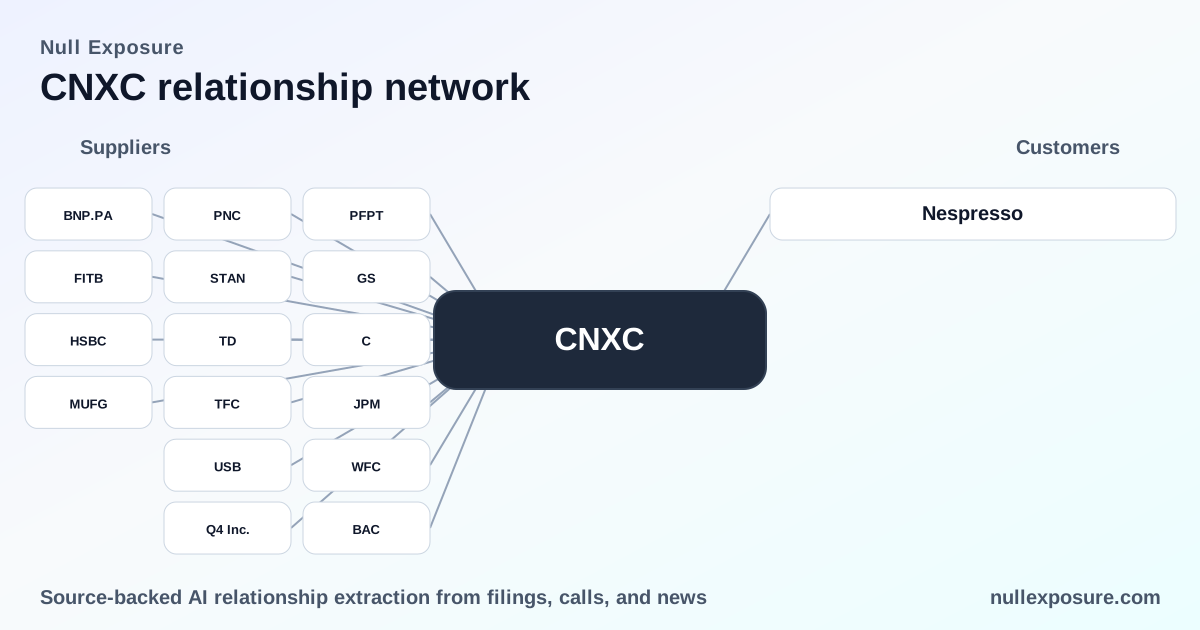
Concentrix (CNXC) — Customer Relationships and What They Tell Investors
Concentrix operates a global technology-led customer experience (CX) services business that monetizes by delivering outsourced CX, automation, analytics and back-office services to large enterprise clients across five verticals. Revenue is generated through a mix of transactional services and multi-year service agreements, with the company leveraging a global delivery footprint to scale margin and lock in long-tenured clients. For primary diligence and comparative work, see the firm’s customer signals and relationship disclosures at https://nullexposure.com/.
Why Concentrix’s customer base drives both upside and concentration risk
Concentrix’s model is scale-driven and client-concentrated. The company reports that its five largest clients represented approximately 19% of revenue in fiscal 2025, which makes client retention critical to near-term topline stability. At the same time, Concentrix’s average tenure for its top 30 clients is 16 years, which signals entrenched relationships and high switching costs for many customers.
- Contracting posture: Client contracts range from under one year to more than five years, and commonly include early termination provisions with 30–90 days’ notice, producing a mix of recurring and near-term cancellable revenue. This dual posture supports revenue flexibility but increases short-term churn risk when macro conditions shift.
- Global delivery and reach: Concentrix operates globally and serves U.S., European and British clients from delivery centers worldwide, strengthened by its 2023 acquisition of Webhelp that extended presence in Latin America, Europe and Africa. Third‑party recognition from Everest Group confirms leadership across the Americas, APAC and EMEA.
- Client scale and vertical exposure: The customer base skews toward very large enterprises (including more than 160 Fortune Global 500 clients as of November 30, 2025), which underpins sizeable contract values but concentrates revenue around a finite set of counter‑parties.
For an investor-focused snapshot of Concentrix’s sales and customer-facing stance, review the company overview and customer intelligence at https://nullexposure.com/.
Company-level constraints that shape operating economics
The disclosures and extracted constraints provide a clear view into how Concentrix organizes its go-to-market and operations. These are company-level signals rather than relationship-specific claims:
- Contract mix (short- and long-term): Contracts explicitly range from under one year to over five years and are subject to early termination (typically 30–90 days). This structure creates a hybrid revenue profile: durable customer relationships but with embedded short-term cancellation exposure.
- Maturity and customer stickiness: Average tenure of 16 years for the top 30 clients is a structural advantage for retention and upsell, supporting long-term revenue visibility for a meaningful portion of the book.
- Concentration (materiality): The top five clients constituting ~19% of revenue is material; portfolio shocks to any large client or vertical could create outsized revenue volatility.
- Global delivery and geographic diversification: The company operates across Americas, APAC and EMEA, with material operations added through the Webhelp acquisition—this supports labor arbitrage and regional resiliency but increases operational complexity.
- Role and criticality: Concentrix functions primarily as a service provider, delivering end-to-end CX solutions, automation and analytics; the firm also operates financing arrangements tied to receivables, reflecting financial engineering to support working capital.
- Segment focus: The business is concentrated in services, not product sales, which links margin upside to operating leverage and efficiency gains in global delivery.
Implication: Investors should balance the protective effect of long-tenured, large-enterprise clients against the tangible short-term cancellation risk and revenue concentration.
Customer relationship: what the public signals show
Below is a complete, plain-English summary of every documented customer relationship in the available results.
- Nespresso — Concentrix was selected to implement advanced AI conversational technologies intended to improve customer engagement and the brand experience; the mention comes from a March 9, 2026 news report highlighting Concentrix’s roll‑out of pre‑built agentic AI solutions. (Source: StockTitan news item, March 9, 2026.)
That coverage confirms Concentrix’s strategic push into AI-enabled CX for premium consumer brands and underscores the firm’s value proposition of combining technology with operations to drive better customer experiences.
Operational implications for operators and procurement teams
Concentrix’s disclosures and relationship signals imply a specific contracting and delivery profile that procurement and operations should consider:
- Negotiation levers: Given the presence of both short- and long-term contracts and termination windows of 30–90 days, buyers have room to structure performance-driven, short-notice arrangements when onboarding new services, while suppliers must price for potential churn.
- Integration risk when switching: 16-year average tenure with top clients signals deep operational integration; migrating away from Concentrix for mission‑critical functions will create high switching costs for clients.
- Geography and delivery management: Global delivery ideally matches clients with regional labor markets and continuity plans, but it increases vendor management complexity—particularly across APAC, EMEA and LATAM centers added through M&A.
- Financial arrangements: The company’s use of receivables financing reflects an operational finance posture that supports working capital but can be an added counterparty consideration for clients evaluating payment terms.
Investment takeaways and risk checklist
- Positive: Concentrix benefits from scale, long client tenure and a broad global delivery footprint that enable margin expansion through operational leverage and cross-sell into large enterprises.
- Cautionary: Client concentration (top 5 = ~19% of revenue) and contract cancellability (30–90 days) present genuine downside in adverse macro or client-specific scenarios.
- Technology angle: Engagements such as the Nespresso AI implementation illustrate Concentrix’s ability to sell higher‑value, technology-enabled services to premium brands — a potential margin enhancer if scaled across clients.
For a deeper read on Concentrix customer dynamics and to access structured relationship intelligence, visit https://nullexposure.com/.
Bold and focused underwriting of Concentrix should weigh the defensiveness of long-tenured enterprise relationships against the fragility introduced by short-notice termination rights and client concentration.