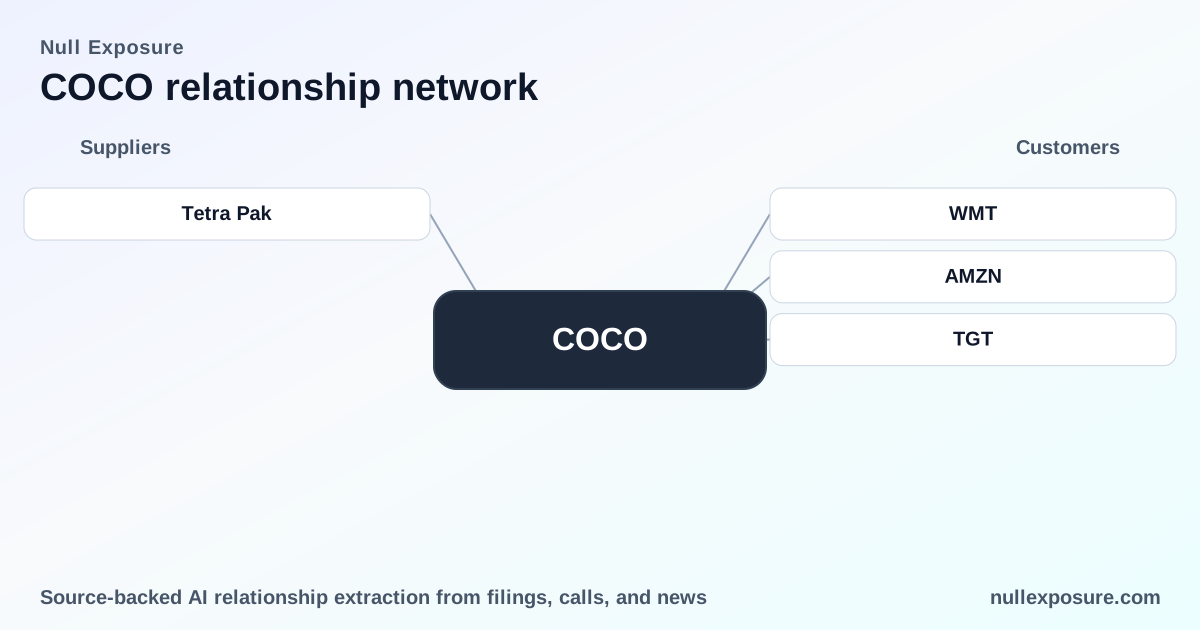
Vita Coco (COCO): Customer Map and Commercial Risks for Investors
Vita Coco monetizes by manufacturing and selling coconut-water-based beverages through a mix of large retail partners, distributors, and e‑commerce channels; the company earns product gross margins on branded sales (its core business) and incremental margin from new SKU innovations and private‑label or distributor agreements. Revenue is concentrated in large-format retail and a small number of distribution partners, which drives both scale and vulnerability—investors should weigh growth from expanded shelf distribution against the exposure of near‑term contract shifts. For a concise view of provider-level relationships, visit https://nullexposure.com/.
How Vita Coco sells, and what that structure means for returns
Vita Coco’s economic model is straightforward consumer staples: highly branded core product (coconut water ~96% of sales) sold through club stores, supermarkets, convenience stores, drug stores, and online channels. The company relies on large retailers and distributors for shelf presence and velocity, which creates a classic trade‑off: distribution concentration accelerates penetration and lowers go‑to‑market cost, while also producing outsized sensitivity to a few counterparties.
Key operating characteristics that drive investor risk and return:
- Contracting posture: Retail relationships are largely short‑term and promotional in nature; Vita Coco does not rely on long locked‑in purchase commitments with retail‑direct customers, leaving pricing and placement subject to retailer negotiation. Evidence for this contracting posture comes from company disclosures describing the absence of long‑term minimums with retail customers.
- Concentration and criticality: Sales to the largest distributor and largest retail‑direct customer together represented approximately 48% of consolidated net sales as of December 31, 2024, signaling material counterparty risk.
- Global footprint and maturity: Vita Coco operates in over 35 countries with primary markets in North America and Europe (U.K. and Germany), positioning it as a global branded beverage player but one that still depends materially on major North American retail partners.
- Relationship lifecycle signals: The company has both ended distribution agreements (a stockholder distribution arrangement concluded in 2024) and is winding down certain private‑label supply contracts that did not meet margin targets—indications of active portfolio management rather than passive contract renewal.
- Role mix: The company sells both to distributors and directly to major retailers, functioning as seller, reseller partner and, when applicable, private‑label supplier.
- Spend scale signal: Historical revenue tied to a specific distribution agreement was in the low millions (reported at $1,642k, $4,048k and $6,375k in 2024–2022), consistent with select mid‑range contract sizes rather than multi‑hundred‑million bilateral deals.
(For more on how these relationship signals are compiled, see https://nullexposure.com/.)
Relationship map: what matters for portfolio risk and why
Costco — single highest‑risk counterparty headline
Costco is the counterparty most frequently referenced in investor‑alert press coverage asserting that Vita Coco faced the loss of a Costco contract that was characterized as representing roughly 25% of Vita Coco’s net sales; several law‑firm alerts and press notices in April–May 2026 cite the allegation. According to multiple investor‑alert releases and press wires in early May 2026, the claim about a potential Costco contract loss underpins heightened investor scrutiny and litigation interest (PR Newswire and other law‑firm notices, May 2026).
Walmart — distribution gains and strategic shelf resets
Walmart is cited as a positive operational lever for Vita Coco: company commentary and earnings‑call summaries note recovered and expanded shelf space at Walmart, translating into improved U.S. brand visibility and a reported 5–6% lift in scan data after distribution improvements. Finviz and investing.com coverage of the FY2026 earnings commentary highlighted Walmart distribution gains and analyst notes describing Walmart as a roadmap for broader large‑format expansion (Finviz recap and Investing.com, March–May 2026).
Amazon — e‑commerce availability and marketing reach
Amazon functions as an important e‑commerce channel for Vita Coco branded SKUs and new product rollouts; company press releases and marketing coverage list Amazon among the online platforms stocking Vita Coco and Vita Coco Treats, supporting direct‑to‑consumer discoverability and supplemental sales (brand press content, March 2026).
Target — exclusive SKUs and retailer partnerships
Target is identified as the exclusive retail partner for at least one flavor launch (Cherry Vanilla Vita Coco Treats), signaling targeted retailer‑exclusive promotions that drive traffic and co‑marketing benefits for new SKUs (press coverage of product launches, March 2026).
Why each relationship matters to valuation and downside
- Costco concentration risk: The investor alerts referencing a Costco contract that could represent ~25% of sales are a material downside scenario for near‑term revenue and multiple compression if realized; the claim is driving legal scrutiny and should be prioritized in downside stress tests.
- Walmart as a growth lever: Expanded shelf space and stronger distribution at Walmart are the clearest path to near‑term U.S. volume growth, and should be modeled as a revenue acceleration channel in base cases.
- Amazon and Target as margin/marketing plays: Online availability and retailer‑exclusive SKUs improve brand reach and support incremental SKU margins; these channels are important for product launches but are not a substitute for large, centralized retail distribution.
Tying the constraints back to commercial execution
The company signals—short‑term retail contracting, high concentration (48% sales to two large customers), global distribution, and selective termination of marginal low‑margin private‑label deals—collectively describe a commercial model that prioritizes branded growth and margin preservation at the cost of concentrated counterparty exposure. Investors should treat the ending of a distribution agreement in 2024 and the winding down of private‑label supply as evidence that Vita Coco actively manages counterparties to protect long‑run margins.
Risk checklist for investors
- Concentration risk: Two customers accounted for ~48% of net sales as of Dec‑2024—model downside accordingly.
- Contract flexibility: Short‑term retailer posture increases volatility in placement and promotional mix.
- Event risk: Public investor‑alerts about Costco contract status are a catalyst for earnings downside and reputational drag.
- Execution risk: Gains from Walmart shelf resets support growth, but execution must scale across other large formats.
Bottom line and next steps
Vita Coco’s business is simple to model but sensitive to counterparty shifts: positive distribution moves at Walmart and retailer exclusives support growth, while any confirmed loss of a large club‑store agreement such as Costco would materially compress revenue and multiples. Investors should build scenarios that stress a material club‑store contract loss and, conversely, assume continued Walmart distribution expansion for upside.
For a practical toolkit on monitoring counterparties and tracking new alerts, visit https://nullexposure.com/ for regular updates and relationship signal monitoring.