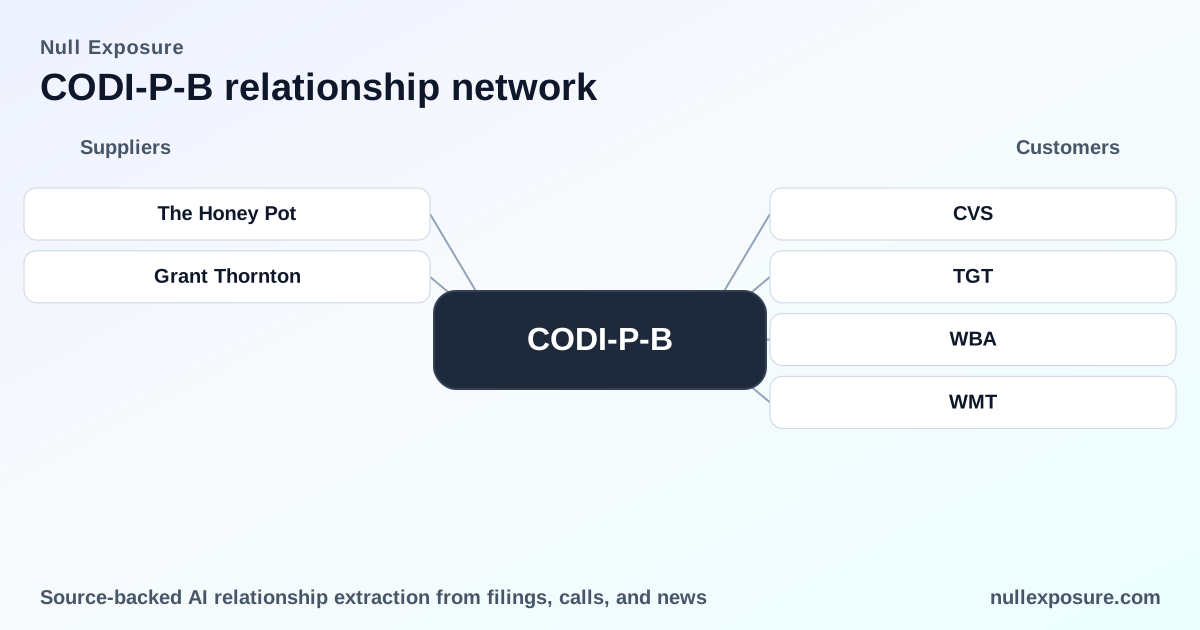
CODI-P-B: Customer Relationships That Drive a Portfolio-Level Income Play
Compass Diversified (CODI) operates as a permanent-capital investor owning a portfolio of middle‑market businesses; it monetizes through operating cash flow from subsidiary companies, recurring dividend distributions to holders of instruments like the 7.875% Series B fixed-to-floating cumulative preferred shares, and through selective asset sales that realize value and accelerate deleveraging. Recent activity — notably the sale of Sterno’s foodservice business and broad retail placement for consumer brands — underscores a dual monetization strategy of cash yield plus active portfolio management. Learn more at https://nullexposure.com/.
The investor thesis in one paragraph
CODI is a yield-oriented, diversified owner-operator: it captures cash yield through subsidiary earnings while managing portfolio value via bolt-on M&A and disposals. The Series B preferred shares deliver a high coupon profile backed by a corporate structure that intentionally rotates non-core assets to replenish liquidity and reduce leverage, making CODI-P-B a play on stable coupon income supported by a private-equity style operating model.
What the relationship data shows — high level
The relationship signals in public releases center on two operational threads: (1) portfolio rebalancing through divestitures and (2) consumer retail distribution for a rising CPG brand owned by a CODI subsidiary. These relationships are not vendor contracts in isolation; they represent points where CODI converts subsidiary performance into cash or scale.
Customer relationships mapped (each relationship in the record)
Archer Foodservice Partners
Compass Diversified entered a definitive agreement to sell Sterno’s food service business to Archer Foodservice Partners for an enterprise value of $292.5 million, a transaction CODI explicitly tied to accelerating deleveraging. This sale is a clear example of CODI monetizing a subsidiary business to improve balance-sheet flexibility. (GlobeNewswire, March 30, 2026)
CVS
The Honey Pot Company, a CODI subsidiary, lists CVS among its national retail partners, indicating a broad brick‑and‑mortar distribution footprint that supports scale and recurring retail revenue. Placement in CVS contributes predictability to Honey Pot’s consumer sales channels. (GlobeNewswire press release via StockTitan and GlobeNewswire, February 19, 2026)
Target (TGT)
Honey Pot products are carried at Target, giving the brand access to a high-traffic retail platform and omnichannel merchandising opportunities; Target distribution materially enhances retail penetration and consumer awareness for the subsidiary brand. (GlobeNewswire, February 19, 2026)
TGT
The dataset includes a separate entry labeled TGT that references the same retailer relationship for The Honey Pot Company; this duplicates the Target listing but reiterates that Target is a named, national retail partner for the CODI-owned brand. (GlobeNewswire, February 19, 2026)
Walgreens
Walgreens is listed as a retail distribution partner for The Honey Pot Company, reinforcing a multi‑retailer strategy across community pharmacy and mass-retail channels that diversify point-of-sale exposure. (GlobeNewswire, February 19, 2026)
Walmart (WMT)
Walmart carries Honey Pot products across its store network, delivering broad national scale; Walmart’s distribution amplifies volume potential and supports shelf presence in both traditional and big‑box outlets. (GlobeNewswire, February 19, 2026)
USA Rare Earth (USAR)
CODI announced a partnership with USA Rare Earth to sell and distribute each other’s products, an inter‑company commercial relationship that signals cross‑selling and distribution collaboration outside CODI’s core consumer brands. This expands CODI’s B2B distribution posture into specialty industrial channels. (MarketScreener, March 23, 2026)
How these relationships inform operating model and business model characteristics
- Contracting posture: CODI operates through majority- or full-owned subsidiaries that negotiate their own commercial deals; the parent company’s role is portfolio oversight and capital allocation rather than direct retail contracting. The Honey Pot placement with national retailers indicates subsidiary-level direct retail agreements while the Sterno sale demonstrates active asset disposition.
- Concentration and diversification: Retail distribution across Target, Walmart, CVS, and Walgreens points to low single-customer concentration for The Honey Pot Co., reducing revenue risk from any one large reseller. At the portfolio level, CODI’s approach is intentionally diversified across disparate end markets.
- Criticality of relationships: National retail accounts are critical to consumer brand scale; retailer shelf placement materially affects cash flow for a CPG subsidiary and therefore indirectly supports CODI’s ability to service preferred dividends. The Sterno divestiture to Archer reduces exposure in the foodservice vertical and converts an operating asset to cash.
- Maturity and monetization cadence: The mix of established retail relationships and strategic asset sales indicates a mature portfolio management model — subsidiaries with retail traction are scaled for steady cash, while non-core assets are recycled to fund deleveraging or new investments.
Risk and opportunity takeaways for investors
- Opportunity — reliable cash profile: The Series B preferred coupon is supported by a diversified set of subsidiary cash-generators and repeatable retail revenue channels for consumer holdings. Retail placement at Target, Walmart, CVS, and Walgreens enhances predictability.
- Opportunity — active value realization: The Sterno sale to Archer for $292.5 million demonstrates CODI’s capability to translate subsidiary value into liquidity, which directly supports balance-sheet improvement and dividend coverage mechanics.
- Risk — operational dependence on retail execution: While retailer diversity reduces single-customer risk, shelf performance, promotions, and category competition at large national chains remain operational levers that affect subsidiary cash generation and therefore CODI’s distribution capacity.
- Risk — portfolio cadence matters: CODI’s yield and capital structure depend on effective timing of disposals and reinvestments; mis-timing or underperformance at subsidiary level would compress the firm’s ability to maintain preferred coupons through operating cycles.
Final read: what investors should do next
For income-focused allocations, CODI-P-B presents a high-coupon route backed by an operator that converts portfolio actions into liquidity, but exposure is tied to subsidiary retail execution and transaction timing. For further, regularly updated relationship intelligence and market context on CODI and similar income vehicles, visit https://nullexposure.com/.
Bold takeaways: CODI monetizes through operating subsidiaries and selective asset sales; national retailer distribution reduces concentration risk for consumer holdings; recent Sterno sale materially strengthens deleveraging and liquidity.