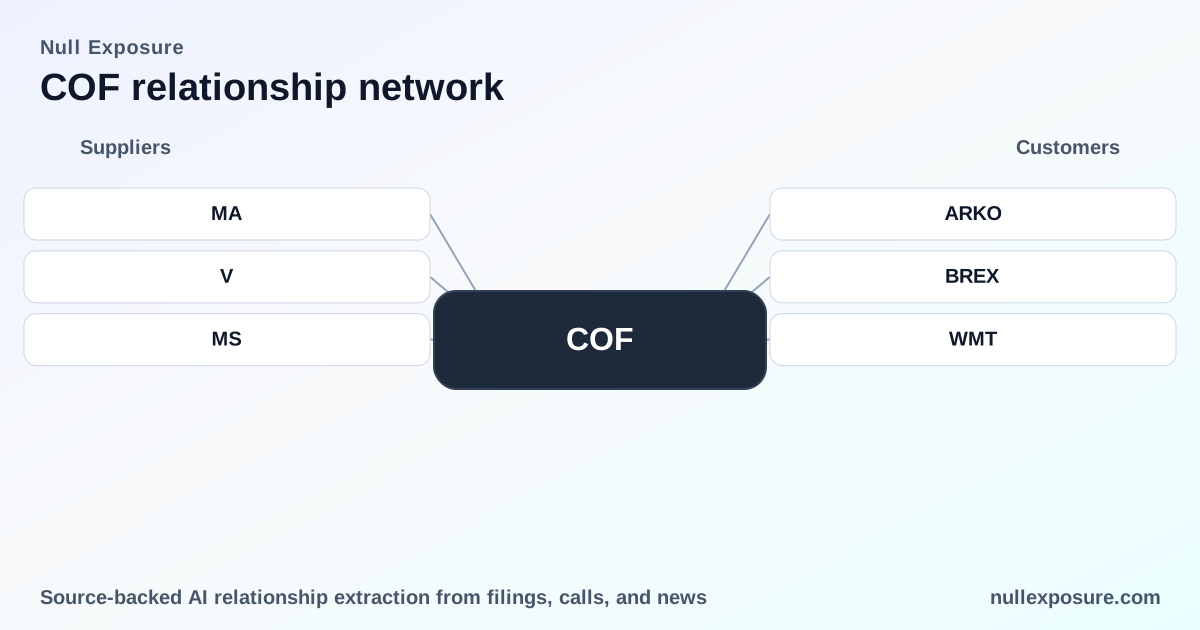
Capital One (COF) — Customer Relationships and What They Signal for Investors
Capital One is a diversified U.S. bank holding company that monetizes through interest income on credit cards, auto and commercial loans, plus fees and interchange revenue from card products and services. Its operating model mixes mass-market consumer lending with commercial banking and capital markets activity; the company acts both as lender and financial services provider to corporate clients, while also originating, servicing and, in some cases, selling assets. For investors evaluating counterparty exposure, Capital One’s customer relationships show a portfolio of lending, warehouse and arranger roles across commercial and consumer counterparties, with geographic focus in North America and selective activity in the U.K. Learn more at https://nullexposure.com/.
How to read these customer links: contracting posture and strategic role
Capital One’s customer relationships in the sample are predominantly financing and credit facilities, book‑running / arranging roles, and deposit transfers. These ties indicate a mixed contracting posture: commercial lending and warehouse lines to mid‑market and specialty finance firms, joint lead arranger roles for large REITs and trusts, and transactional deposit/asset sales to other banks. Together these relationships reflect medium criticality (they support recurring interest and fee income) and moderate concentration — Capital One shows repeated exposures to specialized lenders and real estate borrowers but no single counterparty dominates public mentions. The company’s customer base spans mature core products (cards, auto loans) and services such as credit facilities and warehouse financing.
- Counterparty mix: individuals, small businesses and mid‑market corporates.
- Geography: primarily North America with EMEA activity through Capital One (Europe) plc.
- Materiality signal: company-level disclosure indicates many customer risks are netted or immaterial after hedging or offsets.
Explore consolidated relationship monitoring at https://nullexposure.com/ for deeper diligence.
Relationship snapshots — what the public record documents
Below are concise, investor‑oriented summaries for every customer relationship flagged in the results set, each with the cited source.
National Healthcare Properties (NHPBP / NHPAP)
Capital One served as a joint bookrunner on a $550 million senior unsecured credit facility for National Healthcare Properties, indicating an arranger role on REIT financing. According to GlobeNewswire and CityBiz reporting of December 2025, Capital One participated alongside major banks as a joint bookrunner.
Investcorp Credit Management BDC (ICMB)
Investcorp reports multiple revolving credit facilities and a senior secured revolver with Capital One, with reported unused commitment (e.g., $41.1M) and borrowing base availability noted in Q4/2025–FY2026 earnings call transcripts and filings; this shows Capital One as a key lender and liquidity backstop for this BDC (Investing.com, MarketBeat, TradingView — May 2026).
Axos Financial / Axos Bank (AX)
Axos announced a purchase and assumption of ~$3.2B in IRA/CD deposits from Capital One, a deposit transfer that reduces Capital One’s deposit base while increasing Axos’s liabilities, reported across Investing.com, TradingView and MarketBeat in April–May 2026.
RLJ Lodging Trust (RLJ)
RLJ aligned covenants on a 2022 term loan with Capital One as part of a refinancing package, signaling Capital One’s role as term lender and covenant counterparty in hotel-sector finance (TradingView, March 2026).
Consumer Portfolio Services (CPSS)
Consumer Portfolio Services signed a $150 million warehouse line and a $900 million prime forward flow commitment with Capital One, highlighting Capital One’s warehouse financing and forward flow placement functions for specialty consumer finance originators (Investing.com, Intellectia.ai, May 2026).
Capital One / Discover integration (COF-P-K)
Coverage around the Capital One–Discover combination noted access to Discover Pulse debit network and network impacts for Mastercard‑branded debit products; reporting cited Digital Transactions on merger closing logistics (Digital Transactions, March 2026).
Pebblebrook Hotel Trust (PEB / PEB‑P‑E)
Pebblebrook closed a $450 million term loan and extended a $650 million revolver with Capital One named as a joint lead arranger, reflecting Capital One’s participation in large hospitality financings (Yahoo Finance, Pulse2, CityBiz — March 2026).
Lumexa Imaging (LMRI)
Capital One Securities acted as a bookrunner for Lumexa Imaging’s IPO, showing Capital One’s investment banking distribution capabilities in equity capital markets (PR Newswire, March 2026).
Summit Hotel Properties (INN‑P‑E)
Summit’s refinancing included Capital One National Association as a joint lead arranger, again illustrating Capital One’s role in lodging-sector credit facilities (HotelManagement‑Network, reported March 2026).
Arko Corp. (ARKO)
Arko used IPO proceeds to repay approximately $184 million of indebtedness under its Capital One line of credit, which demonstrates Capital One’s role as a revolving lender to energy/retail operators (GlobeNewswire / ManilaTimes, Feb–Mar 2026).
Phreesia (PHR)
Phreesia’s 10‑Q notes available borrowing capacity under a Capital One credit facility as part of its liquidity runway, demonstrating Capital One’s supplier role for growth‑stage SaaS operating credit (TradingView, March 2026).
Rimini Street (RMNI)
Rimini amended its credit agreement with a lending group led by Capital One to revise restricted payment limits, indicating Capital One’s position as a lead lender controlling covenant and payout flexibility (MarketBeat, TradingView, March–May 2026).
Goodyear / Chart (GT / GTLS)
Capital One Securities served as a co‑manager or advisor on debt and divestiture transactions for industrial issuers, reflecting Capital One’s capital markets distribution footprint (TractionNews, ADVFN — March 2026).
Live Nation (LYV)
References to events at “Capital One Arena” are venue naming/marketing mentions rather than a counterparty finance relationship; the link is commercial/brand presence (NBCWashington listing, 2026).
Brex (BREX)
Capital One announced a definitive agreement to acquire Brex, a strategic consumer and corporate card/finance platform move disclosed on Capital One’s earnings call (COF Q4 2025 earnings call transcript, March 2026).
Walmart / WMT
Historical card partnership changes (e.g., past termination in May 2024) are noted in market commentary; this context is relevant to Capital One’s co‑branded card strategy and partner risk (Finviz coverage, March 2026).
Meta Platforms & Google (META / GOOGL)
Customer litigation alleges Capital One disclosed data to Meta and Google; this is a legal and reputational counterparty linkage rather than a financing relationship and is reported in class action coverage (TopClassActions, May 2026).
GRNT‑WS
Capital One Securities acted as a book‑running manager for securities offerings, underlining recurring capital markets business (SEC filing, FY2023).
Ryan (RYAN)
Capital One Securities served as a co‑manager on municipal or corporate offerings, showing continued involvement in underwriting syndicates (InsuranceJournal, FY2021).
Constraints and investor implications
The extracted constraints provide company‑level signals rather than counterparty-specific facts:
- Counterparty types: Capital One serves a broad mix — mid‑market corporates, small businesses and retail individuals, which diversifies revenue but creates exposure across economic cycles.
- Geography: Primary focus in North America (U.S., Canada) with EMEA presence through COEP in the U.K., which implies regulatory and FX considerations.
- Role variety: Capital One acts as seller (consumer loans, cards), service provider (derivative accommodations, warehouse lines) and arranger, supporting fee diversification.
- Materiality: Some disclosures characterize certain derivative exposures as net immaterial after offsetting; this points to risk‑management practices that reduce headline market‑risk.
- Segment mix: Core product concentration remains in credit cards, auto loans and commercial lending, with services and capital markets activity complementing interest income.
Investors should treat these signals as evidence of a multi‑modal banking franchise: lending generates stable interest margins while arranging and credit facilities produce fee income and concentrated counterparty exposures in the commercial finance and real estate sectors.
Bold takeaway: Capital One’s public relationships show consistent participation in warehouse financings, revolving credit facilities and arranger roles — dynamics that support recurring fee and interest income but concentrate exposure in mid‑market and specialty lenders.
For a consolidated view of these relationship exposures and to integrate them into portfolio monitoring, visit https://nullexposure.com/.