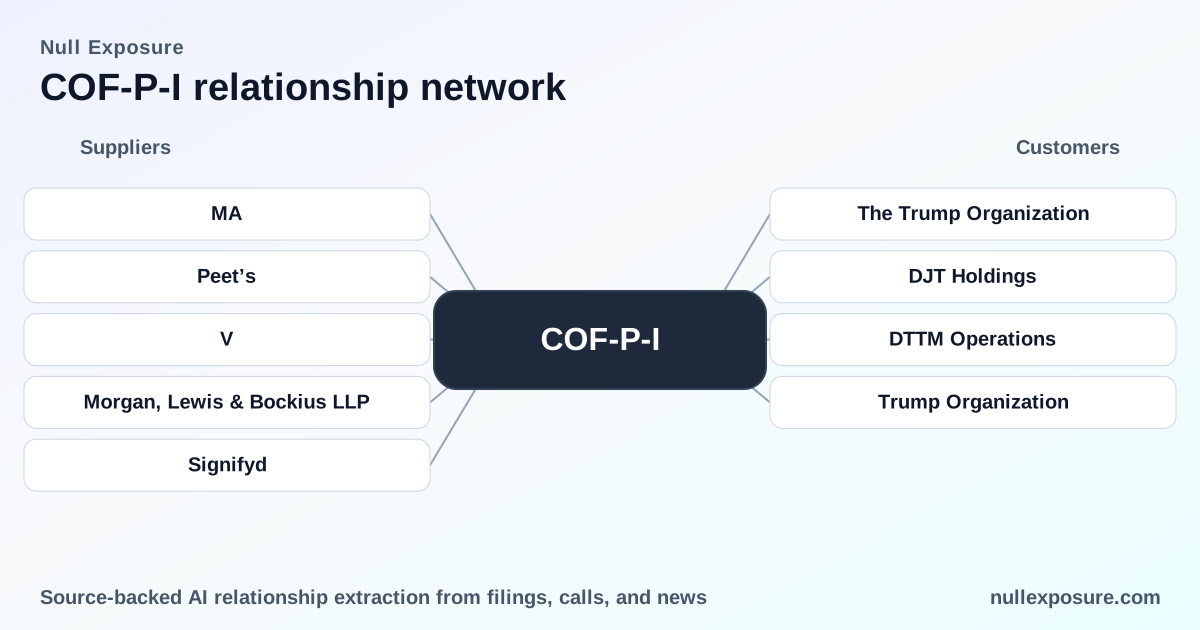
Capital One (COF-P-I) — Customer Relationships That Change the Risk Profile
Capital One operates and monetizes as a diversified U.S. consumer and commercial bank: a large credit-card franchise, retail and commercial deposit gathering, and consumer lending lines that earn net interest margin and fee income. For holders of COF-P-I preferred stock, customer relationships that generate scale and low-cost funding are a principal driver of credit stability, while high-profile account disputes create concentrated reputational and litigation risk. For a focused map of recent customer signals, see Null Exposure’s overview: https://nullexposure.com/.
Why customer links matter to preferred-holders and operators
Capital One’s balance sheet is sensitive to deposit composition, card receivables performance, and brand stability. Customer concentration risk is operational rather than purely financial: a few high-profile disputes can spur regulatory attention, accelerate deposit flight from certain cohorts, and prompt adverse publicity that increases funding costs. The recent signals in the market are not about earnings volatility—this is about governance, reputational capital, and legal exposure.
Bold operating model takeaways:
- Contracting posture: Capital One exerts contractual control over account relationships (ability to close accounts), which creates operational discretion and attendant litigation risk.
- Concentration: The bank’s revenue base is broadly diversified, so individual retail or commercial clients are usually not systemically material, but high-profile clients create asymmetric reputational impact.
- Criticality: Customer relationships are critical to deposit and card retention dynamics; loss of marquee co-brand partners can interrupt new account acquisition channels.
- Maturity: Many corporate relationships are long-standing and legacy in nature; long-tenured relationships amplify legal and reputational stakes when they end.
No explicit contractual constraints were flagged in the customer-scope data set as company-level signals, which indicates no systematic third-party constraint disclosures tied to specific customers were captured.
A compact roll call of every customer relationship the market flagged
Below are the relationships surfaced in coverage, each with a concise plain-English summary and source reference.
The Trump Organization — decades-long accounts closed, litigation followed
Capital One is the defendant in litigation alleging that it closed more than 300 accounts held by the Trump Organization after Jan. 6, 2021, and that the organization had held millions of dollars with the bank for decades before the announced termination. This is a high-profile, long-tenured client dispute with reputational and legal exposure.
Source: Fortune, March 7, 2025 — https://fortune.com/2025/03/07/trump-company-sues-woke-capital-one-for-canceling-accounts/
DJT Holdings — plaintiff entity alleging longstanding banking ties were severed
The complaint lists DJT Holdings among the named plaintiffs, asserting that plaintiffs and affiliated entities had hundreds of Capital One accounts closed after a long period of business. The inclusion of multiple affiliated entities broadens the litigation footprint beyond a single legal entity.
Source: CNBC, March 7, 2025 — https://www.cnbc.com/2025/03/07/trump-organization-lawsuit-capital-one-account-closures-jan-6-riot.html
DTTM Operations — affiliated operating company included in the suit
DTTM Operations is named as a plaintiff alongside other Trump-affiliated entities, with the complaint describing account closures that affected the operating entities as well as trusts and holding companies. Operational entities being tied into the complaint increases the factual complexity and discovery scope.
Source: CNBC, March 7, 2025 — https://www.cnbc.com/2025/03/07/trump-organization-lawsuit-capital-one-account-closures-jan-6-riot.html
Trump Organization (CNBC version) — legal complaint filed in Florida with specific allegations
CNBC’s reporting reiterates that the Trump Organization sued Capital One in Florida claiming unjustified closures of more than 300 bank accounts tied to Jan. 6 events, framing the dispute as an operational account-closure controversy with potential financial damages and injunctive relief sought. The filing in state court anchors the dispute in a jurisdictional posture that will shape litigation timelines and remedies.
Source: CNBC, March 7, 2025 — https://www.cnbc.com/2025/03/07/trump-organization-lawsuit-capital-one-account-closures-jan-6-riot.html
Walmart — co-branded card relationship and product distribution channel
Capital One issues co-branded cards with large retail partners; CardRates referenced recent Capital One Walmart co-branded cards as part of the firm’s card portfolio strategy. Co-brand partnerships like Walmart drive new account acquisition, cross-sell, and fee income, and are constructive for distribution diversification.
Source: CardRates (first seen May 2026; referencing FY2024 product rollouts) — https://www.cardrates.com/advice/which-credit-bureau-does-capital-one-use/
What these relationships imply for credit and operational risk
The Trump-related litigation is a distinct risk vector that is legal, reputational, and political rather than credit-driven. Expect extended discovery, potential reputational contagion among politically-engaged depositors, and heightened regulatory scrutiny of account-closure policies. In contrast, co-brand relationships such as Walmart are steady revenue channels that offset headline risk through distribution scale and consumer product penetration.
Operational implications:
- Legal disputes with high-profile customers generate outsized headline risk and can increase funding volatility.
- Co-brand partnerships are durable sources of new customers and lower acquisition cost, supporting net interest margin and fee stability over time.
- Absence of explicit third-party contractual constraints in the capture set indicates Capital One retains operational control over account decisions, but that discretion is the locus of litigation and policy risk.
Clear takeaways for investors and operators
- Monitor litigation progress and potential class-action spillover. High-profile suits change cost-of-capital dynamics through reputational channels.
- Value diversification in customer acquisition channels. Co-brands like Walmart materially support new account flows and reduce single-client concentration risk.
- Assess governance and policy transparency. Discretion over account closure is an operational asset but requires robust policy and legal defenses to protect franchise value.
For a fuller mapping of customer-linked credit and operational signals — and to track emerging disputes and co-brand dynamics — visit Null Exposure: https://nullexposure.com/.
Capital One’s customer signals are bifurcated: strategic commercial partnerships preserve revenue diversification, while high-profile litigation presents an asymmetric downside risk that investors in COF-P-I must price for. Operators should prioritize legal containment, transparent policy frameworks, and diversified distribution to protect franchise value.