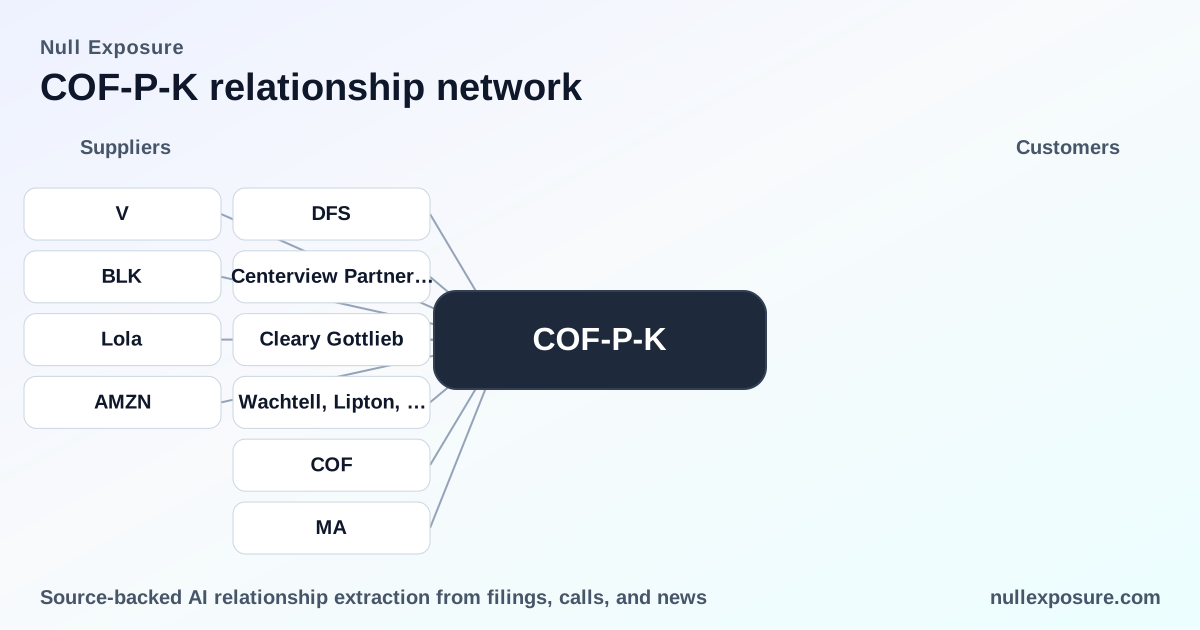
COF-P-K: What Capital One’s Prove tie-up means for income investors and operators
Capital One Financial (represented here by preferred ticker COF-P-K) is a large U.S. bank holding company that monetizes through consumer and commercial lending, credit-card interchange and fees, and deposit-gathering for funding. Investors in the preferred tranche should view customer partnerships not as isolated product bets but as operational levers that affect credit costs, fraud loss, customer retention, and technology spend — all of which feed into the risk/return profile of a fixed-income claim on the franchise.
For a compact, business-focused map of Capital One’s customer relationships and what they imply for operations and risk, see Null Exposure’s customer profiles: https://nullexposure.com/
Executive takeaway: authentication partnership strengthens an operational moat
Capital One’s recent public mention with Prove — a vendor that offers card-plus-phone hardware authentication branded AirKey — is a targeted investment in fraud reduction and frictionless customer experience. For investors, the practical effect is a potential reduction in fraud-related losses and dispute costs, and for operators, it signals a continued move toward embedding strong, low-friction authentication at the payments layer. This is a tactical, high-ROI security play rather than a wholesale platform shift.
If you want a full customer map and relationship history, Null Exposure keeps the underlying records and source links curated: https://nullexposure.com/
The relationship landscape: every customer link surfaced
Below is the complete set of customer relationships returned in the source material. Each entry is presented in plain English with a concise source reference.
Prove — AirKey card + phone authentication
Capital One is using Prove’s AirKey capability to treat customers’ credit or debit cards and smartphones as hardware authenticators, converting the card/phone pair into a secure, low-friction second factor for transaction and account protection. This integration is designed to both harden authentication and preserve the consumer experience at the point of sale and in mobile flows. (Reported by The FinTech Times, May 2026: https://thefintechtimes.com/capital-one-turns-debit-and-credit-cards-into-authentication-methods-with-airkey/)
What this single partnership signals about Capital One’s operating model
Even though the current extract contains a single documented customer tie, the nature of that tie reveals several company-level characteristics important to investors and operators:
- Contracting posture — strategic vendor relationships over ad-hoc buys. A public deployment with a specialized authentication provider implies negotiated, productized integration rather than one-off consulting. That posture reduces operational variability and supports scalable security controls.
- Concentration and vendor risk — focused but diversified. The disclosed relationship is with a specialist (Prove). This suggests Capital One is willing to use third-party specialists for specific security functions while retaining broader platform control — a pattern that reduces vendor concentration risk relative to outsourcing core banking functions.
- Criticality — high. Authentication is fundamental to fraud loss, customer trust, and regulatory compliance; a change in this domain directly impacts loss rates and operational resiliency.
- Maturity — tactical, production-ready deployments. Public coverage of AirKey use indicates the feature is beyond pilot stage and is being positioned for customer-facing rollouts.
Because no explicit constraints were extracted from the source material, the above are company-level operational signals derived from the relationship type rather than constraint excerpts.
Why investors should care — quantifiable operational levers
Security and authentication changes do not move top-line revenue directly, but they materially affect the preferred-holder equation in three ways:
- Lower operational loss: Better authentication reduces fraud, chargebacks, and associated remediation costs — improving the underlying asset quality that supports capital and payment spread metrics.
- Customer economics: Reducing friction increases card usage and retention; small percentage gains in interchange or average spend compound across large card portfolios.
- Regulatory and compliance exposure: Stronger authentication reduces supervisory risk and the likelihood of fines or mandated remediation programs that can pressure capital and earnings.
These levers translate into a more predictable operating environment for the issuer of the preferred instrument and, over time, stronger coverage for fixed dividends.
Operational implications for bank operators
For practitioners inside Capital One or peer institutions, the Prove tie-up implies actionable priorities:
- Integrate authentication changes into dispute workflows and chargeback analytics, not just mobile apps.
- Treat vendor authentication logs as a critical telemetry source for fraud models and merchant activation strategies.
- Prepare back-office reconciliation and customer support for a transition to hardware-backed authentication to avoid short-term friction spikes.
Investors should therefore monitor adoption rates, fraud-loss delta, and any public commentary on merchant or cardholder friction as leading indicators of the program’s success.
Risks and what to watch next
- Adoption lag: If customers do not use the card+phone flow, the investment won’t yield the expected reduction in losses.
- Vendor dependency: While the partnership is targeted, reliance on third-party authentication technology creates operational coupling; evaluate remediation plans and migration costs.
- Regulatory scrutiny: Any authentication regime that affects customer access will attract attention; assess disclosures and compliance filings for changes in consumer-protection controls.
Key watch items: public disclosures on rollout scale, statements about fraud-rate impact, and any operational incidents tied to authentication changes.
Final read for investors evaluating COF-P-K
Capital One’s engagement with Prove for AirKey is a pragmatic, security-focused partnership that strengthens the firm’s operational resilience and could modestly improve credit-metrics relevant to preferred investors. The single documented customer relationship is narrowly scoped but strategically important — it reflects a bank that pursues specialized vendors for high-criticality functions while maintaining platform control. Keep an eye on adoption metrics, fraud-loss disclosure, and any subsequent vendor announcements that broaden the program.
For a deeper catalog of customer relationships and continuous monitoring for COF-P-K, visit Null Exposure’s research hub: https://nullexposure.com/