ChoiceOne Financial (COFS): Customer Relationships and Operational Signals that Drive Value
ChoiceOne is a Michigan-based community bank holding company that earns net interest income from lending and deposit spreads while supplementing fee and service revenue through loan servicing and a small fintech licensing business. The franchise monetizes a regional deposit base, a concentrated commercial real estate lending book, and recurring servicing and licensing fees; investors should value ChoiceOne as a credit-sensitive, regionally concentrated bank with incremental upside from non-interest income streams. For a strategic read on customers and partner exposures, visit https://nullexposure.com/ for a concise data-driven dossier.
How ChoiceOne makes money and why customers matter
ChoiceOne operates as a single reportable segment of community banking. Core profitability derives from loan interest margins and deposit funding, with operating leverage coming from stable deposit volumes and credit yields in the Michigan markets it serves. The company also serves as a loan servicer for third parties and operates 109 Technologies, LLC — a wholly owned subsidiary that licenses fintech intellectual property to other banks, providing recurring licensing cash flow. According to company filings, these lines of business diversify revenue beyond traditional interest spread, while derivatives and swap arrangements are used to accommodate customer demand for fixed-rate lending.
One customer relationship in the public record
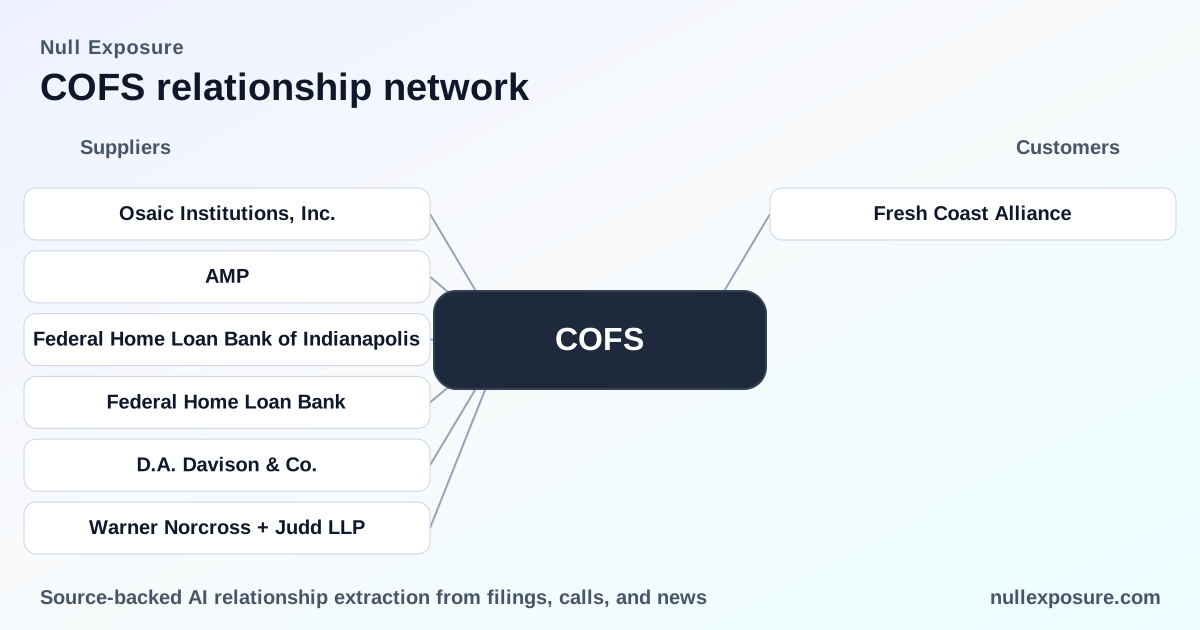
Fresh Coast Alliance — community sponsor bank relationship
ChoiceOne Bank acted as the sponsor bank for a $1.0 million Affordable Housing Program grant awarded to Fresh Coast Alliance in partnership with the Federal Home Loan Bank of Indianapolis, signaling local philanthropic and community development engagement that supports the bank’s CRA profile and local relationship franchise. According to a PR Newswire release dated March 9, 2026, Fresh Coast Alliance announced ChoiceOne as its sponsor bank for the grant, with the nonprofit’s executive director publicly thanking ChoiceOne for the partnership.
Operational constraints and company-level relationship signals
Investors should interpret customer relationships for COFS through operational constraints disclosed in filings and recent public communications. These constraints collectively define the bank’s contracting posture, concentration risks, counterparty mix, and revenue maturity.
-
Contracting posture — short-term liquidity and long-term hedging coexist. Filings describe a warehouse line of credit used to facilitate mortgage originations with an average life under 30 days, indicating short-term, transactional lending to other financial institutions. Simultaneously, ChoiceOne executes longer-term interest rate swaps with commercial borrowers and offsets those swaps with correspondent banks, creating paired long-term contractual exposures tied to customer demand for fixed-rate loans.
-
Licensing as a recurring, higher-margin channel. Company disclosures identify 109 Technologies, LLC as a wholly owned subsidiary that owns fintech IP licensed to third-party banks and holding companies, signaling a licensing revenue stream that is contract-based and potentially multi-year in nature.
-
Counterparty mix is retail and commercial regional customers. The bank serves individuals and businesses across Kent, Muskegon, Newaygo, Ottawa, Lapeer, Macomb, and St. Clair counties in Michigan, with no foreign assets or income reported — a domestic, regionally concentrated customer base.
-
Concentration and materiality: diversified revenues but asset concentration in CRE. ChoiceOne reports that no single customer accounts for 10% or more of total revenues, which reduces revenue concentration risk. At the same time, filings show commercial real estate exposures representing 58.3% of the referenced loan aggregation, indicating credit concentration in CRE that is material to asset risk and capital planning.
-
Service-provider posture and scale of servicing operations. ChoiceOne services loans for others; the unpaid principal balances of loans serviced were $502.0 million at December 31, 2024 (versus $495.7 million at year-end 2023), demonstrating an active servicing book that generates fee income and establishes the company as a third-party service provider in the mortgage ecosystem.
-
Relationship stage: active customer and derivative book. Filings note that interest rate swaps with commercial loan customers had notional amounts aggregating $56.5 million as of December 31, 2024 (up from $0 a year earlier), and that the company reports total deposits of $2,214,103 in the filing excerpts, reflecting an active deposit base that funds lending and operations.
-
Single-segment operations. Management evaluates operations on a company-wide basis and reports community banking as one reportable operating segment, implying limited internal diversification and correlation of customer outcomes across products.
These constraints are company-level signals drawn from public filings and press communications; they are not tied to any single customer unless the disclosure explicitly names that counterparty.
What investors should read into these signals
-
Earnings quality is driven by net interest margin stability and non-interest income diversification. The combination of a traditional loan/deposit margin and ancillary income from servicing and licensing creates multiple revenue levers, but the core profit driver remains interest spread.
-
Concentration in commercial real estate is the primary credit risk. With CRE comprising a majority share of the lending portfolio, loan performance in local CRE markets will materially influence asset quality and provisions.
-
Regional concentration increases sensitivity to Michigan economic cycles. The firm's lack of foreign operations and concentration in a handful of Michigan counties means macroeconomic or sectoral shocks in the state will have outsized impact compared with more geographically diversified peers.
-
Derivative use reflects customer-driven hedging and introduces counterparty and operational complexity. The newly active swaps book underlines management’s willingness to structure longer-duration outcomes for customers; investors should monitor hedging effectiveness and correspondent counterparty exposure.
-
Licensing and servicing provide optionality. The 109 Technologies licensing arrangement and a half-billion-dollar servicing book create fee income buffers that improve earnings resilience if executed profitably.
Risks, monitoring items and valuation implications
- Track quarterly loan performance and CRE loss metrics closely; CRE stress will be the dominant downside for a loan book with that concentration.
- Monitor swap portfolio valuation and collateral arrangements; derivative counterparty credit and liquidity flows can affect capital and funding.
- Watch growth or contraction in licensed fintech revenue from 109 Technologies and servicing fee margins—these lines are the most scalable non-interest income levers.
- Given the bank’s regional footprint and single operating segment, valuation should embed a discount for concentration risk vs. diversified regional peers, while recognizing upside from improving local credit conditions or licensing scale.
Bottom line and investor action
ChoiceOne is a classic community bank with a loan-funded deposit franchise, material CRE exposure, active loan servicing, and an emerging fintech licensing line. The customer relationships disclosed publicly—exemplified by community partnerships such as the Fresh Coast Alliance sponsorship—support the bank’s local franchise and regulatory profile but do not change the core credit- and geography-driven investment thesis. For a focused data package and relationship maps that materially accelerate diligence, visit https://nullexposure.com/.
Key monitorables for investors: quarterly CRE performance, servicing balances and fee margins, licensing revenue traction from 109 Technologies, deposit stability, and the mark-to-market of the swaps book. Each will determine whether ChoiceOne’s regional advantages translate into durable shareholder value.