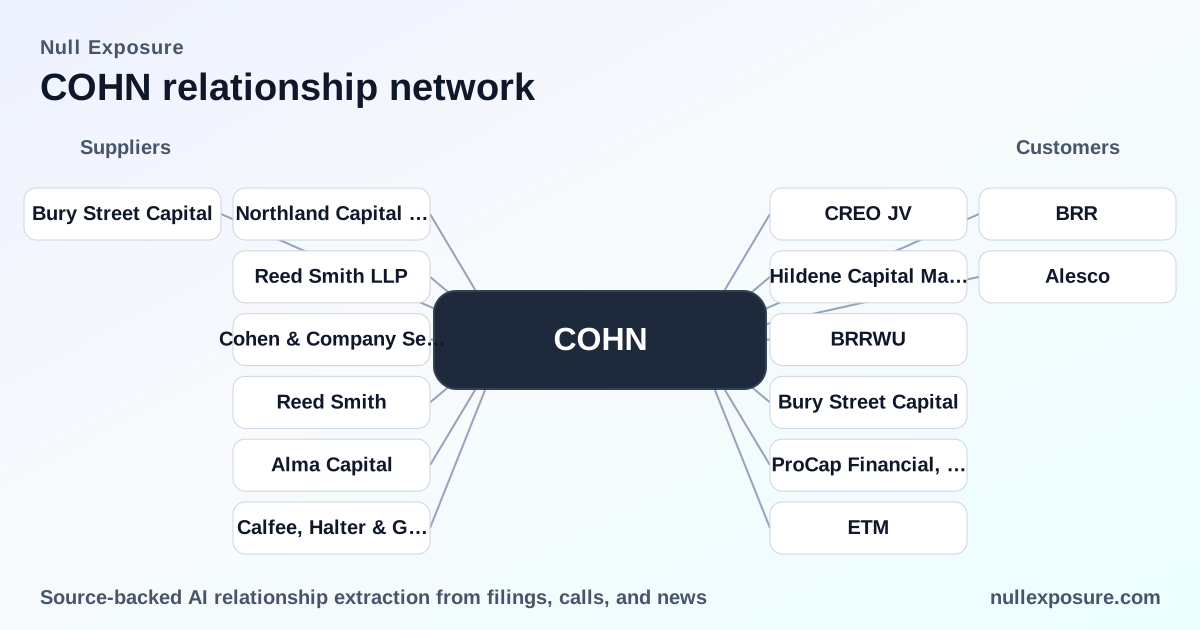
Cohen & Company (COHN): Revenue drivers and customer relationships that move the P&L
Cohen & Company is a boutique investment manager and capital markets firm that monetizes through a mix of management fees, servicing and performance fees, fixed‑income broking and principal transactions, and episodic markups tied to sponsor and SPAC activity. The firm's operating model combines recurring asset‑management economics with lumpy principal‑transaction revenue, and its earnings profile is therefore driven by discrete deal flow as much as steady fee income. For investors evaluating customer relationships, the key questions are concentration, counterparty mix (mid‑market vs. smaller originators), geographic footprint, and the proportion of revenue that is transactional versus contractual. Learn more about how we surface counterparty intelligence at https://nullexposure.com/.
How Cohen actually makes money — an operational reading for investors
Cohen’s financials show two distinct revenue engines. First, asset management: the company collects management and servicing fees and realizes deferred/performance fees from sponsored vehicles and JV arrangements. Second, capital markets and principal transactions: the firm earns brokerage and arranging fees (including agency gestation repo fees) and occasional large markups when founder/placement shares are consolidated or re‑priced after SPAC closings. Together these behaviors create steady fee margins supplemented by episodic, high‑margin transaction gains that drive headline quarterly volatility.
- Contracting posture: primarily fee‑for‑service in asset management and agency financing; transactional principal positions when Cohen acts as buyer/seller of founder or placement shares.
- Concentration/criticality: capital markets segment depends on a limited set of counterparties, making customer relationships materially significant to segment results.
- Geography and market focus: revenue is focused in the U.S. mortgage and fixed‑income markets but Cohen runs capital markets operations in Europe as well, supporting both domestic and EMEA flows.
- Maturity and stability: management fees provide recurring cash flow while principal transactions inject quarter‑to‑quarter volatility; gestation repo is a niche, potentially volatile line.
Deal‑by‑deal: every customer relationship called out in public reporting
Below I list each relationship that shows up in recent coverage, with a concise one‑to‑two sentence summary and the primary public source for the observation.
CREO JV
Cohen reported a 23% increase in asset management revenue to $9 million driven principally by deferred performance fees and servicing fees from the CREO JV, indicating the JV is a meaningful contributor to recurring asset‑management revenue (Quartz earnings coverage, March 2026: https://qz.com/cohen-company-inc-cohn-reports-earnings-1851769415).
Hildene Capital Management
Cohen sold its rights and obligations under certain CDO agreements to Hildene Capital Management and recorded a small gain of $2,734 as disclosed in its regulatory filings, reflecting an active disposition of legacy structured‑product exposures (TradingView summary of the SEC 10‑Q, March 2026: https://www.tradingview.com/news/tradingview:d2bd9434f4676:0-cohen-co-inc-sec-10-q-report/).
BRRWU (market reference to Columbus Circle/ProCap transaction)
Cohen’s Q4 reported spike in principal‑transaction revenue was linked to the December 5, 2025 closing of the Columbus Circle Capital Corp I / ProCap Financial business combination, which generated $33.0 million of principal‑transactions revenue from the markup of consolidated founder and placement shares (BayelsaWatch earnings recap, March 2026: https://bayelsawatch.com/cohen-company-inc-q4-full-year-2025-earnings/).
Columbus Circle Capital Corp I
The SPAC sponsor Columbus Circle Capital Corp I’s closing with ProCap Financial resulted in the $33.0 million principal‑transactions revenue in the quarter, underscoring Cohen’s ability to monetize sponsor founder/placement position markups tied to SPAC closings (local coverage and earnings release, May 2026: https://www.mychesco.com/a/news/regional/cohen-company-reports-2025-results-declares-dividends/).
ProCap Financial, Inc.
Cohen explicitly tied the December 5, 2025 business‑combination closing of Columbus Circle Capital Corp I with ProCap Financial to the quarter’s $33.0 million principal transactions gain, plus related compensation and non‑controlling interest expenses allocable to founder shares, making ProCap the principal transaction driver for that period (press release and earnings release, March–May 2026: https://www.globenewswire.com/news-release/2026/03/06/3250988/0/en/Cohen-Company-Reports-Fourth-Quarter-Full-Year-2025-Financial-Results.html).
ETM
ETM named Cohen & Company Capital Markets as exclusive U.S. financial advisor in its move to seek a Nasdaq listing, reflecting Cohen’s advisory mandate and deal‑execution role for small‑cap cross‑border listings (TradingView coverage of the advisory appointment, March 2026: https://www.tradingview.com/news/smallcaps:14bfcce0f094b:0-etm-appoints-ballard-partners-and-cohen-company-for-nasdaq-listing/).
Bury Street Capital
Cohen’s Pride IV vehicle—where Bury Street Capital appears as a participant—secured 31% of the vintage, signaling active collaboration between Cohen’s asset management platform and outside European allocators on larger vintage funds (Sahm Capital / press release, February 2026: https://www.sahmcapital.com/news/content/pride-iv-exceeds-expectations-becoming-cohen-company-asset-managements-largest-european-vintage-to-date-at-4815-million-2026-02-23).
Alesco
Cohen disclosed that asset management revenue in a prior period declined to $1.9 million following the sale of remaining legacy Alesco CDO management contracts, indicating the wind‑down of legacy structured‑credit management relationships (regional coverage, March 2026: https://www.mychesco.com/a/news/regional/cohen-company-posts-strong-q3-gains-amid-surging-advisory-revenue/).
What these relationships imply about Cohen’s operating model
- Revenue mix and volatility: The ProCap/Columbus Circle transaction demonstrates that principal transactions can dominate quarterly revenue, whereas CREO JV and Bury Street Capital contributions show that asset management still provides recurring fee income. Investors must discount headline quarters for one‑time SPAC‑related markups when modeling sustainable earnings.
- Customer concentration and criticality: Public disclosures explicitly state the capital markets segment depends on a limited group of customers, so loss or inactivity at a few sponsors or mortgage originators would materially impact results.
- Counterparty profile: Evidence points to a client base skewed toward mid‑market and small business mortgage originators for the mortgage group, supporting execution, hedging, and repo financing services rather than large institutional prime brokerage.
- Geography: The firm operates primarily in the U.S. market with a European arm (CCFESA) supporting EMEA clients, so macro housing activity in the U.S. is a first‑order revenue driver while Europe provides diversification.
- Service orientation: Cohen operates both as a service provider (management, agency repo and advisory fees) and periodically as a seller/principal (matched principal trades and markups), a combination that elevates upside but increases execution and balance‑sheet risk.
Investor takeaway and next steps
Cohen & Company is a high‑leverage, fee‑plus‑transaction business where a handful of sponsor deals and JV performance fees can swing quarterly results. For investors assessing COHN, prioritize: 1) the sustainability of asset management fee bases (JV and fund commitments), 2) pipeline visibility for sponsor/SPAC or founder‑share transactions, and 3) counterparty concentration metrics in the capital markets business. For a deeper read on customer signals and counterparty risk frameworks visit https://nullexposure.com/.
Bold strategic relationships—like the ProCap/Columbus Circle closing and the CREO JV—are the proximate drivers of recent upside, but the recurring fee book and the narrow, niche repo business ultimately determine long‑term valuation stability.