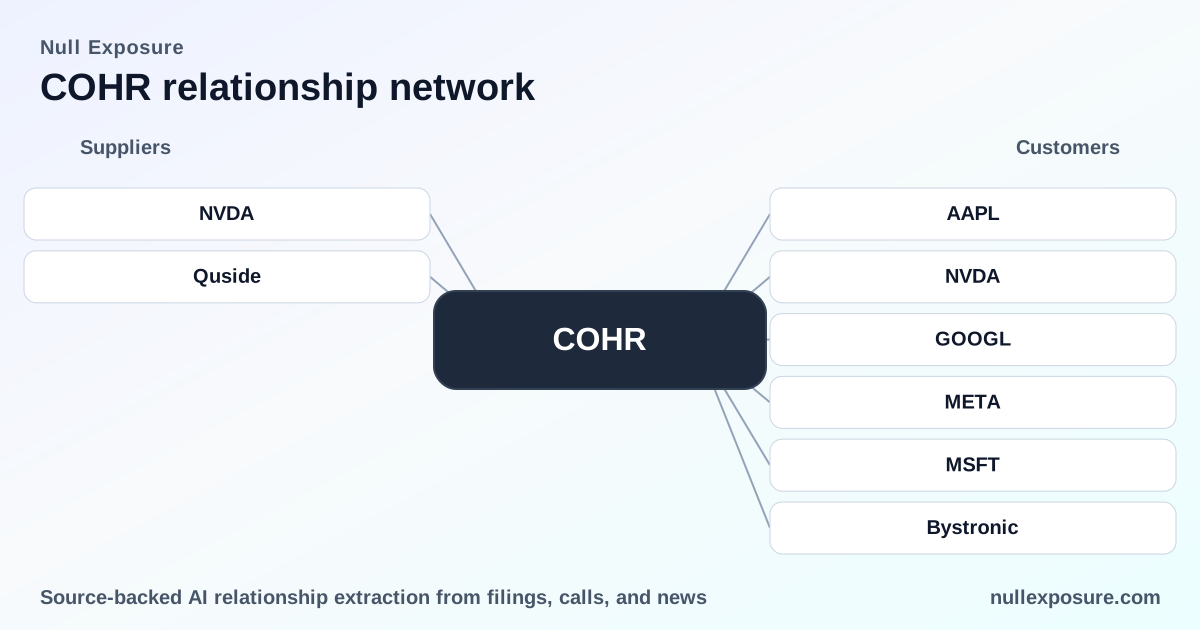
Coherent Inc (COHR): Customer Relationships Rewired for an AI Optics Cycle
Coherent builds and sells lasers, optical components and transceiver modules to industrial, instrumentation and hyperscale customers; it monetizes through product sales, services (repairs/installation) and higher‑margin integrated modules sold to hyperscalers and OEMs. Recent multiyear supply deals and a $2.0 billion strategic investment from NVIDIA reposition Coherent from a diversified photonics vendor into a cornerstone supplier for next‑generation AI datacenter optics, while material customer concentration and short‑term, shipment‑based contracts continue to govern revenue recognition and working capital dynamics. For a deeper signal view, visit https://nullexposure.com/.
The operating model: how contracts, concentration and geography shape risk and upside
Coherent’s commercial posture is transactional and capital‑intensive. The company generally transfers ownership and recognizes revenue at a point in time — contracts overwhelmingly require payment within 30–90 days — which keeps working capital exposure front‑loaded but reduces long tail revenue recognition complexity. Coherent sells into large enterprise end‑users that exert bargaining leverage; the company itself discloses two customers that each contributed more than 10% of revenue in fiscal 2025, a material concentration that amplifies single‑counterparty revenue volatility.
Geography drives demand and operational footprint: North America accounted for $3.56 billion of fiscal 2025 revenue, Europe ~$699 million and China ~$680 million, demonstrating a heavy NA bias but truly global end markets. Sales are executed both directly and through distributors; services (repairs, installation) are short‑duration and recognized at a point in time. Collectively these signals describe a mature product seller that is rapidly evolving into a higher‑value module supplier to hyperscalers and AI infrastructure providers.
What the headlines and filings say about Coherent’s customer links
Below I run through every customer relationship referenced in public sources in the set we reviewed. Each entry is a concise investor‑oriented takeaway with the original reporting cited.
NVIDIA — strategic investor and multi‑billion dollar purchaser
Coherent announced a strategic partnership with NVIDIA that includes a $2.0 billion investment by NVIDIA and a non‑exclusive, multibillion‑dollar purchase commitment for advanced laser and optical products intended to secure capacity and underwrite Coherent’s U.S. R&D and manufacturing expansion. Source: multiple March 2026 press reports, including WPXI and Engineering.com coverage of the March 2, 2026 announcement.
Apple — multiyear VCSEL supplier for iPhone and iPad
Coherent disclosed a new multiyear agreement with Apple to supply a next‑generation VCSEL product family for iPhone and iPad, tying a strategic consumer OEM to Coherent’s optical component roadmap. Source: Coherent Q4 FY2025 earnings call (company statement first reported March 2026).
Google (Alphabet) — hyperscaler transceiver buyer
Industry commentary describes Coherent as selling full transceiver modules to hyperscalers such as Google, capturing more revenue per connection by integrating optics and electronics into deliverable modules rather than selling discrete parts. Source: Finterra analysis published via FinancialContent (Feb–Mar 2026 narrative).
Meta — hyperscaler market participation
Coherent is cited alongside other suppliers as targeting hyperscalers like Meta for integrated transceivers, reinforcing the company’s strategy of shifting sales mix toward higher‑value, module‑level deliveries. Source: Finterra/FinancialContent coverage in early 2026.
Microsoft — another hyperscaler buyer
The company is positioned to sell full transceiver modules and optics to Microsoft as part of a broader go‑to‑market push into datacenter networking and AI infrastructure supply chains. Source: Finterra/FinancialContent narrative (FY2026 commentary).
Bystronic — buyer of Coherent’s Tools for Materials Processing unit
Coherent completed the sale of its Tools for Materials Processing business to Bystronic, removing roughly $100 million in annual sales while boosting margins and reducing debt, effectively redirecting Coherent’s customer footprint away from legacy industrial product buyers. Source: 247wallst coverage and related March 2026 reporting.
RY (Royal Bank of Canada) — likely false positive (different company referenced)
The press items in the set describe an RBC partnership with “Cohere,” an AI software company, not Coherent the photonics manufacturer; treat this entry as an unrelated mention rather than a Coherent customer relationship. Source: WebWire and fintech.ca press items (March 2026).
(If you want the original parsed links and source snippets for each of the items above, NullExposure aggregates them on demand: https://nullexposure.com/.)
What investors should take from these relationships
- Demand de‑risking via strategic customers: The NVIDIA investment and purchase commitments convert future demand into a form of committed revenue and capacity allocation, materially reducing R&D execution risk and undergirding capital expenditures for U.S. manufacturing. This is a structural re‑rating catalyst for growth investors predicating returns on AI datacenter optics adoption.
- Revenue concentration remains a double‑edged sword: Coherent reports two customers contributing >10% of revenue in fiscal 2025; that concentration amplifies upside when large wins land (e.g., NVIDIA, Apple) and amplifies downside if orders become lumpy or renegotiated.
- Short payment terms, high bargaining power: The firm’s point‑in‑time revenue recognition and 30–90 day payment cycles minimize receivable duration but leave margin and pricing exposed to the negotiating leverage of large enterprise customers.
- Strategic portfolio tightening: The divestiture of the Tools for Materials Processing unit to Bystronic cleanses lower‑margin legacy exposure, concentrating management focus and capital on photonics for communications and AI.
Key risks and variables to watch next
- Order cadence and backlog disclosure: Large, multiyear supply commitments will require transparent backlog reporting to convert investor optimism into reliable near‑term revenue guidance.
- Margin delivery in InP manufacturing: Capital‑intensive production scaling for Indium Phosphide and silicon photonics must translate to expected gross margins; failure to do so would stress valuation that now embeds a premium.
- Customer termination and exclusivity clauses: Public reports emphasize non‑exclusive agreements; any future change toward exclusivity or material contract re‑pricing will reshape revenue visibility.
Bottom line for operators and investors
Coherent has repositioned from a diversified photonics vendor into a strategic optics supplier for hyperscalers and AI infrastructure, driven by multiyear product contracts with Apple and a transformational strategic investment and purchase commitment from NVIDIA. The company’s operating model is transactional, capital‑intensive and concentrated, and the newest customer relationships materially derisk demand and R&D spending while increasing dependency on a small number of very large customers. For signal tracking and relationship monitoring, visit https://nullexposure.com/ for curated, investor‑grade sourcing and alerts.