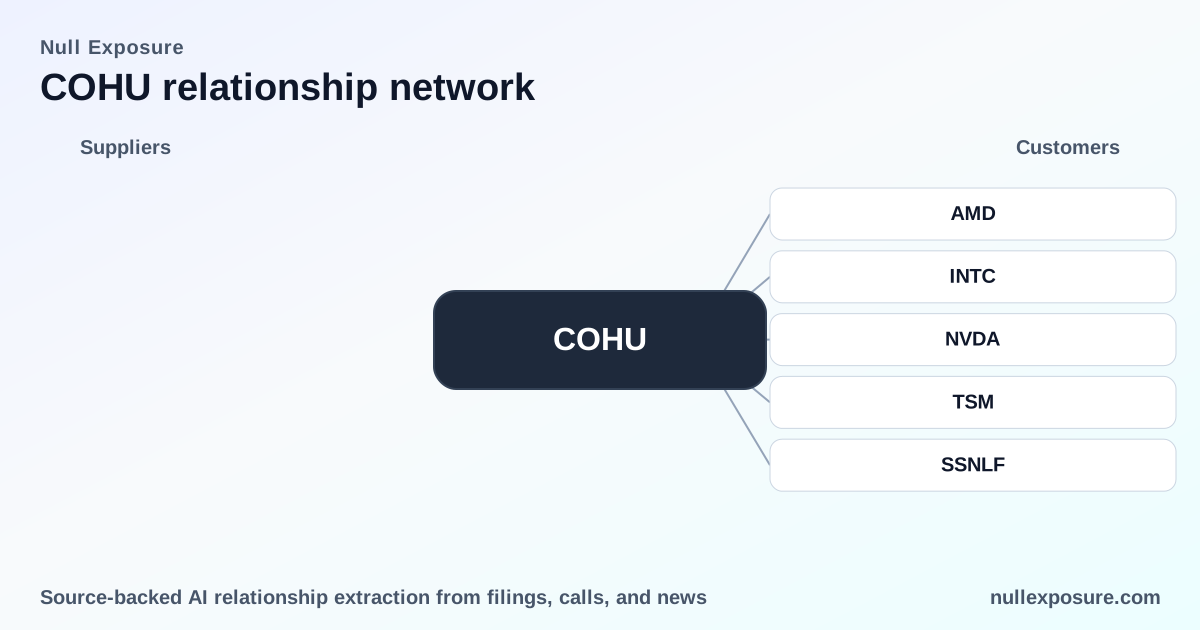
Cohu’s customer map: who buys the test equipment that underpins advanced chips
Cohu is a specialized supplier of semiconductor test, inspection and metrology equipment, supplemented by test interface components and data-analytics software; the company monetizes through equipment sales, spares and consumables recognized at shipment, recurring software subscriptions (DI‑Core) and time‑based service revenue. Revenue is concentrated and global—manufacturing customers and foundries drive outcomes—and the business mixes short‑term transactional flows with a small but growing recurring software and service footprint.
If you want to explore Cohu’s customer relationships and their strategic implications in a single view, start with the curated mapping at https://nullexposure.com/.
What the public signals tell investors about Cohu’s go‑to‑market
Cohu sells capital equipment and test subsystems to global semiconductor manufacturers and test subcontractors; it collects most revenues on short payment terms, recognizes spare parts upon shipment, and runs a subscription product (DI‑Core) that contributes to recurring revenue. For FY2024 Cohu disclosed that its ten largest customers represented 57% of revenue, underlining concentration risk and the economic sensitivity to a small set of major buyers. At the same time, the company reported $5.6 million of performance obligations with durations over one year, signaling a modest pipeline of multi‑year commitments and service arrangements.
Key financial context: trailing twelve‑month revenue of $481.3M, gross profit $209.0M and negative EPS and operating margins reflect cyclical pressure in semiconductors; analyst coverage is bullish on upside with a consensus target near $57.43 (mix of one Strong Buy and six Buy ratings). Use https://nullexposure.com/ to compare this relationship map against peers.
News feed mentions — who shows up in Cohu’s customer narrative
The following entries reflect every relationship pulled from the news feed. Each item contains a concise plain‑English takeaway and the original news reference.
NVIDIA (NVDA)
Cohu’s quality‑assurance and inspection technologies are positioned to support AI‑oriented chip designers such as NVIDIA by improving yield and device validation on advanced nodes, according to a December 2025 Markets FinancialContent article discussing demand drivers for Cohu’s equipment. (TokenRing / Markets FinancialContent, Dec 12, 2025)
Intel (INTC)
The same industry commentary flagged Intel as a beneficiary of enhanced test and inspection tools, implying Cohu’s systems play a role in the validation and quality control stages for leading IDM roadmaps. (TokenRing / Markets FinancialContent, Dec 12, 2025)
NVDA (second mention)
The feed includes a repeat mention of NVIDIA emphasizing the same point: AI chip performance ramps increase the value proposition for Cohu’s inspection and test suites in the supply chain. (TokenRing / Markets FinancialContent, Dec 12, 2025)
AMD (AMD)
AMD is identified alongside other leading chip designers as a likely end user of Cohu’s inspection and test capabilities, reflecting demand from fabless designers for high‑throughput quality assurance. (TokenRing / Markets FinancialContent, Dec 12, 2025)
TSMC (TSM)
Cohu’s equipment is explicitly linked to foundries such as TSMC, which leverage test and inspection systems to optimize production yields across diverse customer wafers; this positions Cohu as a supplier into the foundry ecosystem. (TokenRing / Markets FinancialContent, Dec 12, 2025)
TSM (second mention)
A duplicate listing for TSMC reiterates the same relationship: foundry customers like TSMC will rely on Cohu’s products to maintain yield and stringent quality controls. (TokenRing / Markets FinancialContent, Dec 12, 2025)
Samsung (SSNLF)
The article also names Samsung among major contract manufacturers and foundries expected to deploy Cohu’s equipment for production yield optimization and quality control across their manufacturing footprints. (TokenRing / Markets FinancialContent, Dec 12, 2025)
How these relationships translate to strategic constraints and risks
The company disclosures and product descriptions provide clear signals about Cohu’s operating posture:
- Contracting posture: Predominantly short‑term transactional sales—payment terms do not exceed one year—while a small portion of revenue relates to longer performance obligations (Cohu disclosed $5.6M of revenue expected to be recognized beyond one year at Dec 28, 2024). This structure produces rapid revenue recognition on hardware sales, with limited long‑dated contractual visibility. (Cohu filings, FY2024)
- Revenue mix and maturity: Core revenue derives from manufactured test and interface equipment and spares recognized on shipment, complemented by a growing software subscription (DI‑Core) and time‑based service offerings that increase recurring revenue proportionally. (Cohu filings)
- Geographic footprint and concentration: Sales are global with meaningful APAC exposure—China, Malaysia, Philippines and Singapore are material shipment destinations alongside the United States—while the top‑ten customer concentration (57% in FY2024) elevates customer concentration risk. (Cohu filings, FY2024)
- Criticality to customers: Equipment is mission‑critical for yield and QA at chip designers and foundries; losing share with a major foundry or IDM would have outsized revenue impact given concentration. (Cohu filings and industry commentary)
- Segment posture: The company reports in a single Semiconductor Test & Inspection segment that blends manufacturing hardware, automation and software—this hybrid model increases margin variability and ties capital spending cycles to semiconductor capex. (Cohu filings)
These characteristics produce asymmetric exposure: rapid revenue sensitivity to semiconductor capex, mitigated to a modest degree by recurring software and service revenue that strengthen long‑term cash flow predictability.
Investment implications — how to position risk and opportunity
- Upside: Exposure to AI and advanced nodes gives Cohu access to higher ASP systems and long‑term foundry validation cycles; the market narrative around NVIDIA, AMD, TSMC and Samsung supports a demand pathway for Cohu’s inspection systems. (TokenRing / Markets FinancialContent, Dec 12, 2025)
- Downside: High customer concentration (57% from top ten) and negative operating margins imply earnings are cyclical and dependent on a handful of large buyers; short payment terms and spares recognized at shipment limit revenue smoothing. (Cohu filings, FY2024)
- What to watch next: order backlog and booked multi‑year service contracts, DI‑Core subscription growth rates, and any disclosures of large new equipment wins at TSMC, Samsung or the leading chip designers—these items will materially shift near‑term cash flow visibility.
If you are evaluating supplier concentration and customer dependency risk for semiconductor equipment suppliers, Cohu’s profile is a textbook case of high customer concentration, global foundry exposure and a modest transition to recurring revenue.
For a deeper, comparative view of customer relationships across the semiconductor equipment suppliers universe, visit https://nullexposure.com/ to see how Cohu stacks up against peers and to access primary‑source relationship evidence.