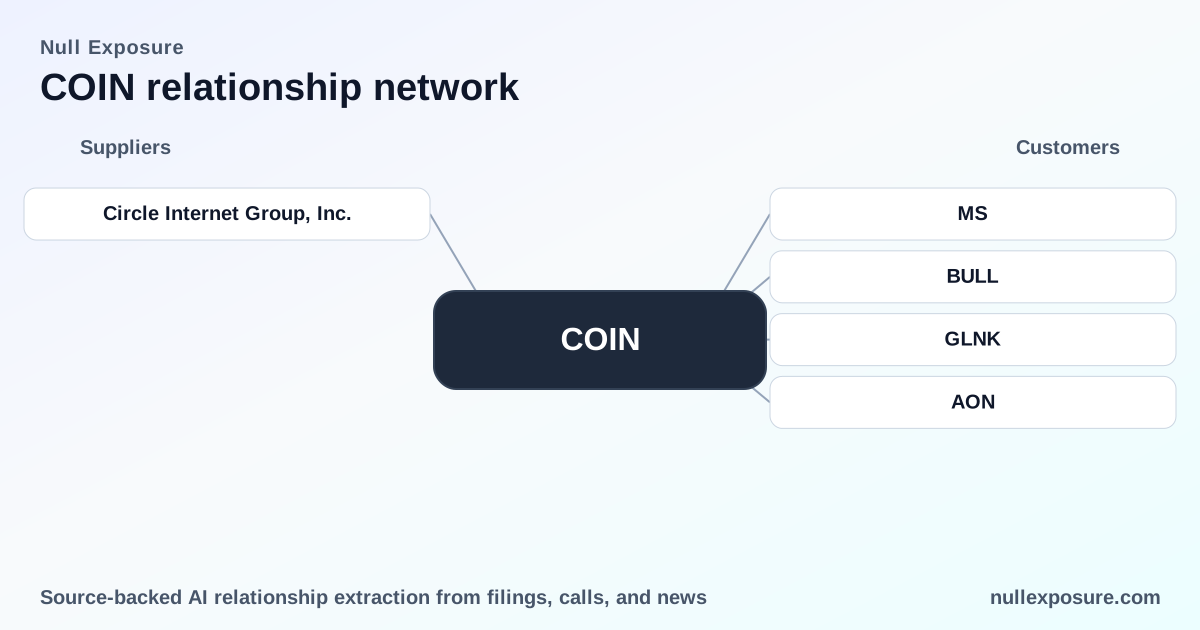
Coinbase customer relationships: the commercial map investors need to know
Coinbase Global operates a multi-product institutional and retail financial infrastructure business built around custody, trading, prime services, derivatives, staking and credit. The company monetizes through transaction fees, subscription and services revenue, and financing and custody-related lending, with large institutional contracts for custody and staking complementing high-volume retail trading. For investors assessing counterparty exposure, the customer map shows Coinbase as a critical custodian and services platform for a broad set of funds, issuers, miners and fintech partners. For a deeper look at how these relationships translate into revenue and concentration risk visit https://nullexposure.com/.
What this customer network implies for investors
Coinbase’s relationship set underscores several operating model characteristics worth underwriting into valuation and risk models:
- Contracting posture and criticality: Coinbase functions primarily as a service provider — custodian, prime broker, staking and credit lender — which makes its role operationally critical for funds and corporates that outsource custody and staking. That creates sticky, high-friction switching costs for customers that custody real crypto assets with Coinbase Custody or Prime.
- Concentration and geography: Despite global product distribution, roughly 84% of revenue was U.S.-sourced in 2025, signaling geographic concentration of economic exposure even as product relationships span multiple jurisdictions.
- Customer mix and maturity: Evidence supports a dual customer mix of retail monthly transacting users and large enterprises (asset managers, miners, broker-dealers), with services revenues (custody, staking, subscription) constituting a material and growing portion of monetization.
- Service maturity: Custody, prime and staking services show repeated adoption by institutional issuers and ETF sponsors, signaling product-market fit and enterprise-grade operations.
A mid-article note: if you want a structured feed of these commercial relationships for research or diligence, see https://nullexposure.com/.
Relationship roll call — concise takeaways investors can action
Below I list every customer relationship surfaced in the collected results, each with a short plain-English takeaway and a source reference.
- BKKT-WS — Bakkt Crypto uses Coinbase Custody Trust Company as a custodial provider for customer assets, per Bakkt’s SEC disclosure (FY2024). Source: SEC filing (Bakkt, FY2024).
- GDOG — Grayscale’s Dogecoin ETF filing names Coinbase Custody Trust Company as custodian for the fund. Source: Coinpedia / regulatory filing (FY2025).
- STSS — Sharps Technology launched a Solana validator “through Coinbase’s institutional infrastructure,” with Coinbase operating the validator and providing custody/OTC support. Source: The Globe and Mail / press release and multiple March 2026 reports (FY2026).
- TDOG — Token product TDOG lists Coinbase Custody Trust Company LLC among custodians alongside Anchorage and BitGo. Source: 21Shares product page (FY2026).
- VAVX — VanEck’s Avalanche ETF intends to stake AVAX via Coinbase Crypto Services as a regulated staking provider. Source: Tekedia and CoinDesk filings (FY2025–FY2026).
- HUT — Hut 8 amended and upsized a Coinbase Credit-backed, Bitcoin-secured revolving facility, increasing Coinbase-linked borrowing capacity to support corporate purposes. Source: TradingView / company disclosures (FY2026).
- BETR — Better Home & Finance (Better) partnered with Coinbase to power Bitcoin and USDC pledges for token-backed mortgages, with pledged crypto held in Coinbase Prime for loan life. Source: BuiltIn, Newswire and multiple March–May 2026 reports (FY2026).
- LTCC — A Litecoin ETF cited Coinbase Global as the primary custodian for physical LTC holdings, supporting liquidity. Source: FinancialContent / markets coverage (FY2026).
- IBKR — Interactive Brokers launched Coinbase Derivatives nano BTC and ETH contracts and expanded crypto futures access via Coinbase Derivatives, LLC. Source: SahmCapital / TradingView coverage (FY2026).
- MSTR — MicroStrategy transferred a large BTC position off Coinbase to Fidelity’s custody platform, illustrating custody migrations between major providers. Source: TS2 Tech / November 2025 report cited in 2026 coverage (FY2025).
- RIOT — Riot Platforms amended a $200 million credit facility with Coinbase Credit, with collateral including bitcoin and USDC held at Coinbase Custody securing the loan. Source: CoinDesk and 8‑K filings (FY2026).
- MS-P-A / Morgan Stanley Bitcoin Trust — Morgan Stanley tapped Coinbase Custody (and BNY Mellon) as custodian for a proposed Bitcoin trust. Source: CoinDesk and Bitcoin Magazine (March 2026).
- GME — GameStop transferred its entire Bitcoin position to Coinbase Prime, indicating use of Coinbase as treasury custody/trading partner. Source: SahmCapital / TradingView (FY2026).
- EZBC — Franklin Templeton’s bitcoin ETF narrative referenced real BTC custody with Coinbase rather than derivatives. Source: SimplyWall.st (FY2025).
- SMLR — Strive used proceeds to repay a $20 million Coinbase credit loan as part of debt restructuring, pointing to Coinbase’s role as lender. Source: TradingView / company press release (FY2026).
- BLSH — Bullish routed IPO proceeds, largely settled in USDC (and EURC), to custody exclusively with Coinbase. Source: Bullish press coverage and GFMag (FY2025).
- STEX — Streamex’s GLDY gold-backed token lists Coinbase Prime among approved custodians for the tokenized security. Source: GlobeNewswire / company press release (FY2026).
- Morgan Stanley (MS) — As above, Morgan Stanley’s proposed Bitcoin product will use Coinbase Custody alongside BNY Mellon as custody partners. Source: CoinDesk (March 2026).
- AON — Aon tested stablecoin payments with Coinbase as part of broader market experimentation. Source: CoinDesk coverage of market partnerships (FY2026).
- ETH / staking considerations — Grayscale and other staking filings reference Coinbase Custody in operational arrangements addressing staking risks and tax considerations. Source: BitcoinMagazine and staking-focused coverage (FY2025–FY2026).
- GLNK (Grayscale Chainlink Trust) — Coinbase Custody listed as primary custodian for the Chainlink trust. Source: Bitget academy coverage (FY2026).
- HODL — A trust filing notes Coinbase serves as Bitcoin custodian and that an affiliate is an additional custodian. Source: 10‑K filing (Hodl trust, FY2024).
- KULR — KULR disclosed a $20 million Coinbase Credit facility and used Coinbase-linked financing to grow BTC holdings. Source: GlobeNewswire and BitcoinMagazine (FY2025).
- ROMA — Roma Green Finance securities are tradable on Coinbase, evidencing Coinbase’s listing distribution for smaller issuers. Source: Yahoo Finance news (FY2026).
- NCTY — The9 announced a custody account with Coinbase Custody, reflecting custody engagements with smaller public firms. Source: PR Newswire via Finviz (historic FY2015 mention surfaced).
- BULL / Webull — Webull expanded crypto access in Australia and Brazil through a partnership powered by Coinbase Prime, bringing hundreds of assets to its platform. Source: Finance Magnates and Investing.com (FY2025–FY2026).
- BULLZ / BULLW — Webull-branded variants across markets reiterated Coinbase partnerships for crypto launches in Brazil, Australia and the Netherlands. Source: Investing.com and Newswire (FY2025–FY2026).
- BGLWW — Blue Gold referenced Coinbase’s Base layer-2 as deployed infrastructure. Source: SahmCapital academy coverage (FY2025).
- RZLV — Rezolve AI’s token SQD was noted as listed on Coinbase among other venues, expanding token liquidity. Source: CoinCentral (FY2026).
- JPM-P-J — Coverage tied JPMorgan’s expanding crypto work to partnerships with industry players such as Coinbase. Source: Cointelegraph (FY2025).
- ASST — A company used proceeds to retire a $20 million Coinbase loan, again reflecting Coinbase as a corporate lender. Source: StockTitan (FY2026).
- Additional ETF and trust sponsors (Grayscale, Fidelity, Franklin, VanEck and others) — Multiple filings list Coinbase Custody/Prime/Crypto Services as custodian or staking provider across ETF and trust launches (ETH/GLNK/FSOL/VAVX/GDOG). Source: CoinDesk, ETF.com, Bitget and regulatory filings (FY2025–FY2026).
- Multiple mentions grouped under Sharps/STSS coverage — Sharps repeatedly disclosed delegations of SOL and operation of a Coinbase-supported validator and custody/staking relationships across press outlets. Source: The Globe and Mail, The Block, QuiverQuant and other March–May 2026 coverage (FY2025–FY2026).
What investors should underwrite from this list
- Custody and staking are core revenue drivers: repeated custodian and staking-provider selections by ETF sponsors and funds indicate recurring, fee-bearing relationships.
- Financing and credit are strategic levers: multiple credit facilities (Hut 8, Riot, KULR, Strive/Semler) demonstrate Coinbase’s role as an on-balance-sheet lender against crypto collateral.
- Platform stickiness and regulatory signaling: selection by large brand names (Morgan Stanley, Grayscale, Fidelity-linked filings) signals enterprise trust in Coinbase operations and contributes to barriers for competitors.
Risks and portfolio implications
- Concentration risk: heavy U.S. revenue concentration and reliance on custody/prime relationships create exposure to U.S. regulatory and market cycles.
- Counterparty exposure: Coinbase’s lender role increases credit exposure to miners and issuers; loan defaults would compress margins and raise asset-liability friction.
- Operational dependency: as custodian for numerous ETFs and tokenized securities, Coinbase holds a critical operational role where any service disruption would have industry-wide consequences.
For institutional-ready mapping, schedules and raw relational feeds built for diligence teams are available at https://nullexposure.com/.