Coca‑Cola Consolidated (COKE): Customer Concentration, Channel Dynamics, and What Investors Need to Know
Coca‑Cola Consolidated builds its business by manufacturing, marketing and distributing non‑alcoholic beverages—primarily products of The Coca‑Cola Company—across 14 states and D.C., monetizing through direct sales to retail and on‑premise channels, third‑party distribution agreements and packaged goods logistics. Revenue is driven by high‑volume grocery and mass‑merchandise accounts, with margin and working‑capital characteristics tied to distribution models and retailer contracting. For a concise view of counterparty risk and commercial exposures, see NullExposure’s customer analysis hub: NullExposure.
Quick read: concentration is a structural feature, not an anomaly
Coca‑Cola Consolidated’s customer base is highly concentrated among large U.S. retailers, with two customers alone accounting for a material share of unit volume and net sales. The company’s operating model—direct store delivery (DSD) combined with casepack distribution—creates both negotiating leverage for large customers and operational dependence for the bottler. That structural concentration is the primary commercial risk vector for investors.
Relationships that shape revenue and risk
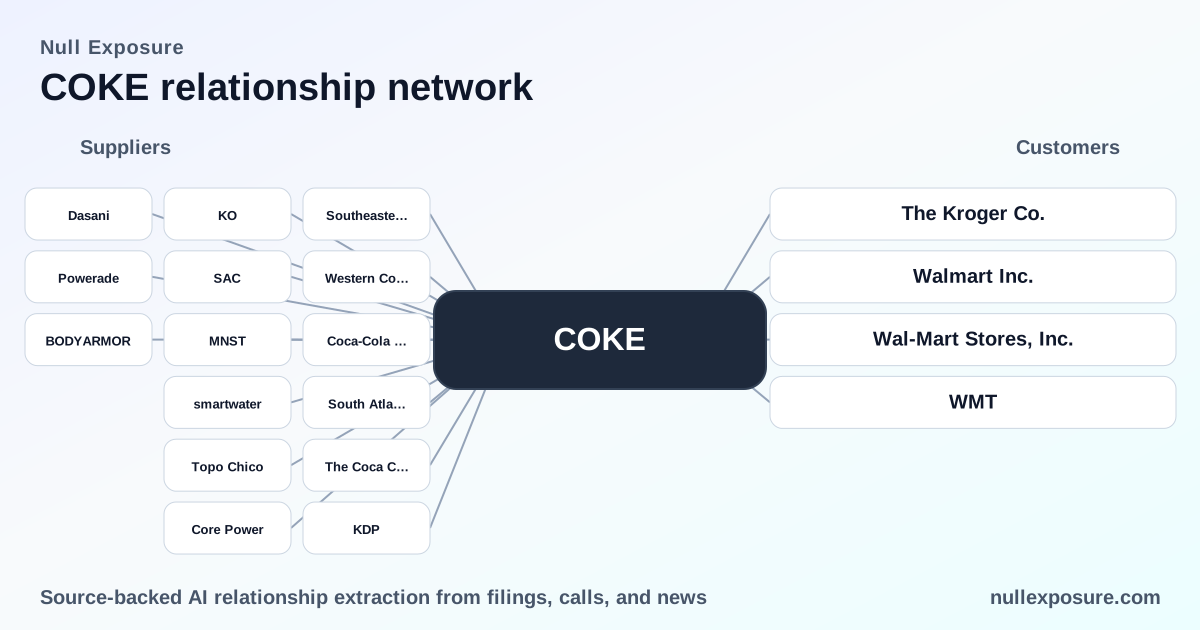
The Kroger Co.
Kroger accounted for a significant portion of bottle/can sales volume and net sales in FY2024, representing roughly 15% of bottle/can volume and about 12% of net sales, placing it among Coca‑Cola Consolidated’s largest retail partners. This is reported in the company’s FY2024 Form 10‑K and flagged as a material customer relationship in the risk disclosures. (FY2024 10‑K)
Walmart Inc.
Walmart is the single largest retail customer, representing approximately 21% of total bottle/can sales volume and about 17% of net sales in FY2024, reflecting the company’s dependence on national mass‑merchant distribution for scale. The FY2024 10‑K explicitly identifies Walmart as one of the two largest customers whose loss would have a material adverse effect. (FY2024 10‑K)
Wal‑Mart Stores, Inc.
The FY2024 filing lists Wal‑Mart Stores, Inc. in a table quantifying bottle/can sales volume, again showing the retailer at roughly 21% of bottle/can volume, which underlines that the company’s disclosures use legacy naming conventions while describing the same large‑enterprise account. This is presented as part of the customer concentration table in the 10‑K. (FY2024 10‑K)
Walmart (distribution model change disclosed in 2025 results)
Coca‑Cola Consolidated disclosed that in Q2 2024 it shifted distribution of casepack Dasani water sold in Walmart stores to a non‑DSD method, reflecting a change in routing and service model for a specific product line in that account. That operational change was described in the company’s first‑quarter 2025 results press release. (GlobeNewswire, Apr 30, 2025)
WMT (news duplicate reflecting the same distribution shift)
The GlobeNewswire release also surfaces under the ticker attribution "WMT" and reiterates that the Dasani casepack distribution to Walmart stores moved to a non‑DSD method in Q2 2024, highlighting product‑level shifts within a major customer relationship. This duplicate news entry confirms the operational adjustment disclosed in the company’s investor release. (GlobeNewswire, Apr 30, 2025)
How the constraints define the operating model and commercial posture
The company‑level signals from filings and disclosures paint a consistent picture of Coca‑Cola Consolidated’s commercial profile:
- Large‑enterprise counterparties dominate: The 10‑K quantifies Walmart and Kroger as very large customers, which creates concentrated buyer power and requires the bottler to negotiate on national commercial terms (company‑level signal).
- U.S. geographic focus: The business sells and distributes in the United States across multiple retail channels and on‑premise locations, which concentrates macro and regulatory exposure to North America (company‑level signal).
- Materiality of top customers: The 10‑K explicitly states that the loss of Walmart or Kroger would have a material adverse effect, so these relationships are critical to financial stability (this constraint names the two retailers and is therefore relationship‑specific for Walmart and Kroger).
- Active, core revenue relationships: Customer tables and sales‑mix disclosures classify these partnerships as active and part of the company’s core product distribution—this is an operational maturity signal tied to recurring, high‑volume commerce (company‑level signal).
- Seller posture with multiple distribution channels: Coca‑Cola Consolidated operates as the seller and distributor, using DSD and casepack-to-non‑DSD transitions to optimize cost and service, which gives it some operational flexibility but also introduces execution risk when routes change (company‑level signal).
Investment implications — what investors should price in
- Concentration risk is the central valuation lever. With roughly 36% of bottle/can sales volume attributable to Walmart and Kroger combined and about 29% of net sales tied to those accounts in FY2024, any contract renegotiation or account loss would materially affect top‑line and operating leverage (FY2024 10‑K). Investors should treat counterparty renegotiation risk as a first‑order factor.
- Operational execution matters as much as price. The shift of Dasani casepack distribution to non‑DSD for Walmart demonstrates the company’s ability to reconfigure routes, but it also creates execution complexity that can temporarily suppress margins or increase working capital needs (GlobeNewswire, Q1 2025 release).
- Mature, defensive end market with concentrated bargaining power. Beverage demand is resilient, but the retail channel is mature and concentrated, giving customers meaningful leverage on pricing, promotional funding and shelf placement.
- Valuation context and capital returns. Coca‑Cola Consolidated’s reported market capitalization and multiples (MarketCap ≈ $13.96B; EV/EBITDA ≈ 15.7; Forward PE ≈ 17.4) reflect both the stable cash flow profile and the embedded concentration risk; investors should reconcile these multiples with the probability and impact of adverse commercial outcomes (company overview metrics).
If you want a structured exposure map and counterparty scoring that translates these disclosures into scenario P&L outcomes, NullExposure provides a concise analytics view: NullExposure.
Final read: position sizing, monitoring, and governance checklist
For investors and operators evaluating COKE customer relationships, the checklist is straightforward and actionable:
- Stress test earnings for partial and full loss scenarios at Walmart and Kroger.
- Monitor distribution model changes (DSD vs. non‑DSD) as leading indicators of margin and working capital shifts.
- Assess promotional and slotting expense trends in retail accounts, which are often negotiated outside headline pricing.
- Track filings and quarterly releases for updates on customer mix and any concentration mitigation strategies (e.g., geographic expansion, product diversification).
Bottom line: Coca‑Cola Consolidated’s commercial model delivers scale through a small number of very large retail relationships—this is both a competitive asset and the principal investment risk. Continuous monitoring of contractual posture and distribution execution against Walmart and Kroger will determine whether current multiples fairly compensate for that concentration.