Columbia Banking System (COLB): Agency funding, mortgage concentration, and what customers tell investors
Columbia Banking System operates as the holding company for Columbia State Bank, monetizing through traditional regional banking activities: originating and servicing consumer and commercial loans, collecting deposit spreads, and selling or funding mortgages through agency channels and treasury services. The company's economics are driven by real-estate lending concentration, deposit funding stability, and fee income from private banking and treasury services, while persistent agency funding for originated mortgage exits anchors both liquidity and margin dynamics.
If you want a concise view of customer-level exposures and partner links, explore further at https://nullexposure.com/.
How Columbia actually makes money and why customer relationships matter
Columbia is a regional bank focused on the Western U.S., earning interest income from a loan portfolio and deposit margins while supplementing returns with mortgage origination and wealth/treasury fees. Real-estate lending is the dominant revenue engine, and the firm converts originated residential mortgage production into funded loans or agency sales that affect balance sheet growth and net interest margin. According to the company overview and recent disclosures, Columbia reported roughly $2.336 billion in revenue TTM with notable profitability and return measures (profit margin ~28%, ROE ~10.2%), reflecting a stable regional franchise that relies on both retail deposit funding and agency mortgage markets for distribution and liquidity.
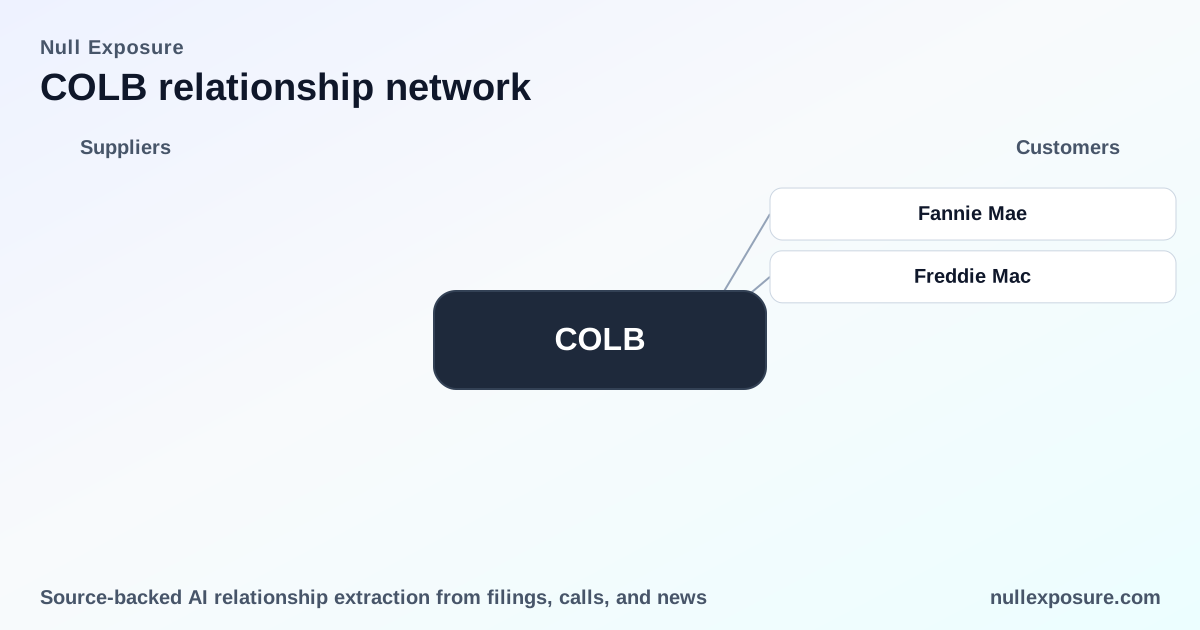
Agency mortgage counterparties: Fannie Mae and Freddie Mac
Columbia explicitly uses the government-sponsored enterprises as permanent financing outlets for a large share of loans leaving the bank. The relationships listed in the results are:
- Fannie Mae — Columbia routes a substantial portion of originated mortgages out of the bank that are permanently financed by Fannie Mae, ensuring liquidity and reducing on‑balance-sheet duration risk for those loans. According to the Q4 2025 earnings call transcript, roughly 85% of exiting loans are permanently financed by Fannie or Freddie (InsiderMonkey, earnings call transcript, March 2026).
- Freddie Mac — The firm uses Freddie Mac alongside Fannie Mae as a primary permanent buyer for exited mortgages, sharing agency concentration across both GSEs and thereby institutionalizing the mortgage exit pathway. This dynamic was disclosed in the same Q4 2025 earnings call transcript noting the combined agency financing proportion (InsiderMonkey, earnings call transcript, March 2026).
Both notes above reflect the company’s operational choice to leverage agency markets to convert originations into funded assets off the bank’s core lending book. This agency funding pipeline is a structural customer/partner relationship that materially influences liquidity and capital deployment.
Operating constraints and what they indicate about the business model
Several company-level signals from filings and disclosures clarify how Columbia manages customers and counterparties:
- Contracting posture: short-term — The bank reports that substantially all customer contracts have expected durations of one year or less, with payments due when services are rendered or shortly thereafter. This reflects a transactional, deposit- and loan-oriented commercial posture where rolling customer relationships and repricing are routine (company filings).
- Counterparty mix: individuals and small businesses dominate — Columbia serves a mix of consumers, small businesses, and commercial clients across its footprint; filings cite both individual and small-business customers as core counterparty types. That distribution ties credit risk and deposit behavior closely to local economic cycles across its regions.
- Geographic concentration: Western U.S. service area — The customer base is concentrated in Washington, Oregon, Idaho, California, Nevada, Utah, Arizona, and Colorado, making regional economic trends a principal driver of credit performance and deposit flows.
- Concentration risk: material exposure to real estate lending — Management states real-estate related loans accounted for approximately 75% of the loan and lease portfolio as of year-end 2024, a material concentration that elevates vulnerability to real estate cycles and underwriting trends.
- Funding criticality: deposits are a primary source of funds — Deposits are characterized as a critical source of funds for growth and profitability, underlining the importance of local customer relationships and deposit retention strategies.
- Relationship role: primarily a service provider — Columbia provides a broad range of banking, mortgage, treasury and wealth management services; it also executes customer-facing treasury products such as foreign-currency hedges, reflecting a service-provider posture to corporate and institutional clients.
- Relationship maturity: active hedging program — Filings show the bank had interest rate swap assets (notional ~$4.3 billion) and liabilities (notional ~$4.4 billion) as of December 31, 2024, indicating an active interest-rate risk management program supporting the customer/loan portfolio.
- Business segment: services-driven banking operations — The company reports a single reportable segment concentrated on banking operations, where loan and deposit products and treasury services are the revenue levers.
Taken together, these constraints describe a regional bank that runs short-duration customer contracts, depends on local retail and small-business relationships for deposits and loans, and offsets balance-sheet and interest-rate risk with active hedging and agency distribution.
Key investor takeaways and risks to monitor
- Agency dependence is a structural feature. The practice of permanently financing roughly 85% of exited mortgages through Fannie or Freddie stabilizes liquidity and reduces on‑balance-sheet concentration for originated mortgages, but it also links Columbia to agency pipeline and pricing conditions (InsiderMonkey, Q4 2025 earnings call, March 2026).
- Real-estate concentration is material. With roughly 75% of loans in real-estate categories, credit performance is highly correlated to regional housing markets and commercial real-estate cycles (company filings, year-end 2024).
- Deposits are mission-critical. Deposit retention and cost management drive funding stability; deposit stress would force more reliance on wholesale funding or reduce origination capacity.
- Active hedging implies exposure management but also counterparty activity. Large swap notionals show management discipline on interest-rate exposure but introduce counterparty and liquidity considerations around derivative markets (company disclosures).
If you are tracking counterparty and customer exposures for Columbia, a structured view through customer relationships and contract constraints sharpens portfolio-level decisions—explore more at https://nullexposure.com/.
Bottom line
Columbia Banking System runs a classic regional banking franchise: local deposit and lending relationships fund an origination engine that turns to Fannie and Freddie for permanent mortgage financing, while active hedging and service lines add operational breadth. For investors, the dominant themes are agency funding reliance, real-estate concentration, and deposit funding criticality — the intersection of these factors will determine earnings durability across macro cycles and policy shifts.