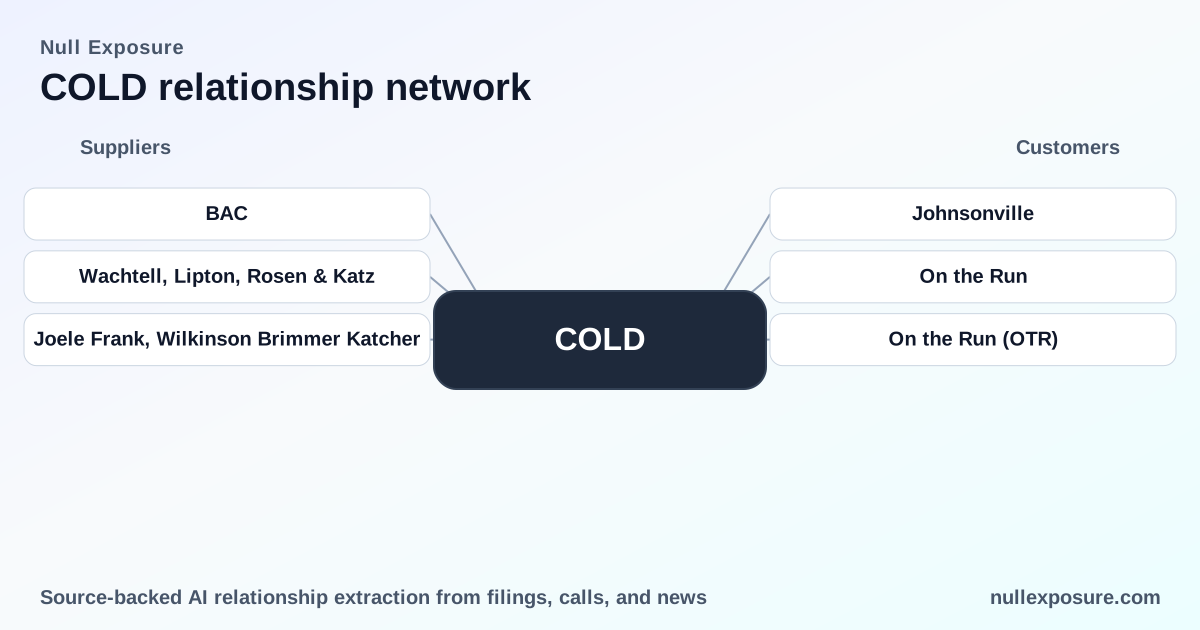
Americold (COLD) — Customer Relationships: Johnsonville and On the Run, what investors should price in
Americold owns and operates the world’s largest portfolio of temperature‑controlled warehouses and monetizes through rent and storage fees, fixed storage commitments, and higher‑margin value‑added services such as distribution and fulfillment for food retailers and manufacturers. The business is capital‑intensive and driven by occupancy and multi‑year customer commitments; management has deliberately shifted revenue mix toward fixed storage commitments to stabilize cash flows while continuing to win new logistics partnerships in growth markets. For deeper screening and competitive customer intelligence, visit https://nullexposure.com/ for driven, investor‑grade signals.
What the customer picture tells investors about the operating model
Americold’s customer profile reinforces a classic industrial REIT structure: highly capitalized real estate assets, large enterprise customers, and a mix of short and long contract tenors. The company signals both contracting postures in filings—acknowledging the short‑term nature of many contracts while also documenting a deliberate transition to agreements that embed fixed storage commitments and variable rates for ancillary services. This hybrid contracting posture implies revenue sensitivity to utilization in the near term but a visible pathway to more predictable cash flow as fixed commitments scale.
Concentration and criticality are material to the investment thesis. Management reports that the 25 largest warehouse customers generated roughly half of warehouse revenues in 2024, a concentration level that makes customer retention a core risk and value driver. At the same time, Americold’s long average customer tenure (weighted average >35 years for its 25 largest customers) is a positive signal of sticky, mature relationships that underpin recurring revenue.
Geography and scale are also central. Americold runs a global network of 239 temperature‑controlled warehouses with heavy North American exposure and meaningful footprints in Europe and Asia‑Pacific. That global scale enables multi‑market customer relationships and cross‑regional service offerings, but it also introduces execution and expansion risks when supporting rapid rollouts for large retail chains.
Finally, Americold functions both as landlord and operator: it is a service provider performing warehouse management and value‑added services, and it is a buyer of tenant commitments through rent and storage contracts; the sale‑leaseback activity described in filings also establishes a partial seller/finance posture in the capital stack.
Key takeaway: Americold combines concentration and maturity (large, long‑standing enterprise customers) with a deliberate move toward fixed storage commitments, converting utilization volatility into more predictable, contractually backed revenue streams.
Recent customer wins and what they imply for growth
Americold’s public disclosures in late 2025 and early 2026 highlight selective new wins that reinforce both expansion and the company’s customer strategy.
Johnsonville — established customer recognition in operations
Americold highlighted that Johnsonville’s third‑party logistics effort recognized Americold’s Clearfield location as Summit Warehouse of the Year, an operational accolade that underscores Americold’s execution quality for major food manufacturers. According to Americold’s Q4 2025 earnings call (March 2026), the award was noted specifically in reference to the Clearfield facility, signalling the company’s capability to deliver premium operational performance for large enterprise customers. (Americold Q4 2025 earnings call, March 2026)
On the Run (OTR) — rapid expansion and national rollout in Australia
Americold announced a December 2025 partnership with Australian convenience retailer On the Run to provide storage and distribution services, initially supporting locations in Adelaide and scaling as OTR pursues national expansion. A StockTitan news release summarized the Dec. 23, 2025 announcement that Americold would support OTR’s rapid national rollout in Australia. (StockTitan, Dec. 23, 2025)
Management subsequently updated investors on the Q4 2025 call and in press coverage that the On the Run relationship expanded to include wins in New South Wales and Queensland, and that Americold will support nearly 600 OTR locations across Australia, reflecting a sizable, multi‑site logistics engagement and rapid geographic scale‑up in APAC. (Americold Q4 2025 earnings call transcript; Globe and Mail transcript, March 2026)
Takeaway: On the Run is a growth‑oriented, scale partnership that accelerates Americold’s APAC exposure and demonstrates the company’s ability to support national convenience and retail distribution programs. These wins convert into recurring storage and distribution revenue and validate execution in a new operating geography.
(If you want a consolidated view of customer traction and operational performance across Americold’s enterprise relationships, more investor‑grade intelligence is available at https://nullexposure.com/.)
How these relationships influence risk and upside
- Concentration risk is real: top customers generate roughly half of warehouse revenues, so the loss or contraction of a handful of large customers would have outsized earnings effects. That concentration elevates the importance of customer service quality (as reflected in the Johnsonville award) and contract structure (the shift to fixed storage commitments).
- Contracting mix compresses downside: the explicit transition toward fixed storage commitments converts some on‑demand revenue into contracted cash flow, improving debt serviceability metrics and reducing short‑term utilization sensitivity.
- Geographic diversification is both a growth vector and a complexity burden: wins like On the Run accelerate revenue in APAC but require capital deployment, local logistics management, and regulatory compliance—factors that increase execution risk during scale‑up.
- Maturity of relationships is protective: the reported >35‑year weighted average tenure for top customers signals high switching costs and relationship stickiness that supports valuation multiples relative to commodity cold storage owners.
Investment implications — what investors should watch next
Investors should monitor three operational levers that are visible in customer disclosures and materially affect valuation:
- Pace of conversion to fixed storage commitments. The faster Americold locks revenue into multi‑year commitments, the more predictable FFO growth becomes.
- Customer concentration shifts. Watch changes in revenue share among the top 25 customers; a rising concentration increases tail risk, whereas diversification into many mid‑sized retail customers lowers single‑counterparty exposure.
- Execution on international rollouts. The On the Run national expansion in Australia is a live test of Americold’s cross‑border operating playbook; successful scale should improve revenue per facility and margins for APAC.
Bottom line: Americold’s customer relationships combine high concentration and long tenure with strategic new wins that expand geography and addressable revenue. The company’s deliberate move toward fixed commitments is a central valuation lever that reduces utilization volatility and supports a REIT‑style income thesis — but investors must price in concentration and execution risk during international rollouts.
For a deeper dive into contract structures, revenue concentration trends, and a customer‑level risk heat map, visit https://nullexposure.com/ for investor‑oriented signals and analysis.