Columbia Sportswear (COLM): Customer Relationships That Drive Wholesale Reach and Brand Velocity
Columbia Sportswear designs, markets and distributes outdoor and lifestyle apparel, footwear and accessories across four reportable segments and monetizes through wholesale distribution, direct-to-consumer retail and modest licensing programs. The firm’s revenue mix is deliberately broad—global wholesale partners, owned international subsidiaries and direct channels—so brand placement and retail partnerships are the operational levers that translate product development into cash flow. For investors, the customer footprint is a lens on scalability, channel concentration and the company’s ability to leverage brand initiatives into durable retail sell-through. If you want a quick operational view, visit Null Exposure for structured relationship intelligence.
Executive takeaway: what the customer set tells investors
Columbia’s customer relationships underline a global, diversified wholesale posture with a mix of large chains and small specialty accounts, limited single-customer concentration, and selective licensing. Key characteristics: global reach, low customer concentration, retail distribution dependence, and incremental brand-led product placements that drive short-term assortment lifts. These dynamics support steady revenue generation but create sensitivity to retail inventory cycles and wholesale shelf placements.
How Columbia’s operating model shapes vendor and customer risk
The company sells in more than 110 countries and operates through owned subsidiaries in some APAC markets while using distributors elsewhere, which creates a hybrid operating model: direct control where scale and margin matter, distribution partnerships where market access is more efficient. Licensing is intentionally small—less than 1% of total revenue—so brand extension risk is immaterial to core revenue. Columbia reports that no single customer accounted for 10% or more of net sales in recent years, signaling low counterparty concentration and reduced single-buyer risk. These facts imply a contracting posture that is broad and transactional rather than concentrated and bespoke, and a customer maturity that is established—Columbia is a predictable supplier to a stable set of retail partners.
Mapping Columbia’s recent customer mentions (what happened and where it matters)
EVO — exclusive high-tech snow kit launch (FY2026)
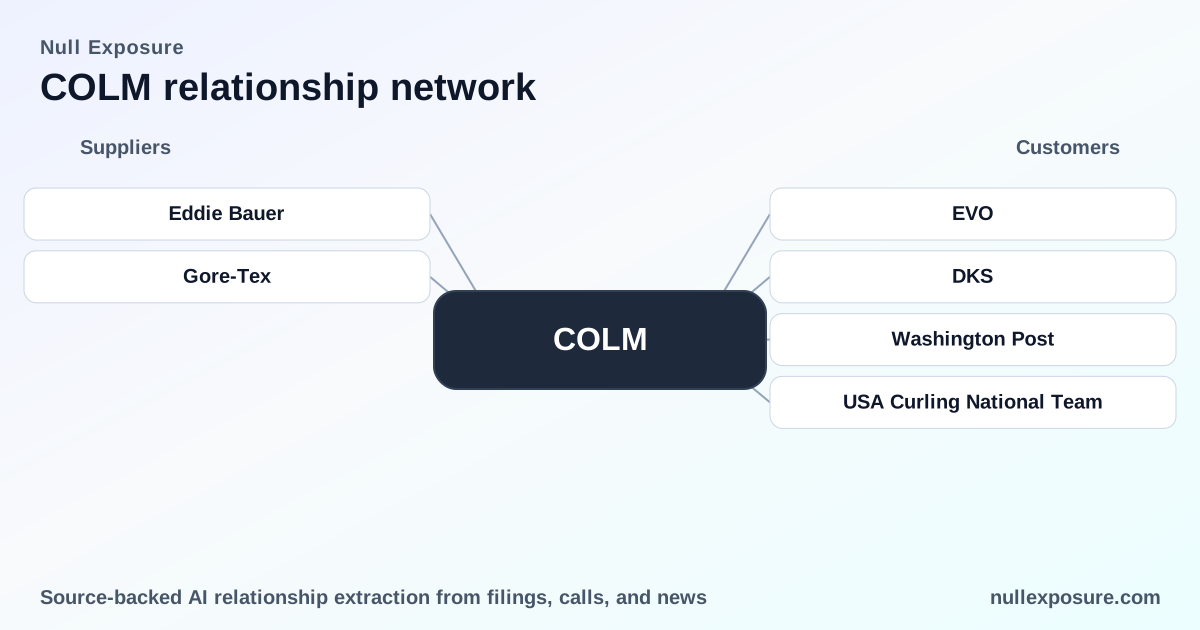
Columbia released a high-tech snow kit sold exclusively through EVO and Columbia’s e-commerce storefront, and held a launch event at EVO’s Salt Lake City location. This is a targeted channel partnership that blends exclusivity with experiential marketing to drive product awareness and e‑commerce traffic. Source: InsiderMonkey transcript of Columbia’s Q4 2025 earnings call (reported March 2026) — https://www.insidermonkey.com/blog/columbia-sportswear-company-nasdaqcolm-q4-2025-earnings-call-transcript-1688567/
Dick’s Sporting Goods — expanded seasonal assortment and team collection placements (FY2026)
Columbia executives reported plans to triple the Amaze line’s footprint in Dick’s Sporting Goods locations for the upcoming fall season, a move that increases in-store presence and distribution scale in a major U.S. sports retail chain. This escalation in shelf space is a direct wholesale growth lever that will influence U.S. wholesale revenue in the back half of the year. Source: SGB Online interview with CEO Tim Boyle (May 2026) — https://sgbonline.com/exec-columbia-sportswear-ceo-tim-boyle-sees-u-s-wholesale-returning-to-growth-in-second-half/
Dick’s Sporting Goods — Olympic outfitter placement and timed assortment (FY2025)
Columbia returned as outfitter for the USA Curling National Team and made key pieces from that collection available through Columbia and select Dick’s Sporting Goods stores, tying sponsorship to retail availability and leveraging Olympic visibility for product sell-through. This demonstrates Columbia’s practice of synchronizing sponsorships with wholesale rollouts to capture event-driven demand. Source: SGB Online announcement (March 2026) — https://sgbonline.com/columbia-sportswear-returns-as-the-outfitter-of-the-usa-curling-team/
Dick’s Sporting Goods — confirmation of expanded in-store presence (FY2026, additional coverage)
Additional retail-media coverage reiterated that Columbia planned to expand its Amaze line into three times as many Dick’s locations year-over-year, further emphasizing the company’s reliance on large-format retail to scale seasonal introductions. This repeated, consistent messaging across outlets shows coordinated merchandising strategy. Source: Shop Eat Surf Outdoor trade coverage (May 2026) — https://shop-eat-surf-outdoor.com/news/columbia-sportswear-ceo-strikes-optimistic-note-despite-u-s-challenges-in-q1/619098/
Washington Post (ad placement) — national brand positioning (FY2026)
Columbia placed a full-page ad in the Washington Post urging “Make America’s parks open again” during a government shutdown episode, signaling the company’s willingness to use paid national media for brand positioning and political-cultural visibility. This is a brand-level customer engagement with a mass-media channel to support reputational and consumer-awareness objectives. Source: Outside Online coverage referencing the ad and related campaign (March 2026) — https://www.outsideonline.com/outdoor-gear/gear-news/gert-boyle-columbia-sportswear-obituary/
USA Curling National Team — official uniform sponsorship (FY2025/2026)
Columbia returned as the official uniform sponsor for the USA Curling National Team ahead of the 2026 Winter Olympic Games, supporting athlete and coach uniforms across multiple team categories and using the sponsorship to drive limited-edition retail assortments. This is a classic sports marketing-to-retail conversion that boosts seasonal product demand and brand credibility in winter-sport categories. Source: SGB Online announcement (March 2026) — https://sgbonline.com/columbia-sportswear-returns-as-the-outfitter-of-the-usa-curling-team/
What the relationships mean for investors: opportunities and risks
- Opportunity — scalable wholesale ramps: The Dick’s expansion and the EVO exclusive demonstrate Columbia’s ability to convert brand initiatives into widened retail distribution and e‑commerce promotion, offering short-term top-line lift and better inventory turnover in targeted categories.
- Opportunity — event-driven merchandising: The USA Curling sponsorship and related product drops provide predictable seasonal revenue uplifts tied to high-visibility events, improving gross margin through premium-priced, limited assortments.
- Risk — retail execution dependency: Columbia’s commercial outcomes are sensitive to how major retailers allocate shelf and promotional space; execution risk increases if retailers cut space or if planned expansions (e.g., tripling Amaze locations) are delayed.
- Risk — low licensing leverage: Licensing is immaterial (<1% of revenue), which contains risk but also limits non‑seasonal, high‑margin revenue diversification.
- Structural strength — geographic and counterparty diversification: Sales in more than 110 countries and no single customer >10% of net sales reduce concentration risk and support resilience to localized retail disruptions.
Contracting posture, concentration, criticality and maturity — a concise profile
Columbia’s commercial contracting posture is broad and transactional, relying on wholesale agreements and retailer assortment placements rather than bespoke, exclusive supply contracts except in targeted launches (e.g., EVO exclusives). Concentration is low—no single customer represented 10%+ of net sales—and the customer base mixes large enterprises with independent specialty stores, reflecting mature, distributed channel relationships. Criticality is moderate: Columbia is an important brand partner for winter and outdoor categories but not uniquely indispensable to any single major retail partner. The use of owned subsidiaries in some APAC markets and distributors elsewhere indicates operational maturity and pragmatic market access decisions.
For a structured breakdown of these relationships and how they map to portfolio risk, see more at Null Exposure — the platform organizes counterparty signals to support investment diligence.
Bottom line
Columbia’s recent customer signals show intentional channel activations that prioritize wholesale expansion, event-linked merchandising, and selective exclusivity. For investors, the combination of low counterparty concentration, global distribution, and recurring retail partnerships points to steady cash generation with episodic upside from targeted launches; downside is tied to retail execution and inventory cycles. Monitor retailer assortment confirmations and sell-through data around seasonal launches to assess whether announced expansions convert to sustainable revenue gains.