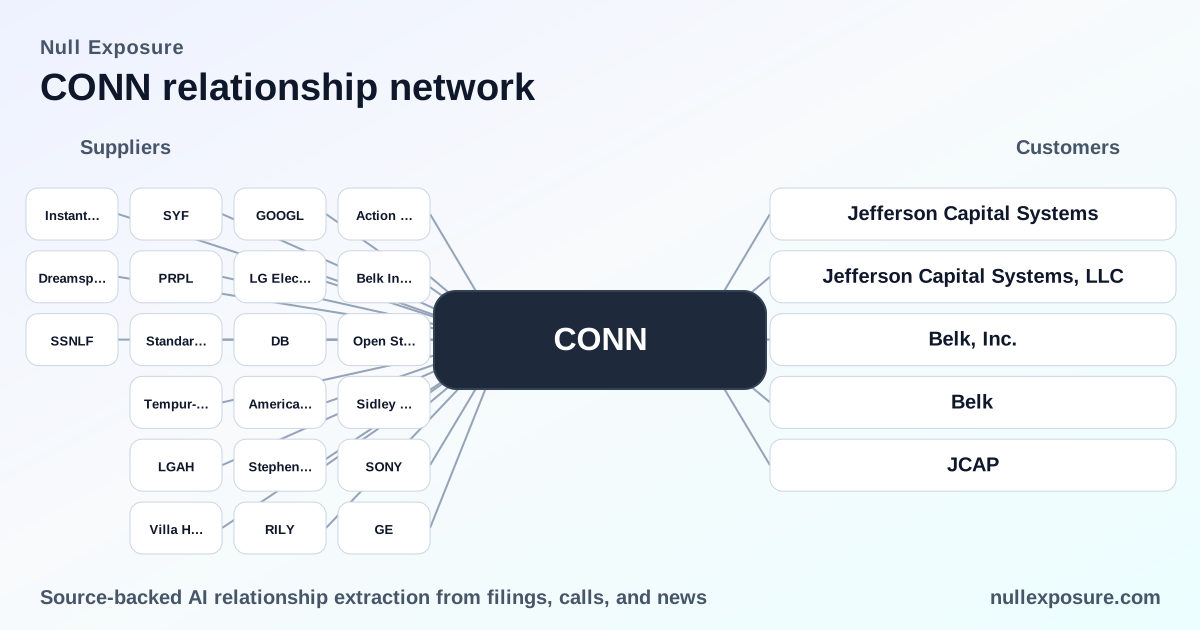
Conn’s Inc. customer relationships: who matters and why it changes the investment case
Conn’s Inc. operates as a specialty retailer of consumer durables and services and historically monetized through two engines: retail sales of appliances, furniture and electronics, and captive consumer finance income earned on in-house loans and servicing. That dual model produced higher margins when the finance arm remained intact; the 2024–25 restructuring and asset sales have materially shifted revenue mix toward retail and third‑party partnerships while stripping out a portion of the company’s financed receivables. For a concise overview of the platform and data-driven coverage, visit https://nullexposure.com/.
What the partner map reveals about strategy and risk
Conn’s partner activity over the last several years signals a pivot from vertically integrated finance-led retailing to a lighter, partnership-driven merchant model. The company is testing distribution extensions (Belk store‑within‑a‑store), integrating acquired brands (Badcock customer credit transition), and — crucially — sold large receivables and servicing assets to debt buyers (Jefferson Capital / JCAP), which materially reduces recurring finance revenue and changes counterparty risk profiles. These dynamics increase reliance on retail channels and third‑party service providers while lowering balance‑sheet exposure to consumer credit receivables.
The relationship roster — concise takeaways and sources
Belk — retail distribution pilot and online integration
Conn’s launched a store‑within‑a‑store pilot with Belk to place Conn’s product assortments (furniture, home electronics, appliances) inside select Belk locations and on Belk.com, leveraging Belk’s traffic to expand reach and offer Conn’s white‑glove next‑day delivery in new geographies. Retail Dive covered the initiative in May 2026, and Conn’s press materials and trade outlets described the pilot’s customer experience focus (PR Newswire; Twice; Home Furnishing Business; Retail Dive — reported 2026).
Sources: Retail Dive (May 2026); PR Newswire press release (Conn’s x Belk pilot); Twice and Home Furnishing Business coverage (2026).
Jefferson Capital Systems / Jefferson Capital / JCAP — sale and servicing transfer
Conn’s sold most of its consumer receivables and related servicing assets in late 2024 to Jefferson Capital Systems (reported across sources as Jefferson Capital / JCAP), transferring the bulk of portfolio cash flows and servicing duties to that buyer as part of the bankruptcy wind‑down and liquidation plan. Multiple filings and earnings releases from Jefferson Capital and news reports document significant collections and portfolio revenue recognized by JCAP from the Conn’s purchase in FY2025–FY2026.
Sources: USA Herald coverage of the confirmed plan (reporting on the $360m sale, FY2025); Jefferson Capital / JCAP investor releases and GlobeNewswire results (Q3/Q4 2025 and FY2026), TradingCalendar and other financial summaries (2025–2026).
W.S. Badcock — acquired brand and credit-program transition
Conn’s announced actions to integrate W.S. Badcock following acquisition, including transitioning Badcock’s customer credit program onto Conn’s in‑house loan offering to realize identified revenue synergies and cost savings. Management quantified combined expense reductions and revenue synergy targets as part of this integration effort.
Source: Retail reporting on Conn’s annual results and management commentary (RetailDive coverage of FY2024 commentary, 2026).
Notes on name variants: the press record refers to the same buyer under multiple labels (Jefferson Capital, Jefferson Capital Systems, JCAP, Jefferson Capital Systems, LLC); all cited items document the receivables sale and servicing transfer from Conn’s to that group in 2024–2025.
How these relationships reframe revenue quality and counterparty exposure
- Revenue mix shift: The Belk partnership and expanded wholesale/partner placements increase product reach but generate lower margin and lower recurring revenue than historically captive financing.
- Loss of finance income: The sale of receivables to Jefferson/JCAP removes a significant source of portfolio and servicing revenue from Conn’s future income stream; Jefferson’s public results show material collections and portfolio revenue tied to the Conn’s purchase, confirming the economic transfer.
- Integration risk vs. upside: The Badcock credit transition offers near‑term cost and revenue synergies if executed cleanly, but successful realization requires IT, underwriting and collections integration under the restructured business.
Key takeaway: Conn’s is now fundamentally a merchandise retailer augmented by distribution partnerships and focused integration work, with a much-reduced role as a receivables originator/servicer.
Operational and business‑model signals (company‑level)
With no explicit constraint excerpts provided, the observable signals indicate the following company‑level characteristics:
- Contracting posture: more channel partnerships and pilot programs (Belk store‑within‑a‑store) rather than large captive finance contracts; Conn’s is licensing distribution rather than extending significant new credit from its balance sheet.
- Concentration: counterparty concentration increased in one dimension — a single buyer (Jefferson/JCAP) absorbed a material chunk of Conn’s receivables — while retail distribution is diversified via partners like Belk and acquired brands such as Badcock.
- Criticality: For investors, the financing business was critical to historical profitability; its removal elevates execution risk on retail operations and partner rollouts to sustain margins.
- Maturity: The business is in transitional maturity—from a vertically integrated retailer/finance company to a leaner retail operator reliant on third‑party asset buyers and strategic retail alliances.
Investment implications and risk checklist
- Earnings profile: Expect lower volatility from credit mark‑to‑market but a lower recurring margin base; retail performance and inventory turns become the drivers of near‑term cash flow.
- Counterparty risk: Jefferson/JCAP’s acquisition of receivables reduces Conn’s exposure to credit losses but concentrates recovery and future collections outside the company. Investors must monitor partner rollouts (Belk) and integration execution (Badcock).
- Catalysts to watch: Belk pilot scale‑up, Badcock credit transition metrics (conversion rates and delinquencies under the new program), and any further disposals or service agreements related to receivables or servicing.
- Downside: Execution failure on retail initiatives or inability to replace lost finance margin would pressure profitability; conversely, successful partner rollouts and cost synergies would stabilize margins absent the finance wing.
For ongoing tracking of partner developments and regulatory filings, see our portal at https://nullexposure.com/ — it consolidates press releases and partner disclosures relevant to CONN and peers.
Bottom line
Conn’s customer and partner map over 2024–2026 reflects a decisive strategic pivot: product distribution and retail partnerships now underpin growth potential while the classic captive finance engine has been largely sold to Jefferson/JCAP. Investors should reframe valuation and risk analysis around retail execution, partner expansion, and integration outcomes rather than legacy finance cash flows.