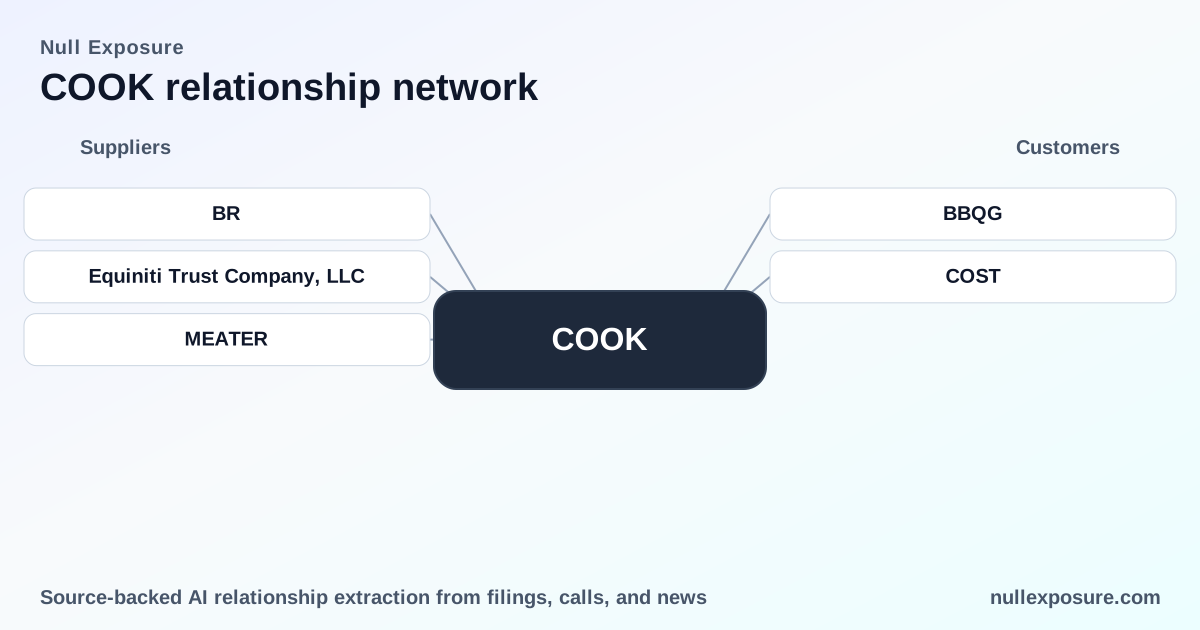
Traeger Inc (COOK): Customer Relationships and Commercial Constraints that Drive Value
Traeger designs and sells wood-pellet grills and a complementary portfolio of consumables and accessories, monetizing through hardware sales and higher-margin recurring consumables and accessories. The business sells via two primary channels — retail partners and a direct-to-consumer arm — and captures aftermarket revenue from pellets, rubs, sauces and accessories that lift lifetime value. For relationship diligence, focus on retail concentration, channel strategy changes, and supplier/customer criticality as the principal operational levers that determine cash flow stability and margin recovery.
Visit Null Exposure for relationship analytics: https://nullexposure.com/
How Traeger monetizes customers and what that implies for operators
Traeger’s revenue mix is structurally a hardware-led platform with recurring annex sales: grills were 53.8% of 2024 revenue while consumables and accessories together represented roughly 46% of sales. This model produces periodic spikes when new grill cycles occur and delivers steady margin support from consumables and accessories between grill cycles. Traeger sells through national retailers, regional dealers and historically through DTC — a distribution posture that creates both concentration risk and recurring aftermarket opportunity.
Key commercial characteristics to use when modeling COOK:
- Concentration and criticality: Traeger derives the majority of revenue from a small set of major retailers; the company itself states a decline in demand or counterparty failure with those retailers would materially affect results. This is a company-level signal of high counterparty concentration and criticality.
- Geographic mix: Traeger reports broad global distribution (over 11,200 retail locations globally) but with North America dominating revenue, reinforcing exposure to U.S. retail trends and seasonal buying patterns.
- Channel posture and maturity: Traeger operates both retail/reseller and DTC channels, but recent disclosures show a strategic shift away from some DTC initiatives, signaling a move to a more reseller-centric distribution model.
- Product segmentation: Grills are the core product, with consumables and accessories as adjacent, high-margin segments that support recurring revenue and customer retention.
Relationship breakdown — who matters and why
Below are every customer relationship found in the search results, with concise takeaways and source context.
ELUT
Traeger supplies components to medical-device manufacturer ELUT: ELUT’s FY2024 filing states that the SIS ECM biomaterial used in its medical devices is manufactured by Cook at a West Lafayette, Indiana facility, indicating Traeger (or related Cook operations) participates as a manufacturing source for ELUT’s products. Source: ELUT FY2024 Form 10‑K (excerpt noted in a 2026 data pull).
Walmart
Walmart is a national retail channel for Traeger pellet grills; multiple news alerts in 2026 note Walmart sells Traeger models (for example a Tailgater model on sale in April 2026), reinforcing Walmart’s role as a major retail distribution partner that drives volume and promotional cadence. Source: MarketBeat instant alerts referencing retail coverage and promotional listings (March–May 2026).
BBQG
Third‑party retail platforms such as BBQGuys list and sell Traeger products alongside competitors like Weber; historical coverage in 2021 described multi‑brand marketplaces that distribute Traeger, highlighting the importance of specialized retailers to brand reach. Source: CNBC coverage (July 2021) on online channels carrying Traeger and competitors.
BBQGuys
BBQGuys — a branded specialty retailer — carries Traeger and competitive grill brands on its site, reflecting the company’s reliance on specialty resellers to reach enthusiast segments and to support accessory/consumable attach rates. Source: CNBC (July 2021) reporting on specialty reseller listings.
COST
Traeger executed a strategic retreat from certain DTC and promotional activities, including discontinuing Costco roadshows and redirecting Traeger.com traffic to retail partners; multiple 2025–2026 reports flag this as part of a channel optimization plan and pellet mill consolidation to reduce cost. The Costco roadshow discontinuation is cited as a cost-saving and channel strategy change. Source: SGBOnline (coverage of Q3 results and strategic moves, March 2026) and TradingView summaries of Traeger’s 2025 Form 10‑K.
Costco
Costco historically functioned as a high-volume promotional partner (roadshow program) for Traeger, but Traeger has publicly discontinued that program as part of Phase 2 channel optimization and has been winding down DTC commerce to redirect consumers to retail partners — a strategic pivot that reduces direct promotional exposure but increases dependence on retail execution. Source: InsiderMonkey transcript of Traeger’s Q4 2025 earnings call and SGBOnline reporting (March–May 2026).
Commercial constraints and what they imply for investors
Treat the constraints below as company-level operating signals that shape counterparty risk and revenue durability.
- Counterparty type: Traeger operates as both supplier and retailer-facing manufacturer with a mixed counterparty base that includes individual consumers and large retail chains (company signal extracted from corporate disclosures).
- Geography: Global retail footprint exists, but North America accounts for the bulk of revenue, concentrating macro sensitivity to U.S./Canadian retail and consumer spending cycles.
- Materiality: Retail concentration is a material risk — Traeger itself reports the majority of revenue from a few major retailers, classifying those relationships as critical to top-line performance.
- Roles and stage: Traeger functions as seller to retailers and buyer of channel services; relationships are largely active and commercially mature, with the company increasingly relying on reseller channels after scaling back certain DTC initiatives.
- Product segmentation: Grills are the core product; consumables and accessories are adjacent products essential for margin profile and recurring revenue generation.
These signals combine to produce a commercial posture where short-term revenue is tied to retail promotional cycles and long-term margin recovery depends on consumable attach rates and channel efficiency.
Investment implications and risks
- Upside: If Traeger stabilizes retail relationships and improves consumable attach, operating leverage can restore margins quickly because consumables and accessories carry higher relative gross margins than grills. Recurring consumables are the primary lever for margin expansion.
- Downside: Concentration with major retailers and the strategic exit from certain DTC and promotional programs (Costco roadshows) increases execution risk: a misstep in retail distribution or promotional alignment could compress revenue and inventory turns.
- Operational watch‑items: Monitor retailer inventory policies, promotional calendars at Walmart and Costco, and Traeger’s pellet-mill consolidation outcomes — each directly affects gross margin and working capital.
For a deeper commercial map of COOK’s customer relationships and exposures, see Null Exposure’s relationship analytics: https://nullexposure.com/
Bottom line
Traeger’s business model captures durable value through repeatable consumable sales layered on periodic hardware purchases, but retail concentration and recent channel shifts are the primary operational constraints investors must price. Prioritize diligence on retail execution, consumable attach rates, and the company’s ability to translate its channel optimization into sustainable margin improvement.