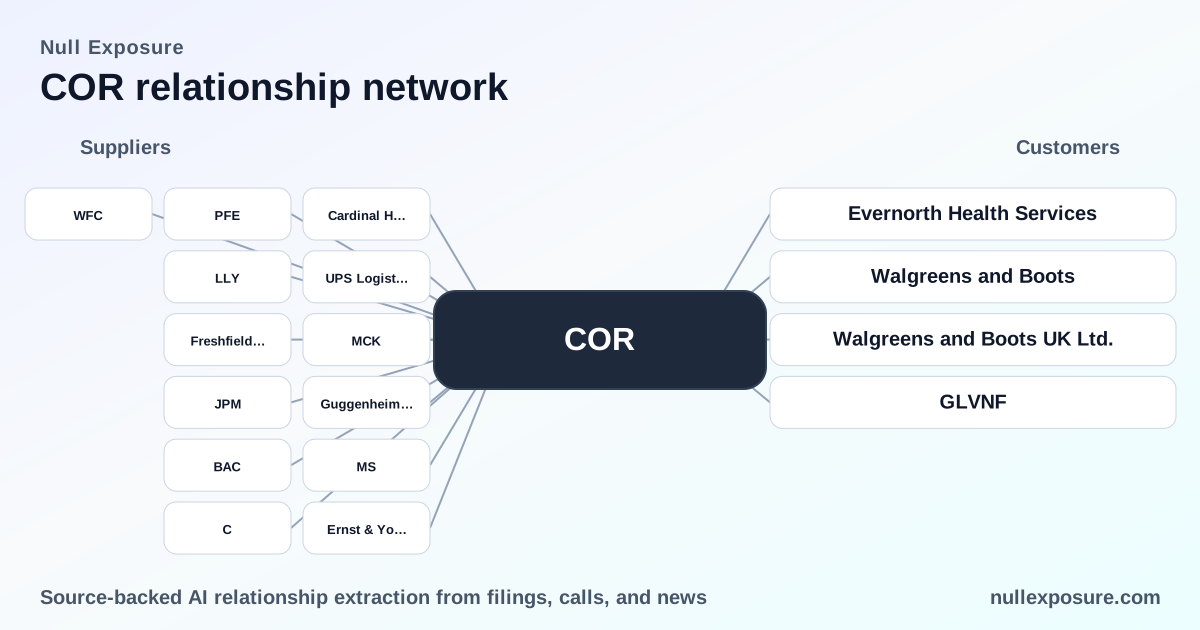
Cencora (COR): Customer Relationships that Underpin a High‑touch Distribution Franchise
Cencora operates as a global pharmaceutical sourcing, distribution and services platform that monetizes through product sales, logistics and commercialization services to healthcare providers, payors and manufacturers. The company generates revenue primarily by selling pharmaceuticals and related products at the point of title transfer, supplemented by logistics, specialty services and commercialization fees across U.S. and select international markets.
For a quick look at the company’s platform and signals used in this note, visit https://nullexposure.com/.
How Cencora’s customer mix drives economics and risk
Cencora is first-and-foremost a distributor and logistics provider: revenue is concentrated in large channel partners and institutional customers, and margins are driven by scale in procurement, contract terms with payors and operational control of cold‑chain and specialty logistics. The company recognizes product revenue at the point title transfers and operates a mix of long‑term strategic contracts and short‑term, annually negotiated arrangements, giving it both durable revenue streams and exposure to renegotiation cycles.
Key operating characteristics to weigh:
- Concentration and criticality: Top customers are highly material—Cencora disclosed that top 10 customers (including governmental agencies and GPOs) represented ~66% of revenue in FY2025, a signal of customer concentration with accompanying counterparty risk.
- Contract maturity mix: The firm holds long‑term agreements (some with stated terms to 2029, and an international distribution agreement with Boots to 2031) alongside numerous short‑term contracts such as GPO arrangements that typically expire annually.
- Role and bargaining posture: Cencora functions primarily as a seller/distributor and logistics provider, often the primary supplier to healthcare provider customers, which supports pricing power in some channels but creates dependency on a small number of large buyers.
- Global footprint with regional specialization: The business serves the U.S. and select global markets, with a dedicated International (EMEA‑focused) segment—this diversifies geography while adding regulatory and customer complexity.
These operating dynamics create durable cash flows from large partners but also expose the company to customer concentration and contract renewal risk, especially where short‑term agreements dominate purchasing channels.
Snapshot: each reported customer relationship
Evernorth Health Services
Evernorth accounted for approximately 13% of Cencora’s revenue in FY2025, and its receivable balance represented roughly 5% of accounts receivable as of September 30, 2025. According to Cencora’s FY2025 Form 10‑K, Evernorth is a material commercial customer in the company’s revenue mix. (Cencora 2025 Form 10‑K)
Walgreens and Boots (combined)
Walgreens and Boots together were approximately 25% of Cencora’s revenue in FY2025 and, together with Evernorth, represented about 38% of trade receivables as of the FY2025 year end—underscoring significant revenue concentration tied to retail pharmacy channels. This is disclosed in the FY2025 Form 10‑K. (Cencora 2025 Form 10‑K)
Walgreens and Boots UK Ltd.
Cencora highlights strategic, long‑term relationships with Walgreens and Boots UK Ltd., including risks tied to the pharmaceutical distribution agreement and a global generic purchasing services arrangement; the company also discloses an international distribution agreement that supplies Boots through 2031. These terms reflect formal multi‑year commitments on the Boots relationship. (Cencora 2025 Form 10‑K)
Before you dive deeper: learn how these relationship signals are extracted at scale at https://nullexposure.com/.
Jazz Pharmaceuticals (JAZZ)
Jazz Pharmaceuticals notes that several oncology and specialty products are sold through specialty distributors including Cencora, confirming Cencora’s role as a distribution channel for manufacturer shipments. Jazz’s FY2024 10‑K lists Cencora among the specialty distributors for specific branded therapies. (Jazz Pharmaceuticals FY2024 10‑K)
Gallant (ticker GLVNF)
Multiple March 2026 news reports describe a fulfillment agreement between Gallant—a veterinary biotech—and MWI Animal Health, part of Cencora, to build an ultra‑low temperature cold chain for veterinary stem cell therapy distribution pending regulatory approval. The press coverage underscores Cencora’s expanding role in specialized cold‑chain fulfillment. (Simply Wall St. news coverage, March 2026)
GLVNF (duplicate news listing)
The same March 2026 coverage is logged under the GLVNF ticker name in news feeds, reiterating that MWI/Cencora’s fulfillment services are being used by Gallant to support nationwide veterinary cold‑chain distribution. This duplication in news sources reinforces the commercial tie between the parties. (Simply Wall St. news coverage, March 2026)
What this customer map implies for investors
- Revenue durability is strong where long‑term contracts exist, notably with Boots (contracted through 2031) and multi‑year arrangements referenced in the FY2025 filing; these contracts underpin predictable volumes and procurement leverage.
- Concentration risk is material: top customers account for two‑thirds of revenue and a large share of receivables, so adverse pricing, renegotiation or non‑renewal by a major counterparty would materially affect revenue and cash flow.
- Contract mix creates volatility vectors: short‑term GPO and governmental contracts can be re‑bid annually, which keeps pricing pressure and renewal risk elevated even as strategic, multi‑year commercial agreements provide balance.
- Value capture beyond distribution: Cencora’s investments in specialty logistics and cold‑chain (illustrated by the Gallant/MWI engagement) expand higher‑margin services and create stickiness with biotech and specialty manufacturers.
- Operational risk signal: the company experienced a contract termination in FY2025 (a sales contract with an oncology customer was terminated following a notice of non‑renewal), indicating that losing a customer is an active operational risk rather than a theoretical one. (Cencora 2025 Form 10‑K)
Bottom line for research and operations teams
Cencora’s customer relationships combine large, material retail and provider partners with a growing set of specialized services that enhance margins and stickiness. The balance of long‑term strategic agreements (including Boots to 2031) and short‑term, annually negotiated contracts creates a hybrid risk profile: predictable core flows but meaningful exposure to a small number of counterparties and to contract renewal cycles.
For a structured view of these and other relationship signals, including contract tenor and concentration indicators, explore the platform at https://nullexposure.com/.
Bold takeaway: Cencora’s market position is anchored by scale and deep distributor relationships, but investor returns depend on managing customer concentration and converting distribution relationships into higher‑margin services over time.