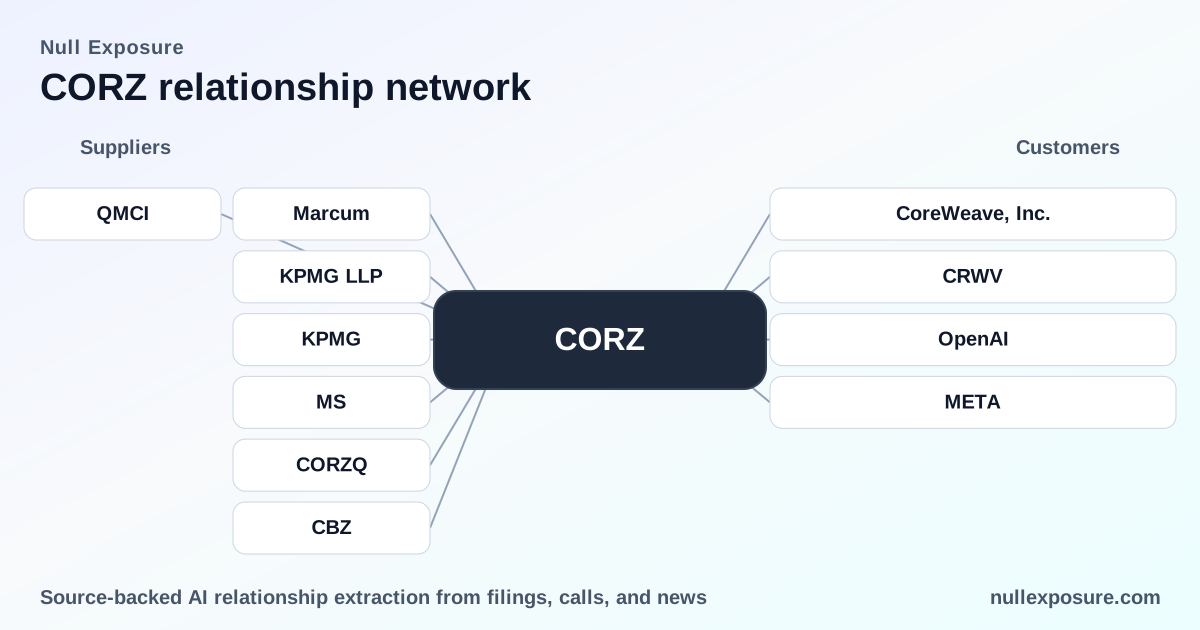
Core Scientific (CORZ): Customer Map, Concentration Risks, and Why CoreWeave Dominates the Narrative
Core Scientific operates and monetizes as a high-capacity digital infrastructure company: it generates cash from three businesses — self-mining of Bitcoin, hosted mining services, and HPC (GPU) colocation and licensing — by selling a mix of fixed-capacity leases and consumption-based hosting to large, hyperscale customers. The company is executing a strategic pivot away from pure bitcoin-mining economics toward high-performance computing leases, funding aggressive capex to convert power and real estate into contracted HPC capacity. For an investor or operator evaluating customer relationships, the single most material fact is the CoreWeave relationship, which both funds and concentrates the HPC growth story. For a detailed research toolkit, visit https://nullexposure.com/.
The investment thesis in one paragraph
Core Scientific is a capital-intensive infrastructure operator monetizing installed power and facilities through multi-year licensing and variable consumption contracts, with a near-term revenue profile driven by bitcoin mining and a strategic re-rating conditional on converting deployed power into recurring HPC hosting revenue. Execution risk is concentrated around a small number of hyperscale customers and large reimbursable capex commitments, while the upside is a structural exposure to secular demand for AI compute if leases scale beyond the anchor customers.
What actually drives revenue — and the operating constraints that matter
Core Scientific’s commercial model mixes contract types and counterparty profiles in ways that shape both upside and risk:
- Contracting posture is mixed. The company reports both short-term renewable arrangements and longer form hosting and licensing agreements that typically run more than a year; operationally this creates a patchwork of recurring but variably predictable revenue streams. (Company disclosures on contract terms, FY2024–FY2025.)
- Billing mixes fixed capacity and usage-based charges. HPC and hosted-mining revenue include fixed capacity fees plus variable consumption-based charges that are recognized as customers consume power. This yields revenue that scales with utilization but introduces monthly variability. (Revenue recognition disclosures, FY2024–FY2025.)
- Target customers are hyperscalers and very large enterprises. The firm explicitly positions its sales toward cloud hyperscalers and large enterprises that require multi-megawatt deployments, concentrating counterparty risk at the high end of the market. (Corporate strategy excerpts.)
- Geography is concentrated in the United States. All revenue historically has been U.S.-based, and the conversion of multiple U.S. data centers to HPC drives the capex profile and regulatory/operational footprint. (Geography disclosures.)
- Capital and spend are material and reimbursable. The company disclosed more than $1 billion in committed conversion capex, with roughly $899 million contractually reimbursable by customers — a capital intensity profile that amplifies both dependence on counterparties and the importance of execution. (Capex commitment disclosures.)
- Segment mix is shifting. While self-mining historically dominated revenue, the company is accelerating HPC hosting; this creates a transitional earnings profile with higher fixed costs and ramp/capacity risk. (Segment disclosures.)
These constraints explain why execution against a small number of large HPC contracts — and the company’s ability to turn deployed power into contracted revenue — is the primary determinant of valuation upside or downside. If you want an investor-oriented primer on contract concentration and capex exposure, see https://nullexposure.com/.
Customer relationships: the full roster and why each matters
CoreWeave (CRWV / CoreWeave, Inc.)
CoreWeave is the anchor HPC customer: Core Scientific disclosed major capex where large portions were funded by CoreWeave under colocation agreements (e.g., $196.4m of $244.5m capex in one quarter and $226.2m of $279.2m in a later quarter). The HPC relationship is material and operationally critical — CoreWeave currently accounts for 100% of the company’s HPC hosting segment revenue and underpins a 590 MW commitment that drives much of the firm’s build-out. (Core Scientific press releases FY2025–FY2026; Q4 FY2025 earnings call; company disclosures and media coverage, 2025–2026.)
CRWV (ticker variant reporting and media)
Multiple media outlets use the CRWV ticker when discussing CoreWeave-related coverage; analysts and press frequently treat CoreWeave/CRWV as the same counterparty because the CoreWeave lease and purchase dynamics dominate investor discussion. Citations in analyst notes and news articles highlight CoreWeave’s role in both upside (pipeline visibility) and downside (execution risk). (CNBC, SimplyWallSt, analyst notes, FY2025–FY2026.)
OpenAI
OpenAI shows up in the coverage as a hyperscaler contracting with CoreWeave — media reports cited CoreWeave’s expanded contracts with OpenAI as part of the broader AI hosting market narrative; construction and timing of Core Scientific’s build-outs were discussed in relation to these hyperscaler commitments. This places Core Scientific in the delivery chain for workloads sourced by leading AI buyers. (CNBC coverage of CoreWeave’s deals, FY2025.)
Meta (META)
Press reporting referenced CoreWeave’s large infrastructure engagements that include a reported $14.2 billion infrastructure agreement with Meta, cited to illustrate the scale of demand CoreWeave chases and the potential size of workloads that flow through Core Scientific’s facilities when CoreWeave is the tenant. (CNBC, FY2025.)
Cadillac Formula 1 Team
Core Scientific announced a commercial partnership naming the company the Official Data Center Partner for the Cadillac Formula 1 Team, supporting simulation, engineering, and manufacturing workloads at the team’s Indianapolis HQ and international operations; this is a brand and capability signal rather than a material revenue stream. (Company partnership announcement reported March 2026 via SimplyWallSt and related outlets.)
AULT-P-D (Ault Alliance / Sentinum)
Ault Alliance’s Sentinum subsidiary reported Bitcoin mined using miners hosted at Core Scientific facilities across multiple press releases, illustrating Core Scientific’s hosted-mining customer role and the continuing business in third-party hosted mining even as the company expands HPC. These disclosures show recurring hosted-mining activity but at a smaller scale relative to the CoreWeave HPC relationship. (Ault Alliance / Sentinum press releases, 2023–2024.)
OAK-P-A (Oaktree Capital Management LP)
Oaktree Capital reported an SEC 13F purchase of 1.95 million CORZ shares, indicating institutional investor positioning and an ownership relationship rather than a commercial customer linkage; this is relevant to shareholder base composition and potential activism or strategic backing. (SEC 13F filing reported via QuiverQuant, FY2026.)
Key implications for investors and operators
- Concentration is the central risk: CoreWeave’s role as the single material HPC customer creates outsized execution exposure; any delay, capex dispute, or contractual shift with that partner will quickly affect revenue and liquidity. (CoreWeave contractual disclosures; company criticality note.)
- Capex funding and reimbursement mechanics are a double-edged sword: Reimbursable capex de-risks build economics if counterparty credit holds, but it simultaneously binds Core Scientific to execution schedules and customer funding commitments. (Capex commitment disclosures.)
- Revenue is predictable only to the extent leases are converted and utilization stabilizes: Usage-based billing generates upside with scale but produces near-term volatility until long-term contracts and utilization normalize. (Revenue recognition and contract disclosures.)
For analysts building a model, the two variables to stress-test are (1) CoreWeave renewal and expansion assumptions and (2) timing of capex reimbursement/conversion into contracted HPC revenue. If you want a structured mapping of these counterparty dynamics for investment diligence, visit https://nullexposure.com/ for additional research and relationship visualization.