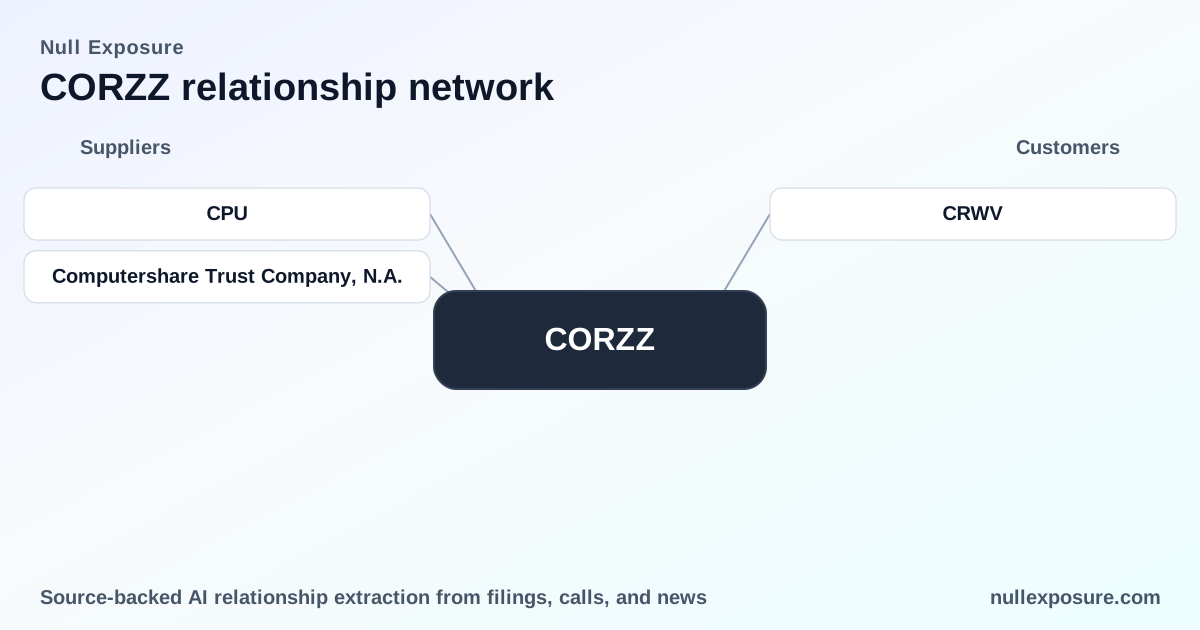
Core Scientific (CORZZ) — Customer Relationships and Strategic Risk Profile
Core Scientific operates and monetizes as a dual business: it runs large-scale digital infrastructure for Bitcoin mining while monetizing excess capacity by hosting and colocation services for HPC and AI customers. The company generates revenue from recurring hosting contracts (both usage-based and licensed), long-term infrastructure commitments and reimbursable capital projects tied to hyperscalers. For investors evaluating customer risk, the defining facts are high counterparty concentration, a capital-intensive convert-to-HPC strategy, and a mix of usage and long-duration contracts that create both predictable cash flow and single-counterparty exposure. For a concise view of Core Scientific’s broader research coverage, visit https://nullexposure.com/.
Executive summary: how the customer model drives value
Core Scientific’s operating model converts power and real estate into recurring hosting revenue and proprietary Bitcoin mining revenue. The company sells:
- HPC Hosting: colocation and GPU-based compute services to hyperscalers.
- Digital Asset Hosted Mining: consumption-based hosting for third‑party miners.
- Self-mining: running its own fleet of miners for in‑house Bitcoin production.
This hybrid structure delivers a blend of recurring, usage-linked cash flows and exposure to Bitcoin economics; the trade-off is material customer concentration and large, reimbursable capital commitments tied to third‑party deployments.
The relationships tracked in public filings and media
Below are every relationship entry identified in the record set. Each item is a plain-English summary followed by a concise source citation.
-
CoreWeave — earnings call mention (2025 Q4)
Core Scientific reported breaking ground on five AI factories as part of a 590‑megawatt commitment to CoreWeave, signaling active deployment of infrastructure dedicated to a single hyperscaler. According to the company’s 2025 Q4 earnings call transcript (file: corzz-2025q4-earnings-call, first seen March 7, 2026), the buildout is underway and connected to CoreWeave demand. -
CRWV (ticker synonym for CoreWeave) — earnings call duplicate (2025 Q4)
The transcript also lists the same CoreWeave commitment using the CRWV identifier, confirming the company’s public emphasis on that customer relationship in its Q4 remarks. This second record mirrors the March 2026 earnings call entry and reinforces the centrality of the CoreWeave engagement. -
CoreWeave — news report on expanded hosting agreement (FY2024 disclosure)
A news report summarized that Core Scientific expanded its hosting agreement with CoreWeave, expected to generate an additional $1.225 billion in cumulative revenue, underscoring the financial scale of the customer relationship. Investing.com covered the announcement in May 2026, reporting on the exercisability of warrants and the CoreWeave hosting extension (Investing.com news, May 2, 2026).
What the contractual and company-level constraints tell investors
Core Scientific’s public disclosures present multiple signals about how these customer relationships are structured and the implications for investors.
-
Contracting posture mixes long-term commitments and consumption models. The company explicitly reports both long-term hosting contracts (multiple years) and consumption-based hosted mining contracts that are recurring, indicating revenue diversity across fixed-term and variable usage billing. These are company-level attributes drawn from its segment disclosures.
-
Concentration is severe and operationally critical. Management states that CoreWeave accounts for 100% of the HPC Hosting segment revenue, and that historically a single customer accounted for ~80% of total revenue in recent years; this elevates single-counterparty risk from commercial, operational and financial perspectives. The materiality constraint naming CoreWeave is explicit in the filings.
-
Customer-driven capital intensity and reimbursable CAPEX. Core Scientific disclosed ~$1.14 billion of contractual CAPEX commitments, with roughly $899.3 million reimbursable by customers under agreements, signaling a business model where customers underwrite a large share of conversion cost to HPC — but also locking Core Scientific into execution risk and timing on reimbursement.
-
Geographic concentration in the United States supports execution but limits diversification. All revenue for the recent fiscal years was generated in the U.S., and conversions are focused across ten domestic data centers, which simplifies regulatory and operational oversight but concentrates geopolitical and power‑market exposure.
-
Counterparty profile skews to hyperscalers and very large enterprises. The company targets hyperscale cloud providers (explicitly named in its strategy), positioning Core Scientific as a strategic supplier but also increasing the bargaining power of a few very large customers.
How the CoreWeave relationship reshapes valuation and risk
CoreWeave is not a marginal customer — it is the fractal center of Core Scientific’s HPC pivot. The relationship exhibits three investor-relevant characteristics:
-
Revenue and operational dependency: CoreWeave represents 100% of the HPC Hosting revenue, making the HPC segment non‑diversified until additional large customers are onboarded. (Company filing disclosures, FY2024–FY2025.)
-
Ramping deployment with milestone CAPEX: The sequential announcements in May–October 2024 and the March 2026 earnings detail show staged option exercises and capacity adds (200 MW initially, followed by additional exercised options), indicating phased revenue recognition tied to physical build milestones. (Company filings and Q4 2025 earnings call.)
-
Large contractual economics: Public reporting and press coverage reference a cumulative revenue expectation north of $1.2 billion tied to expanded hosting agreements, underscoring the potential upside but also the concentration of downside if CoreWeave changes course. (Investing.com coverage, May 2026.)
Practical implications for investors and operators
-
Upside: If CoreWeave executes and demand for AI/HPC capacity remains robust, Core Scientific will convert its CAPEX commitments into sizeable, recurring hosting revenue that offsets mining volatility. Reimbursable CAPEX materially de‑risks capital deployment when contracts perform.
-
Downside: The company is exposed to single-counterparty performance risk, large execution risk on complex data center conversions, and U.S. power‑market dynamics. A withdrawal or renegotiation by its principal HPC customer would materially impair segment revenue and cash flow.
-
Operational posture: The firm exhibits a mixed contract posture — long-term contracts for HPC coupled with usage-based hosted mining agreements — which supports cash flow predictability in one leg while leaving variability in the other.
For deeper company-level tracking and to monitor customer concentration trends in real time, visit https://nullexposure.com/ for continuous coverage and relationship analytics.
Bottom line: concentrated opportunity, concentrated risk
Core Scientific’s strategy to pivot sizeable data‑center capacity to HPC and to monetize that pivot through a major hyperscaler relationship is capital‑intensive and reward‑asymmetric: successful execution against CoreWeave commitments transforms revenue mix and reduces mining cyclicality, but failure or churn at the single largest customer would sharply impair the company’s financial profile. Investors should value Core Scientific with a binary awareness of CoreWeave execution milestones and the company’s reimbursable CAPEX schedule.