Cosmos Health (COSM): Customer Relationships That Drive a Distributed Pharma Play
Cosmos Health operates as a vertically integrated pharmaceutical and consumer-health manufacturer that sells finished goods through a mix of direct sales, contract manufacturing, and exclusive distributor agreements; it monetizes by manufacturing proprietary and third‑party branded pharmaceuticals and health products, selling them to retail chains, national distributors, and regional resellers across EMEA and growing into North America. Revenue streams combine spot invoice sales for finished goods with longer-term manufacturing and exclusive distribution contracts, giving the company both transactional revenue and multi-year order visibility. Learn more about how we map counterparty concentration and commercial risk at the firm level at https://nullexposure.com/.
What investors should watch in Cosmos’ customer footprint
Cosmos is executing a two-pronged commercial strategy: build retail presence for branded consumer SKUs (for example C‑Scrub and Sky Premium Life) while scaling contract-manufacturing and exclusive distribution relationships for prescription and OTC pharmaceuticals. This hybrid model reduces single-customer concentration but increases operational dependence on EMEA distribution channels and a small set of strategic distributors.
Key operating signals from company filings and press coverage:
- Revenue recognition combines single‑point (spot) sales and revenue recognized over production/packaging periods, reflecting both transactional shipments and paced contract manufacturing (10‑K disclosures).
- The company reports no customers >10% of revenue in FY2023–24, signaling current customer-level immateriality but not eliminating revenue concentration risk if a distributor wins large orders (10‑K).
- Core geography is EMEA (Greece, UK distribution centers), with explicit expansion plans for North America and the UAE (10‑K and FY2025 releases).
The counterparty roster — who Cosmos is selling to and how it matters
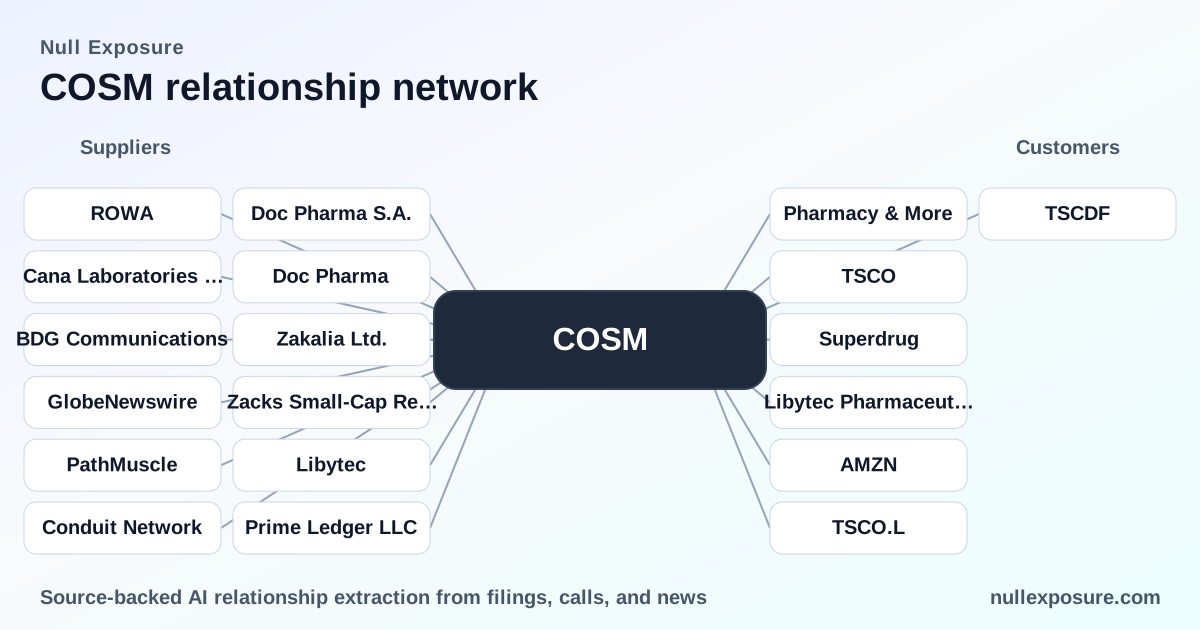
Below are every counterpart referenced in public filings and press coverage; each entry is a concise commercial summary and a source reference.
Pharmacy & More
Cosmos reported net sales to Pharmacy & More of $414,443 in FY2024, down from $480,029 in FY2023 — a small, disclosed retail customer relationship recorded in the FY2024 10‑K. (Cosmos 10‑K, FY2024)
Superdrug
C‑Scrub Wash Chlorhexidine 4% was placed into Superdrug as part of Cosmos’ UK retail rollout, providing national high‑street distribution for the consumer antiseptic product. (Press coverage: Finviz / StockTitan, Feb–Mar 2026)
Tesco (listed under TSCO / TSCO.L / TSCDF in various feeds)
Tesco, the UK’s largest retailer, accepted C‑Scrub into its store network, a strategic retail validation that materially increases shelf reach and consumer visibility compared with Amazon‑only distribution. Multiple March 2026 press items and company releases cite Tesco placement (Bitget, Finviz, GlobeNewswire, StockTitan, Mar 2026).
Libytec Pharmaceutical S.A.
Cana Laboratories, a Cosmos subsidiary, executed a manufacturing and supply agreement to produce PathMuscle for Libytec, with five‑year volumes expected to exceed 1.2 million units — an example of Cosmos’ contract manufacturing expansion. (GlobeNewswire and Yahoo Finance press releases, Jan–Mar 2026)
Pharmex
Cosmos signed a five‑year contract manufacturing agreement with Pharmex for 1.5 million bottles of AMBITASOL antiseptic, giving multi‑year volume visibility for a finished consumer antiseptic SKU. (FY2025 results press release, AccessNewsWire, May 2026)
Provident Pharmaceuticals
Cosmos secured a 10‑year contract manufacturing agreement with Provident Pharmaceuticals for a total of 8 million packs, underscoring long‑term manufacturing revenue potential from institutional partners. (FY2025 results press release, AccessNewsWire, May 2026)
Scientific Pharmacy
Scientific Pharmacy was signed as the distributor for Sky Premium Life in Oman, accompanied by an initial purchase order of 42,000 units — an example of Cosmos using exclusive local partners to enter GCC markets. (FY2025 results press release, AccessNewsWire, May 2026)
Amazon (AMZN)
Cosmos leverages Amazon for established online sales presence for products including C‑Scrub and consumer nutraceuticals; management cites Amazon as a core e‑commerce channel supporting retail expansion. (Company statements in Bitget / AccessNewsWire, Mar–May 2026)
Pharmalink
Pharmalink is an exclusive UAE distributor for Sky Premium Life and has placed multiple purchase orders — a third order of 60,000 units in early 2026 brought cumulative orders to 270,000 units since mid‑2024 and supports a 5‑year target exceeding 3 million units. (Pharmalink orders reported in Investing.com, GlobeNewswire, May 2026)
Diyar United
Cosmos expanded Sky Premium Life into Kuwait through an exclusive distribution agreement with Diyar United, backed by an initial order exceeding 65,000 units and immediate regional revenue recognition. (FY2025 results press release, AccessNewsWire, May 2026)
Medical Pharmaquality
Cosmos signed a contract manufacturing agreement with Medical Pharmaquality for annual production of 3 million MYCOFAGYL pessaries, showing repeatable CMO revenues in women’s health products. (FY2025 results press release, AccessNewsWire, May 2026)
Pharma Cell
Cosmos launched Sky Premium Life in Albania through partner Pharma Cell, securing an initial $300,000 order and establishing a local route‑to‑market for its nutraceutical brand. (FY2025 results press release, AccessNewsWire, May 2026)
Decahedron
Decahedron is cited as a UK channel through which Cosmos achieved solid sales growth, indicating active third‑party retailers and distributors supporting UK volume. (FY2025 results press release, AccessNewsWire, May 2026)
What the constraints reveal about the operating model
The company‑level constraints extracted from filings and releases show a mixed contracting posture and regional concentration:
- Contract mix: Cosmos recognizes revenue both at a point in time (spot sales) and over production/packaging periods (long‑term manufacturing), reflecting simultaneous transactional retail sales and CMO contracts (10‑K disclosures).
- Counterparty profile: Cosmos primarily sells directly to pharmacies and a limited number of large wholesale distributors, which aligns with the company’s stated focus on large enterprise distribution channels across the EU (company filing).
- Geography: EMEA is the primary revenue region, with active UK and Greek operations, but management has publicized expansion plans for the UAE and North America (10‑K and FY2025 releases).
- Materiality: No single customer accounted for ≥10% of revenue in FY2023–24, indicating current immaterial customer concentration at the entity level, though future exclusive distributor wins could change that profile (10‑K).
- Roles: Cosmos operates as seller, reseller, and CMO; the firm explicitly identified Pharmalink as an exclusive distributor for the UAE, confirming distributor role attribution for that relationship (press release).
Investment implications — what this roster means for COSM
- Growth leverage through retail rollouts: Tesco and Superdrug placements materially scale consumer SKU distribution and provide near‑term shelf velocity signals. (Mar 2026 press activity)
- Predictable manufacturing revenue: Multi‑year CMO deals with Provident, Pharmex, and Medical Pharmaquality create anchored revenue streams and improve utilization of production assets. (May 2026 company releases)
- Regional concentration and execution risk: EMEA‑centric operations reduce currency and market diversification; expansion into Gulf states and North America increases addressable market but requires reliable local partners. (10‑K; FY2025 releases)
- Low current customer concentration provides downside protection but exposes operational reliance on distributor execution — if a strategic distributor underperforms, retail expansion speed could slow materially.
For detailed counterparty scoring and bespoke exposure reports for institutional portfolios, visit https://nullexposure.com/ — our methodology maps contract type, counterparty size, and revenue cadence to deliver actionable counterparty risk profiles.
Bold takeaways: Tesco and Superdrug are immediate retail multipliers, Provident/Pharmex/Medical Pharmaquality deliver multi‑year CMO revenue, and Pharmalink demonstrates scalable distributor demand in the UAE. Investors should monitor order cadence from exclusive distributors and execution against five‑year unit targets as leading indicators of sustainable revenue growth.