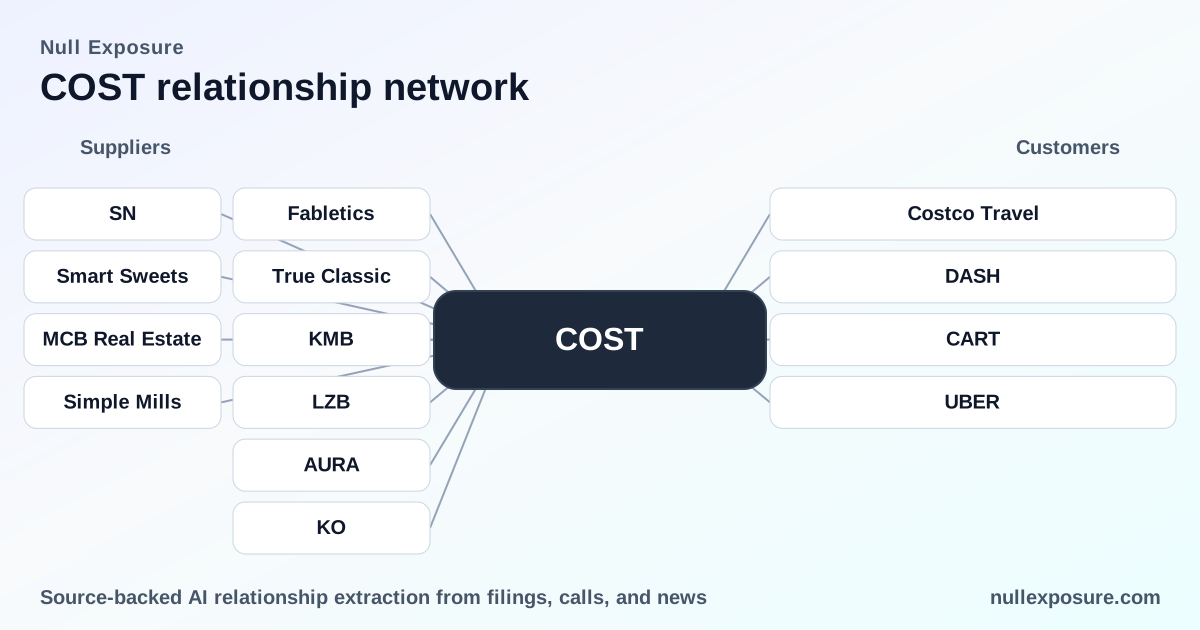
Costco (COST) — customer relationships that drive recurring retail economics
Thesis: Costco operates a membership-first, low-margin/high-velocity retail model that monetizes primarily through annual membership fees and high-volume merchandise sales across physical warehouses and e-commerce channels; its customer relationships combine broad individual membership scale with a growing network of third‑party delivery and promotional partners that extend reach and convenience while preserving Costco’s pricing discipline. For investors, the earnings-call disclosures and public filings show the company is treating partners like Instacart, Uber Eats and DoorDash as operational extensions of its e-commerce funnel, and arrangements with promotional platforms and financial partners as acquisition and payment levers. For more structured intelligence on these relationships visit https://nullexposure.com/.
Business model in one line: subscription-backed retail volume + partner-enabled convenience = predictable recurring revenue with variable transactional upside.
How Costco’s customer relationships operate in practice
Costco runs a two-tier revenue engine: recurring, deferred membership revenue that smooths cash flow and supports narrow retail margins; and transactional merchandise and services sold through warehouses, online, travel, gift cards and business centers. Management now explicitly measures online-originated sales to include same‑day delivery fulfilled by third parties (Instacart, Uber Eats, DoorDash) and services such as Costco Travel, indicating an integrated channel view that treats partners as part of Costco’s sales fabric. According to the company’s 2025 Q4 earnings call, management consolidated online-originated sales to capture the full scope of member shopping behavior (Costco 2025 Q4 earnings call, March 2026).
Visit https://nullexposure.com/ for a dashboard view of these partner links and disclosure signals.
Company-level operating constraints and what they imply for investors
- Subscription contracting posture: Costco recognizes membership fees on a deferred basis and recognizes them ratably over the one‑year membership period, which produces reliable recurring revenue that underpins capital allocation and dividend policy. This is a structural advantage for cash flow stability (Costco 10‑K disclosures).
- Counterparty mix concentrated among individuals: Membership products (Gold Star, Executive) are structured for individuals and small businesses; the company signals a deliberate focus on individual membership penetration as its primary revenue base rather than enterprise accounts.
- Global footprint and channel maturity: Costco operates warehouses across North America, APAC and EMEA, which positions retail scale and supply-chain sophistication as mature company attributes rather than experimental growth bets.
- Seller posture with buyer behavior overlay: Costco is principally a seller of nationally branded and private‑label goods; the company also functions as a buyer in certain wholesale and procurement contexts through its international subsidiaries—an operational duality that influences bargaining power and margin dynamics.
- Segment diversification beyond merchandise: Management categorizes “Other Businesses” to include e-commerce, business centers and travel—signals that Costco views these as strategic revenue adjuncts rather than incidental lines.
Taken together, these signals create a profile of low churn, high predictability in membership revenue, and evolving but measurable dependency on third‑party delivery and promotional partners to convert transactional growth.
Every disclosed customer/partner mention — what it means for COST investors
Costco Travel
Costco explicitly includes Costco Travel in the company’s measurement of online‑originated sales, demonstrating Travel’s integration with e-commerce reporting and its role in non‑merchandise revenue capture. Source: 2025 Q4 earnings call (March 2026).
CART (Instacart referenced as CART)
Costco introduced a $10 monthly credit on Instacart purchases above $150 for executive members and referenced early executive-member hours tied to partner promotions, signaling direct member incentives routed through Instacart to shift incremental spend to same‑day delivery. Source: 2025 Q4 earnings call (March 2026).
Uber Eats
Management listed Uber Eats among same‑day delivery partners included in online-originated sales, indicating Costco treats Uber Eats as a fulfillment channel for convenience-focused members. Source: 2025 Q4 earnings call (March 2026).
DoorDash
Costco cited DoorDash both as a fulfillment partner for same‑day service and as one of the drivers behind gift‑card strength, underscoring DoorDash’s dual role in fulfillment and demand generation. Source: 2025 Q4 earnings call (March 2026).
Instacart
Instacart was singled out again in the discussion of member incentives (the $10 credit) and as a same‑day delivery fulfillment partner, confirming a formal commercial linkage to Costco’s online conversion strategy. Source: 2025 Q4 earnings call (March 2026).
UBER (ticker UBER)
Uber is referenced interchangeably with Uber Eats in the earnings call as part of same‑day delivery fulfillment included in Costco’s online sales metrics, reinforcing the platform’s operational importance. Source: 2025 Q4 earnings call (March 2026).
DASH (ticker DASH)
DoorDash (DASH) appears under gift‑card commentary and same‑day fulfillment, suggesting promotional and transactional overlap that benefits Costco’s digital sales aggregate. Source: 2025 Q4 earnings call (March 2026).
GRPN (Groupon)
A news report documented a Groupon promotion that offered discounted Costco memberships plus a promo code for online purchases, illustrating third‑party promotional channels used to acquire members and drive incremental e-commerce activity. Source: AOL coverage of the Groupon promotion (FY2025 reporting).
CM (Canadian Imperial Bank of Commerce)
A Quartr event note highlighted partnerships between retail banks and brands like Costco to acquire digitally engaged, affluent customers through co‑branded or strategic card relationships—implying Costco’s payment and wallet strategy supports card-linked acquisition and retention. Source: Quartr / RBC Capital Markets event note (FY2026).
ALX (real estate anchor relationship)
ALX’s 2025 10‑K references a shopping center anchored by a 145,000 square foot Costco, showing Costco’s role as a retail anchor for real estate landlords and the company’s downstream impact on property economics and neighborhood commerce. Source: ALX 2025 10‑K.
Strategic implications and risk considerations for investors
- Revenue resilience from memberships is explicit and measurable. The deferred, ratable recognition of membership fees creates a predictable revenue base that cushions merchandise margin volatility.
- Third‑party delivery partners are now operationally relevant. Management’s decision to fold Instacart, Uber Eats and DoorDash into online-originated sales metrics makes these partners material to e-commerce growth and therefore to any thesis that relies on accelerating digital sales.
- Promotional and payment partnerships expand acquisition channels but dilute control. Groupon-style promotions and bank partnership strategies can accelerate membership growth, but they also introduce cost (promotional credits, partner economics) and potential margin dilution.
- Concentration is not a numeric problem but a strategic posture. The company’s focus on individual members and physical warehouse economics implies lower revenue concentration by big enterprise customers but higher sensitivity to consumer retention and membership value perception.
Bottom line
Costco’s customer relationships are a deliberate mix of subscription revenue stability and partner-enabled transactional reach. For investors, the critical reads are not only membership metrics but how Costco integrates delivery, promotional and payment partners into its measured sales funnel—because those partners now materially affect digital sales and member experience. For a concentrated review of partner-level disclosures and to monitor how these relationships evolve in subsequent filings and calls, see https://nullexposure.com/.