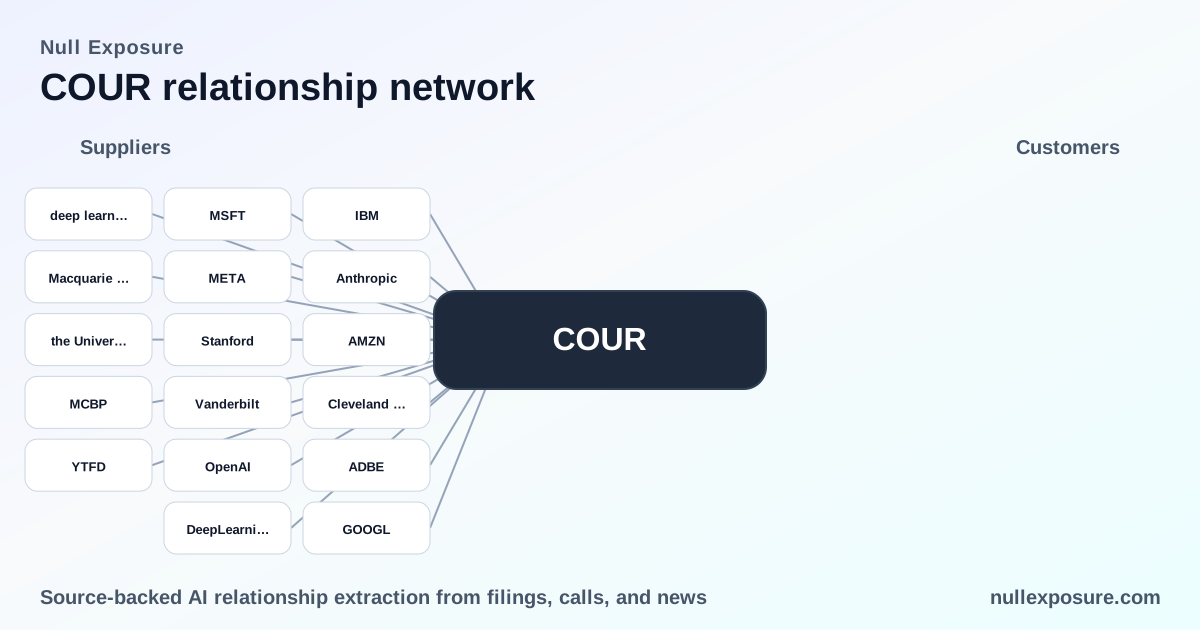
Coursera (COUR) — Customer Relationships and What They Mean for Investors
Coursera monetizes a two-sided online learning marketplace through subscription licenses sold to individuals, enterprises, governments and academic institutions, supplemented by professional certificates and degree partnerships with universities. Revenue is driven by recurring enterprise and consumer subscriptions, plus fee-based credential programs; the company operates as both a service provider (platform and content delivery) and a buyer of partner-authored courses and credentials. For investors, the core investment thesis is simple: growth and margin expansion depend on enterprise penetration, platform integrations that embed learning into workflows, and global scale in recurring subscription revenue. For more corporate and relationship-level due diligence, visit https://nullexposure.com/.
How Coursera’s customer model translates into cash flow
Coursera’s reported trailing twelve‑month revenue of $773.9 million and gross profit of $424.1 million reflect a business built on recurring subscriptions. The company recognizes revenue for access to learning content and related services, which creates predictable cadence but also exposes the business to renewal and retention dynamics. Enterprise contracts range from one to three years, while consumer subscriptions run as short as 30 days — a dual contracting posture that balances committed revenue from large customers with high-volume, shorter-term consumer flows.
Key financial context:
- Market cap roughly $987 million, with negative operating margins and EPS reflecting reinvestment and scale efforts.
- Price-to-Sales ~1.28 and forward P/E ~14.6 on consensus expectations indicate investor sensitivity to margin improvement and enterprise retention metrics.
Microsoft: embedding learning inside daily work
Coursera has an active commercial relationship with Microsoft that goes beyond a simple reseller or customer interaction: Coursera introduced a learning agent within Microsoft 365 Copilot that embeds Coursera training content directly into workplace tools, making learning part of daily workflows and increasing content stickiness. This product-level integration strengthens enterprise distribution and boosts the value proposition for corporate customers who want training surfaced inside productivity applications. (TradingView, May 2, 2026 — https://www.tradingview.com/news/stockstory:bf321eee5094b:0-why-coursera-cour-stock-is-trading-up-today/)
What the Microsoft collaboration implies for Coursera’s customer strategy
- Strategic distribution: Embedding learning inside Microsoft 365 materially increases the likelihood that enterprise customers will adopt Coursera as the default training layer inside ubiquitous productivity software, enhancing ARR predictability and upsell opportunity.
- Product stickiness: Learning surfaced inside workflows reduces friction for end users, improving engagement metrics that translate into lower churn for enterprise subscriptions.
- Channel and brand validation: Microsoft’s partnership functions both as a distribution channel and as a quality signal for other large enterprise prospects.
All customer relationships found in public reporting
- Microsoft — Coursera’s learning agent was integrated into Microsoft 365 Copilot so users can access training content inside workplace tools, embedding learning into everyday workflows. Source: TradingView news report, May 2, 2026 (https://www.tradingview.com/news/stockstory:bf321eee5094b:0-why-coursera-cour-stock-is-trading-up-today/).
(This list reflects all customer relationship mentions surfaced in the examined results.)
Company‑level signals from reported relationship constraints
The filings and constraint excerpts provide a compact picture of how Coursera contracts and operates with customers. These are company‑level signals that shape revenue durability and go‑to‑market risk.
- Contracting posture: Coursera sells subscription licenses to consumers and enterprises, with consumer terms as short as 30 days and enterprise terms commonly one to three years, implying a mixed model of committed and flexible revenue.
- Customer mix and concentration: The company reports more than 1,600 paid enterprise customers purchased through direct sales, signaling significant enterprise scale and concentrated revenue potential among large accounts.
- Counterparty diversity: Public excerpts list customers across individuals, small teams/small businesses, large and very large enterprises, governments, and educational institutions, indicating a diversified buyer base that reduces single-segment dependency.
- Global footprint: Regional figures cited in filings include Asia Pacific ~89,666, EMEA ~166,328, and United States ~$368,540 (excerpted figures reported in company materials), demonstrating meaningful international scale and a revenue/user mix that spans NA, EMEA, and APAC.
- Role and stage: Coursera operates as both service provider (platform/content delivery) and buyer (in the sense it procures and aggregates third‑party content), and the company counts active paid enterprise customers at period end — a maturity signal for a subscription services business.
- Segment focus: The relationships and revenue recognition language emphasize services (access to hosted learning content and related services) rather than physical goods or one‑off transactions.
Together, these signals define Coursera as a subscription-centric, enterprise‑anchored SaaS‑like services business with broad end‑market exposure and rising channel integrations that increase distribution reach.
Risk and upside through the lens of customers
- Upside: Enterprise integrations like Microsoft 365 Copilot increase distribution and engagement, creating a path to higher ARPU and lower churn. Global enterprise scale and a diversified counterparty base support growth and resilience.
- Risk: The model is sensitive to renewal dynamics in large enterprise contracts and to competition for enterprise learning budgets; short consumer subscription terms keep consumer churn a persistent margin pressure. Concentration in a finite set of large enterprise clients creates revenue volatility if a major account reduces spend.
Investment takeaway and next steps
Coursera is a recurring‑revenue learning platform positioned to monetize embedded workplace learning via enterprise subscriptions and credential programs. The Microsoft integration exemplifies the company’s strategy: make learning ubiquitous inside the tools employees already use and convert that ubiquity into durable enterprise contracts. For research teams and investors focused on customer durability, the two levers to watch are enterprise renewal rates/ARR growth and engagement uplift from platform integrations. For additional analysis and relationship‑level diligence, see https://nullexposure.com/.
Bold execution on enterprise distribution and retention will determine whether Coursera can convert its current scale into a reliably profitable subscription business.