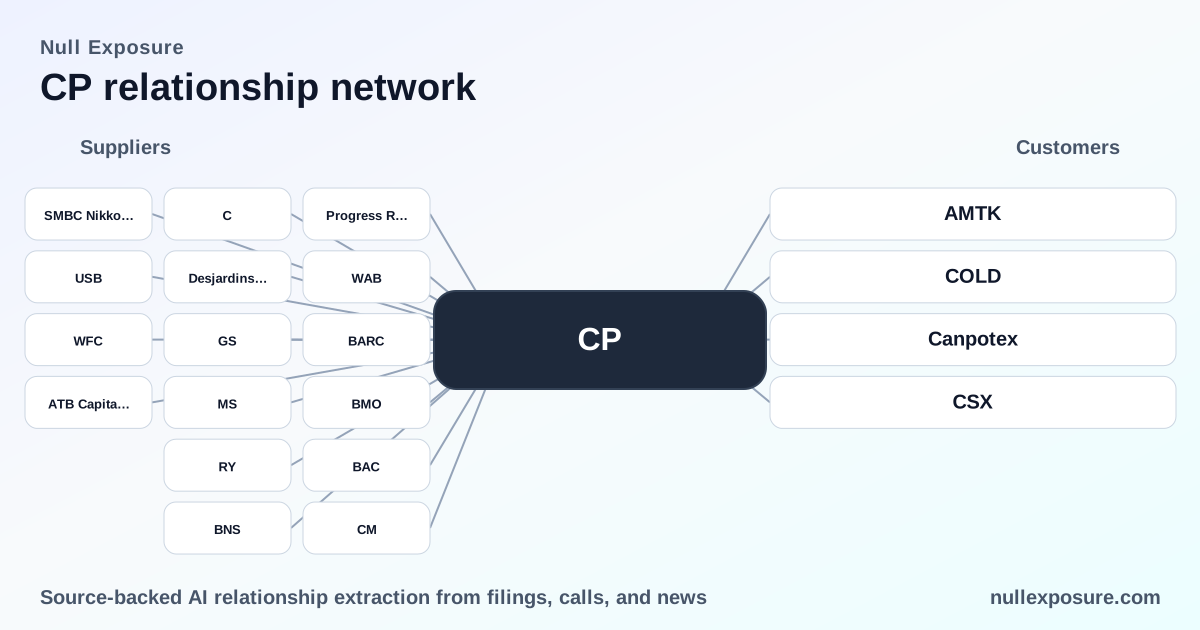
How CP Monetizes a North American Rail Monopoly: freight, contracts, and embedded service relationships
Canadian Pacific Kansas City Limited (CPKC, ticker CP) operates and monetizes a transcontinental freight railway that spans Canada, the United States, and Mexico, earning revenue primarily through freight haulage, intermodal services and ancillary charges such as fuel surcharges tied to individual shipments. CPKC combines framework master service agreements with usage‑based freight billing, producing a mix of contractual stability and volume sensitivity that drives both predictability and cyclicality in top‑line performance. For further investor context and relationship analytics, visit https://nullexposure.com/.
What the customer list actually shows — a compact roll call
Below are the customer and partner relationships identified in recent coverage and transcripts. Each entry is a plain‑English takeaway with a concise source note.
AMTK / Amtrak (two mentions in results)
CPKC highlights its relationship with Amtrak by noting it has earned Amtrak’s Best Carrier designation for 10 consecutive years, which the company frames as a reputational and operational win tied to on‑time performance and service reliability. According to an earnings‑call transcript republished March 9, 2026, management explicitly cited Amtrak’s recognition as evidence of the firm’s service quality. (InsiderMonkey, Q4 2025 earnings call transcript, published 2026‑03‑09.)
SND — Smart Sand
Smart Sand completed a rail expansion at its Oakdale, Wisconsin frac‑sand facility that created optionality to ship unit trains on both Union Pacific and Canadian Pacific, indicating Smart Sand uses CP as a material freight channel for sand shipments. RT&S reported the expansion and CP’s role in providing shipping optionality in March 2017 (article republished/flagged in the dataset on 2026‑03‑10). (RT&S, “Smart Sand completes rail expansion,” originally FY2017; referenced 2026‑03‑10.)
NSC — Norfolk Southern
News coverage indicates Norfolk Southern agreed to purchase CP’s subsidiary Delaware & Hudson Railway Co. to increase NS’s Northeastern reach, a transaction that alters regional network economics and competitive access for CP. TruckingInfo reported the acquisition and its strategic geography impact on March 10, 2026. (TruckingInfo, March 10, 2026.)
Canpotex
CPKC management flagged Canpotex as fully committed through Q1, identifying potash as a steady contributor to base volumes — an explicit signal that agricultural commodities and potash customers are an anchor freight sector for the company. This was stated on the company’s Q4 2025 earnings call transcript. (InsiderMonkey, Q4 2025 earnings call transcript, published 2026‑03‑09.)
COLD / Americold (two mentions in results)
Management described the new Americold business as gaining traction with good visibility for a strong ramp‑up through 2026, signaling growth in refrigerated/intermodal freight after the Americold-related transaction. The remark comes from the Q4 2025 earnings call and underscores cold‑chain expansion as a strategic volume driver. (InsiderMonkey, Q4 2025 earnings call transcript, published 2026‑03‑09.)
CSX
CPKC is partnering with CSX to bring its operating model to Mexico and the U.S. Southeast via the Southeast Mexico Express service, highlighting collaborative network plays that extend CP’s market reach through joint service offerings. This partnership was discussed on the Q4 2025 call. (InsiderMonkey, Q4 2025 earnings call transcript, published 2026‑03‑09.)
Operating model constraints and what they imply for investors
The customer‑relationship signals and corporate disclosures produce an integrated picture of how CP’s business is contracted and how revenue behaves:
-
Contracting posture — framework plus usage: CPKC uses master service agreements that set pricing and terms for future freight work while billing is largely usage‑based by shipment, including fuel surcharges tied to diesel indices. That combination delivers contractual continuity but leaves revenue exposed to volume swings and fuel price moves (company filing language cited in disclosures used by management on recent calls).
-
Geographic concentration — North America dominant: All revenues and long‑lived assets are held within Canada, the U.S., and Mexico, making the company both the only transcontinental rail provider across the three countries and heavily exposed to North American industrial and agricultural cycles.
-
Customer concentration — dispersed: For the years ended December 31, 2024, 2023 and 2022, no single customer accounted for more than 10% of revenues, indicating low single‑customer risk and a revenue base diversified across commodity and intermodal customers.
-
Role and criticality — service provider for essential supply chains: CPKC is a service provider delivering rail and intermodal transportation across ~20,000 miles; its network access and partnerships with other railroads and large shippers position it as a critical logistics backbone in NA supply chains.
-
Maturity and contract stability: The presence of master service agreements signals contract maturity and predictable terms, yet the predominance of usage‑based charges (fuel surcharges, per‑shipment billing) ensures revenue elasticity to commodity volumes and economic cycles.
Taken together, these constraints frame CP as a mid‑to‑large cap rail operator with structural advantages in geography and network effects, while retaining cyclical exposure through shipment volumes and fuel flows. Key investor takeaways: stable contract scaffolding, but earnings are levered to freight demand and input costs.
Investment implications and risk priorities
-
Growth vectors: Partnerships (for example with CSX) and the ramp of Americold‑related refrigerated business are credible near‑term volume drivers and margin diversification plays. Look for continued intermodal and cold‑chain expansion as positive catalysts.
-
Earnings sensitivity: Because fuel surcharges and some revenues are usage‑based, revenue and margins will track economic activity and fuel cost dynamics more than fixed recurring fees.
-
Competitive and regulatory dynamics: Asset sales and regional network changes — such as the Norfolk Southern purchase of D&H — can reconfigure access and pricing power in the Northeast, a factor investors should monitor for route density and competitive intensity.
-
Operational reputation: Recognition from partners like Amtrak for service excellence supports premium positioning and provides operating leverage when negotiating traffic rights and joint services.
For a focused deep dive on CP’s customer relationships and how they map to commercial risk, see our company overview and relationship analytics at https://nullexposure.com/.
Final read: priorities for the next 12 months
Investors should track (1) freight volume trends across potash, automotive, intermodal and cold‑chain segments; (2) fuel price trajectories that affect surcharge mechanics; (3) partnership execution with CSX and Americold ramp metrics; and (4) regional network transactions such as the D&H disposal that shift competitive dynamics. CPKC’s network scale and contractual framework create durable cash flow potential, conditional on execution and macro freight demand.