Copa Holdings (CPA): Customer Relationships that Shape Network Value
Copa Holdings operates a Panama-headquartered airline group that earns revenue through passenger and cargo services, complemented by strategic network partnerships and intra-group fleet management. The company monetizes its route network via ticket sales, cargo lift, and commercial agreements such as codeshares and intra-company asset transfers that expand reach without commensurate incremental overhead. For investors, assessing these customer and partner relationships is central to understanding network resilience and the upside to ancillary revenue streams. Explore more at https://nullexposure.com/.
Why customer ties matter more than seat counts
Copa’s economics are driven less by a single customer and more by an ecosystem of commercial partners and affiliated carriers that amplify route density and yield. Several company-level signals are relevant to investors and operators:
- Contracting posture: Public disclosures and call transcripts show Copa engaging in codeshares and aircraft transfers, indicating an active partnership strategy rather than purely transactional third‑party sales. This is an operational posture that prioritizes network effects and connectivity.
- Concentration and governance: Institutional ownership is very high (about 98% institutional holders), which supports disciplined capital allocation and strategic continuity at the shareholder level; insider ownership is minimal. This shareholder profile reduces idiosyncratic governance risk but elevates sensitivity to macro and network performance.
- Criticality and maturity of relationships: Codeshares and asset transfers are high-impact, mid-to-long-term commercial arrangements rather than one-off transactions; they are inherently scalable and can materially affect load factors and network revenue without equivalent increases in fixed cost.
- Disclosure signal: A focused review of customer relationship disclosures returned no specific contractual constraints or encumbrances tied to customers, which signals that Copa’s customer-side arrangements are not heavily restricted in public filings.
These company-level characteristics shape how to interpret the discrete partner engagements described below.
The relationships that move the revenue needle
Copa’s customer/partner interactions recorded in recent disclosures fall into two categories: intra-group fleet movements and commercial codeshares with regional carriers. Both types are material to network economics, though they influence the business in different ways.
Wingo — aircraft transfer that reinforces a regional affiliate
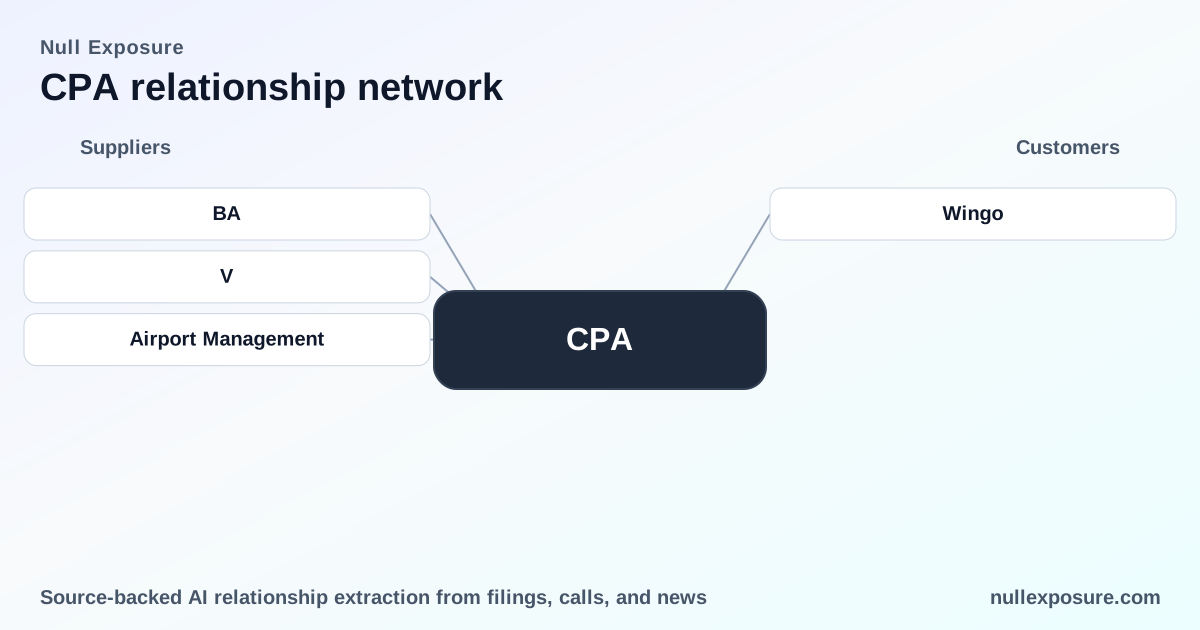
Copa transferred an aircraft to Wingo, increasing Wingo’s fleet to 10 Boeing 737‑800 NGs, an action that reflects active fleet reallocation within the broader corporate or affiliated network. According to an InsiderMonkey transcript of Copa’s Q3 2025 earnings call (published March 9, 2026), this transfer is part of fleet optimization and capacity allocation. Source: InsiderMonkey, Copa Q3 2025 earnings call transcript (March 9, 2026).
Why this matters: fleet transfers are a direct lever for network expansion or consolidation without immediate capital outlay by the receiving carrier; that creates optionality in capacity deployment and supports faster route roll‑out or frequency adjustments.
VLRS (Controladora Vuela) — codeshare activation that expands connectivity
Controladora Vuela (VLRS) reported that it activated codeshares with Copa and Hainan, augmenting existing agreements with Frontier and Iberia to broaden global connectivity and revenue opportunities across its network. This disclosure was captured in an InsiderMonkey transcript of VLRS’s Q4 2025 earnings call (published March 10, 2026). Source: InsiderMonkey, VLRS Q4 2025 earnings call transcript (March 10, 2026).
Why this matters: codeshares extend Copa’s commercial footprint without the need for additional aircraft, feeding passengers into Copa’s hub system and boosting yield per available seat mile through improved feed and higher asset utilization.
How these relationships fit a strategic playbook
Together, the Wingo aircraft transfer and the VLRS codeshare paint a coherent strategy: Copa leverages asset transfers and reciprocal commercial agreements to increase network density and connectivity while managing capital intensity. For operators, that implies a hybrid model—part asset control, part partnership leverage—which reduces the need to deploy new aircraft for incremental routes and accelerates market entry.
Key operational implications:
- Revenue upside is scalable: Codeshares can rapidly add connecting traffic and ancillary revenue streams without matching capital expenditure.
- Flexibility in fleet management: The ability to move aircraft between affiliates signals operational agility; it is a non-trivial competitive advantage in volatile demand environments.
- Network risk profile: Dependence on partner carriers for feeder traffic concentrates commercial risk around partner performance and bilateral commercial terms; however, Copa’s use of both codeshares and intra-group transfers diversifies that exposure across relationship types.
For deeper analysis of Copa’s partner ecosystem and implications for route economics, visit https://nullexposure.com/.
Investment implications — risks and upside in plain terms
- Upside: Codeshares with VLRS and similar arrangements multiply Copa’s effective reach and can lift unit revenue without equivalent capacity investment. Intra-group aircraft transfers — like the one to Wingo — enable faster redeployment to high-return markets and support affiliate growth.
- Risk: Network economics rely on partner execution; a meaningful deterioration in partner load factors or commercial discipline erodes the connectivity benefit. High institutional ownership supports stability, but it does not immunize Copa from macro shocks to travel demand.
- Competitive posture: Copa’s dual approach—commercial partnerships plus asset flexibility—creates a resilient, capital-efficient growth vector that is attractive for investors focused on sustainable route expansion and margin preservation.
Bottom line for investors and operators
Copa’s disclosed customer relationships show a deliberate strategy of leveraging partnerships and intra-group asset movements to grow connectivity and revenue while conserving capital. The two recent, disclosed relationships—an aircraft transfer to Wingo and codeshare activations with VLRS—are complementary levers: one operational, one commercial. Both improve network economics and provide tangible levers management can pull to adjust capacity and market access.
Key takeaway: Copa’s partner engagements are not peripheral; they are central to network strategy and have direct implications for load factors, yield, and capital deployment. For investors and operators modeling Copa, treat codeshares and intra-group fleet allocation as primary drivers of near-term revenue flexibility and medium-term route expansion.
If you want systematic relationship-driven insight across carrier networks, our platform provides the next level of actionable detail: https://nullexposure.com/.