Canterbury Park Holding (CPHC): the customer map that underwrites a small-market racetrack operator
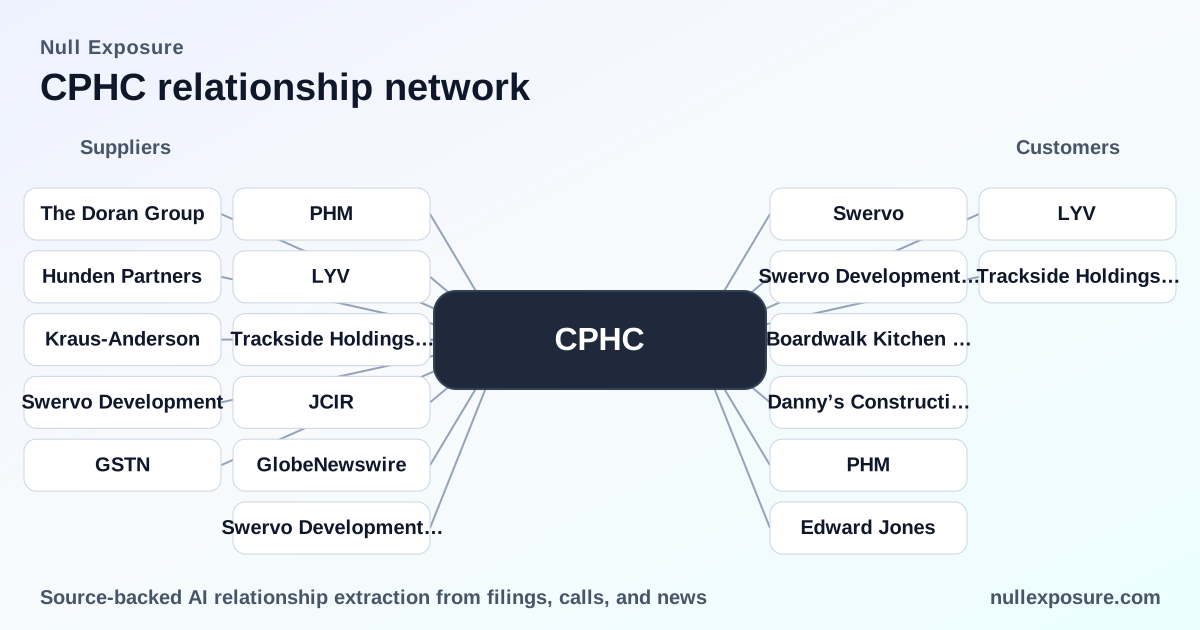
Thesis — Canterbury Park Holding monetizes its Shakopee, Minnesota racetrack and casino through three core cash engines: wagering commissions on live and simulcast racing, food & beverage and casino operations at the track, and selective real‑estate development and land sales that realize episodic gains. Revenue is a hybrid of ongoing service economics (wagering commissions, concessions, leases) and discrete real‑estate monetizations that materially influence near‑term free cash flow. For investors evaluating counterparty exposure and operational partners, the following catalog summarizes every customer and partner relationship disclosed across recent company reports. Visit Null Exposure for deal-level customer intelligence: https://nullexposure.com/.
How Canterbury’s customer relationships shape the business
Canterbury runs a compact, geography‑constrained business whose partners fall into four practical buckets: on‑site tenants and restaurateurs, residential and commercial developers, event operators for an adjacent amphitheater, and professional tenants/lessees for office space. The operating model is local and asset‑centric; wagering and casino services are principal activities, while land sales and joint ventures are used to unlock value from non‑core acreage.
Company‑level signals from the reporting text point to specific operating characteristics:
- Contracting posture: Canterbury acts as both principal (wagering service provider with commissions retained) and seller/landlord, deploying direct leases and joint‑venture arrangements.
- Customer concentration and geography: Primary market is explicitly the Twin Cities metro and adjacent counties, indicating regional concentration of demand and tenant mix.
- Role breadth: The company functions as a service provider (wagering operator) and seller/lessor (food & beverage concessions, commercial office tenants).
- Maturity: Several development projects have moved from construction to stabilized operations, producing recurring rent or one‑time gains on sale.
These signals imply a business that is operationally intensive at the track but uses real‑estate development and selective partnerships to supplement margins and cash flow.
Relationship catalogue — line‑by‑line disclosures
Below are every relationship cited in the provided disclosures, presented in the order seen in company releases and local reporting. Each entry is a plain‑English take with the reporting source and fiscal period.
Danny’s Construction (FY2026)
According to Canterbury’s FY2026 press release on GlobeNewswire, Danny’s Construction occupies the entire second floor of a recently completed office building at the Winners Circle development, reflecting a stabilized tenancy for Canterbury’s commercial space. (GlobeNewswire, FY2026)
Boardwalk Kitchen & Bar (FY2026)
Canterbury reported that Trackside Holdings completed construction and transferred a building to the operating entity Boardwalk Kitchen & Bar, which is now operating the restaurant within the Winners Circle development. (GlobeNewswire, FY2026)
Swervo Development (FY2023)
Local coverage reported that Canterbury sold 37 acres of land to an entity related to Swervo Development for $8.8 million, a transaction that produced a material, one‑time gain on the company’s books. (Bizjournals Twin Cities, FY2023)
Pulte Homes of Minnesota / PHM (FY2026)
Canterbury disclosed that Pulte Homes of Minnesota completed development of a 110‑unit Canterbury Crossing townhome project with units largely sold, indicating the conversion of sold lots into recognized proceeds and reduced land inventory. (GlobeNewswire, FY2026)
Live Nation Entertainment / LYV (FY2026)
The FY2026 release states the new 19,000‑capacity amphitheater being developed on adjacent land will be operated by Live Nation Entertainment, identifying a high‑profile operator for the venue that influences ancillary track attendance and event demand. (GlobeNewswire, FY2026)
Swervo (FY2025)
Canterbury’s FY2025 report recognized a $6.5 million gain on sale of 37 acres to Swervo, confirming the timing and magnitude of the earlier land monetization recorded in the company’s financials. (GlobeNewswire, FY2025)
Edward Jones (FY2026)
Canterbury noted Edward Jones is finishing a first‑floor build‑out at the Winners Circle commercial office building, signaling an institutional tenant taking office space on site. (GlobeNewswire, FY2026)
Swervo Development Corporation (FY2022)
Canterbury’s FY2022 disclosure and local reporting show a formal proposal/plan whereby land would transfer to Swervo Development Corporation for a 19,000‑seat amphitheater, documenting the origination of the amphitheater project relationship. (KSTP, FY2022)
Bloomington Investments (FY2023)
Local reporting described the buyer of the 37 acres as Bloomington Investments, an entity related to Swervo Development, which is the counterparty to the $8.8 million land sale. (KSTP, FY2023)
Boardwalk Kitchen & Bar (FY2025)
Earlier FY2025 reporting confirms that Trackside Holdings finished construction in June and Boardwalk Kitchen & Bar began operations that season, marking the transition from development to operating tenant. (GlobeNewswire, FY2025)
Danny’s Construction (FY2025)
In FY2025, the company reported that Danny’s Construction, along with other food and fitness operators in a 10,000 sq. ft. commercial building, completed their first summer of business with positive patronage, establishing early tenant performance. (GlobeNewswire, FY2025)
PHM / PHM (multiple FY2025 entries)
Across FY2025 releases, Canterbury repeatedly noted that Pulte Homes of Minnesota continued phased development of multiple rowhome/townhome phases, with remaining lots under contract or construction — documenting a multi‑phase developer relationship and ongoing lot monetizations. (GlobeNewswire, FY2025; multiple filings)
Edward Jones (FY2025)
In the FY2025 quarterly report, Canterbury reiterated Edward Jones’ build‑out activity in the Winners Circle office building, underlining a multi‑quarter leasing progression. (GlobeNewswire, FY2025)
Live Nation Entertainment / LYV (FY2025)
The company’s FY2025 communications state that the amphitheater — developed by Swervo and to be operated by Live Nation — was scheduled to open for a full season in summer 2026, establishing the expected operator and timeline for venue‑related revenue tailwinds. (GlobeNewswire, FY2025)
Trackside Holdings LLC (FY2025)
External reporting cited Trackside Holdings LLC as the developer/operator of an on‑site music venue, restaurant and bar expected to open in spring 2025, outlining the intermediate developer partner for the Boardwalk operation. (TradingView / Zacks summarizing FY2025 coverage)
Boardwalk Kitchen & Bar (FY2025; second mention)
A separate FY2025 press note confirms Trackside transferred the constructed building to Boardwalk Kitchen & Bar’s operating entity, restating the completion and handoff as the lessee commenced activity. (GlobeNewswire, FY2025)
Pulte Homes of Minnesota / Pulte (FY2025; additional entries)
Multiple FY2025 updates repeated Pulte’s development progress across second and third phases, noting that remaining lots were under contract and construction, which indicates continued phased monetization of residential parcels. (GlobeNewswire, FY2025; FY2025 Q1/Q3 releases)
What this customer map implies for investors
- Recurring core — wagering and concessions: Canterbury’s principal customer relationships are operational (bettors and concessions) and present stable, margin‑sensitive income streams; the constraints identify the company as principal for wagering services and a seller for F&B, reinforcing direct revenue recognition.
- Real‑estate monetizations are material but episodic: The Swervo/Bloomington land sale and phased Pulte developments produce sizable one‑time gains or deferred recognition across periods; these transactions materially influence reported EBITDA and cash flow timing.
- Tenant credit and lease roll dynamics matter: Institutional tenants like Edward Jones and multi‑unit lessees provide rent stability; the Boardwalk/Trackside/Boardwalk Kitchen & Bar sequence shows Canterbury using joint‑venture and lease structures to transfer operational risk.
- Localized demand concentration: The company’s geographic footprint is the Twin Cities metro plus adjacent counties, indicating sensitivity to local economic cycles and entertainment spending patterns.
Investment checklist and next steps
- Assess how much of the latest EBITDA is driven by recurring wagering versus one‑time land gains; the FY2025 $6.5M land gain is an example of non‑recurring income.
- Monitor amphitheater opening and Live Nation’s operating schedule for measurable uplift to non‑wagering revenues.
- Track lease commencements and occupancy in the Winners Circle office/retail assets to evaluate rent roll durability.
For a deeper view of counterparties and to compare deal exposure across regional operators, explore Null Exposure’s platform: https://nullexposure.com/.
Bold takeaways: Canterbury’s cash profile rests on ongoing wagering/concessions plus episodic real‑estate monetizations; tenant and operator relationships (Boardwalk, Trackside, Pulte, Swervo, Live Nation, Edward Jones) convert development into either recurrent rent or one‑time gains that swing near‑term results.