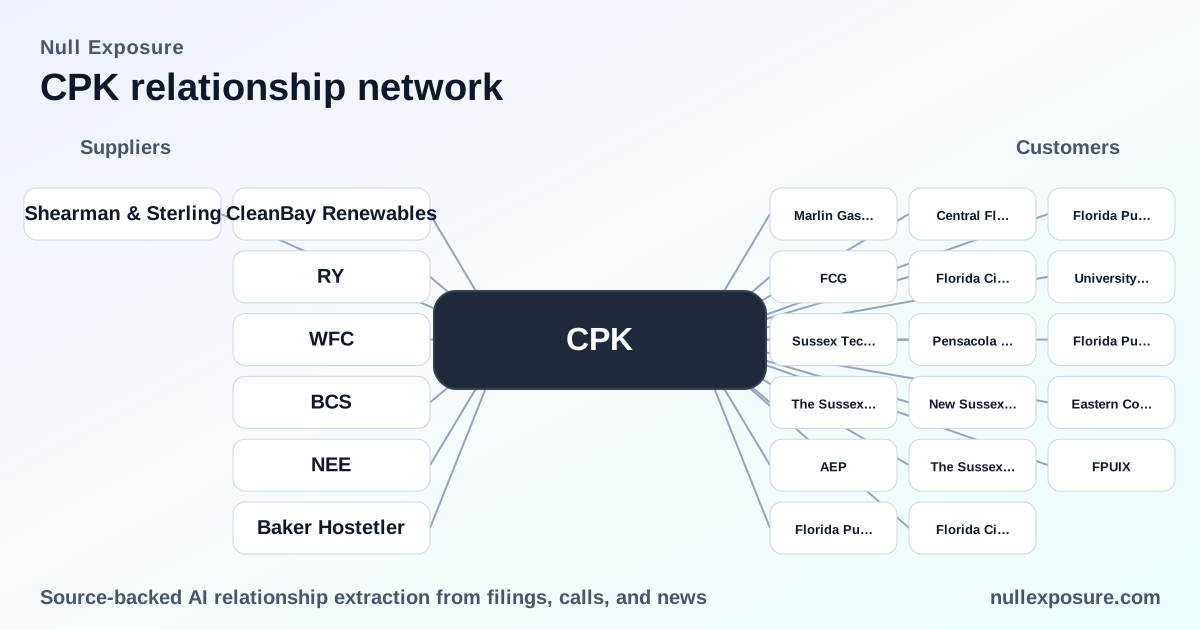
Chesapeake Utilities (CPK) — Customer Relationships and Commercial Footprint
Chesapeake Utilities operates as a regulated energy delivery company that monetizes through regulated distribution rates, long‑term service contracts and fees for energy delivery and ancillary services across natural gas, electricity, propane and mobile CNG/RNG/LNG offerings. The firm combines utility rate base economics with merchant and services revenue (mobile gas, pipeline transportation and RNG projects), producing steady cash flow and predictable margin contribution — a profile investors treat as defensive, regulated earnings with selective growth from infrastructure projects. For a central source of customer‑relationship intelligence, see https://nullexposure.com/.
What investors should look for in the relationship map
Chesapeake’s commercial footprint is a hybrid of regulated distribution franchises and targeted project customers. Key characteristics are long‑dated contractual revenue, geographical concentration in the Mid‑Atlantic and Florida, and a mix of large enterprise and municipal counterparties that create both stable utility cash flow and project‑level growth optionality. That combination frames both upside (regulated rate recovery, pipeline/power projects) and downside (regulatory outcomes, regional demand shifts).
Operating constraints and what they imply for the business model
Chesapeake’s customer relationships and the supporting excerpts report several company‑level signals:
- Long‑term contracting posture: The company references multi‑decade contracts (example: 20‑year arrangements for generation output and steam), indicating durable revenue streams that support regulated utility valuation methods and capital recovery over time.
- Counterparty mix includes large enterprises: Filings reference increased charges tied to a large commercial customer, signaling that a portion of margin dynamics can be materially affected by a single large counterparty.
- Geographic concentration in North America: Operations are concentrated across Delaware, Maryland, Florida, the Delmarva Peninsula, Ohio and parts of the Carolinas — this regional focus shapes regulatory exposure and demand growth sensitivity.
- Service provider and seller roles: Chesapeake functions both as a regulated seller (billing under PSC‑approved tariffs) and as a service provider for mobile gas and pipeline transportation, creating diversified revenue streams across distribution and services segments.
- Segment maturity: Distribution businesses are mature, regulated assets, while services and pipeline projects present higher growth optionality but require permitting and regulatory approvals.
These signals imply stable regulated cash flow with selective project risk, where permitting and PSC approvals are the primary gating items for growth and where a handful of large counterparties can influence near‑term margin volatility.
Relationship detail — every reported counterparty (plain English, source)
-
Marlin Gas Services — Marlin is Chesapeake’s unit that supplies mobile compressed natural gas and virtual pipeline logistics to utilities and pipelines, supporting CNG/RNG/LNG deliveries to customers. According to Chesapeake’s 2024 10‑K, the company has invested to expand Marlin’s virtual pipeline fleet (10‑K, FY2024).
-
FCG (Florida City Gas) — Peninsula Pipeline filed petitions with the Florida PSC for Transportation Service Agreements intended to support additional renewable supply delivery to FCG and related projects. These filings are described in Chesapeake’s 2024 10‑K (10‑K, FY2024).
-
Sussex Technical High School — Chesapeake will provide natural gas service to the new Sussex Technical High School campus, Delaware’s largest school construction project, supporting expanded capacity at the site. The announcement was reported on Finviz in March 2026 (Finviz news, FY2026).
-
The Sussex County Vocational Technical School District (SCVTSD) — Chesapeake and the SCVTSD announced plans to supply natural gas to the new Sussex Technical High School campus currently under construction in Sussex County, Delaware. The Finviz news item covers the March 2026 announcement (Finviz news, FY2026).
-
AEP (American Electric Power) — stocktitan 8‑K note — An agreement was reported in July 2025 where Aspire Energy Express (an affiliate project) entered into an arrangement with American Electric Power to construct and operate an intrastate natural gas pipeline in central Ohio to serve a new fuel‑cell facility powering a data center. This event is summarized in a StockTitan report covering Chesapeake’s 8‑K (StockTitan, FY2026).
-
American Electric Power — duplicate reference — The same July 2025 pipeline/agreement with AEP to support a fuel‑cell facility in central Ohio is described in Chesapeake’s 8‑K coverage (StockTitan, FY2026).
-
Florida Public Utilities Company (FPUC) — Peninsula will construct and own the Belvedere Pipeline and interconnect with interstate Florida Gas Transmission to serve the West Palm Beach area under an agreement described with FPUC; the item dates to earlier regulatory filings covered in news reporting (DailyEnergyInsider, FY2018).
-
Central Florida Gas (CFG) — Peninsula planned pipeline construction and two transfer stations in Escambia County under a transportation services agreement with Central Florida Gas, noted as a Chesapeake subsidiary in regulatory reports (DailyEnergyInsider, FY2018).
-
Florida City Gas (rigzone) — Chesapeake’s acquisition of Florida City Gas for $923 million and subsequent RNG plant projects were reported in July 2024, with three RNG plants to supply Florida City Gas and estimated completion by mid‑2025 (Rigzone, FY2024).
-
Pensacola Energy — A new distribution system was described that will provide gas service to an industrial customer and to Pensacola Energy, a municipal natural gas utility, in filings and news coverage (DailyEnergyInsider, FY2018).
-
New Sussex Technical High School Campus — Chesapeake’s service commitment to the new Sussex Tech campus is also noted in an SEC‑filing summary and press reporting, reiterating the project’s scale and the company’s role in providing gas service (StockTitan SEC filing summary, FY2026).
-
Sussex Technical High School — StockTitan duplicate — StockTitan coverage reiterates Chesapeake’s plan to supply natural gas to the 400,000+ square‑foot facility, highlighting project scale and customer service role (StockTitan news, FY2026).
-
The Sussex County Vocational Technical School District — StockTitan duplicate — The district’s collaboration with Chesapeake on the new campus is reiterated in StockTitan reporting, confirming the public‑sector counterparty (StockTitan news, FY2026).
-
Florida City Gas — 8‑K summary — Peninsula Pipeline’s petitions for Transportation Service Agreements supporting supply to Florida City Gas are referenced in Chesapeake’s 8‑K reporting summaries (StockTitan 8‑K, FY2026).
-
Florida Public Utilities Company — 8‑K summary — Peninsula’s petition filings with the Florida PSC for Transportation Service Agreements to serve coastal communities were outlined in Chesapeake’s 8‑K summaries and PR releases (StockTitan 8‑K and PR Newswire, FY2026).
-
Florida Public Utilities Company — PR Newswire — Chesapeake’s fiscal year 2025 PR release reiterates Peninsula Pipeline’s December 2023 petition for Transportation Service Agreements with FPU to support East Coast Florida communities (PR Newswire, FY2026).
-
Florida City Gas — PR Newswire — PR Newswire reporting also notes Peninsula’s February 2024 filing seeking approval of Transportation Service Agreements with FCG for projects that support renewable supply transport (PR Newswire, FY2026).
-
American Electric Power — PR Newswire — Chesapeake’s FY2025 results and related project disclosures summarize the July 2025 AEP agreement to construct and operate the Ohio pipeline serving the fuel‑cell facility (PR Newswire, FY2026).
-
University of Maryland Eastern Shore — Chesapeake’s permitting process for new pipelines in Somerset County is reported to include connections to UMES as a potential offtake point, covered in local news reporting (DelmarvaNow, FY2020).
-
Eastern Correctional Institute — The same Somerset County pipeline permitting effort lists Eastern Correctional Institute as a planned connection point in local coverage (DelmarvaNow, FY2020).
-
Florida Public Utilities Co. (FPU) — Rigzone duplicate — Rigzone coverage of RNG plant projects and delivery offtakes noted that Pioneer Supply will continue to provide service to FCG and FPU and add delivery points for FPU, confirming third‑party supply arrangements (Rigzone, FY2024).
-
FPU (10‑K entries including FPUIX) — Chesapeake’s 2024 10‑K documents multiple filings by Peninsula Pipeline with the Florida PSC seeking approval of transportation agreements to provide additional firm service to FPU in Newberry and Lake Wales, reflecting regulatory steps to expand supply capacity (10‑K, FY2024).
-
FPUIX (10‑K duplicate) — The 10‑K additionally lists filings for firm service in Lake Wales and Newberry, cited under the FPUIX listing in the company filing (10‑K, FY2024).
Investment implications and closing takeaways
- Regulated core, project optionality: Chesapeake’s customer map confirms a foundation of regulated distribution customers complemented by project customers (pipelines, RNG plants, institutional and large commercial offtakes) that drive incremental growth.
- Regulatory and permitting gates are central: Many relationships are enabled only after PSC approvals or permitting — these are the primary operational hurdles for growth.
- Concentration and counterparty risk: The presence of large commercial and municipal counterparties means a small number of customers can influence near‑term margins even as rate base provides stability.
For a concise, source‑centric view of customer relationships and the implications for valuation and risk, visit https://nullexposure.com/.
Bold takeaway: Chesapeake delivers predictable regulated earnings while selectively monetizing pipeline and services projects — investors should underwrite regulatory outcomes and project permitting when evaluating upside.