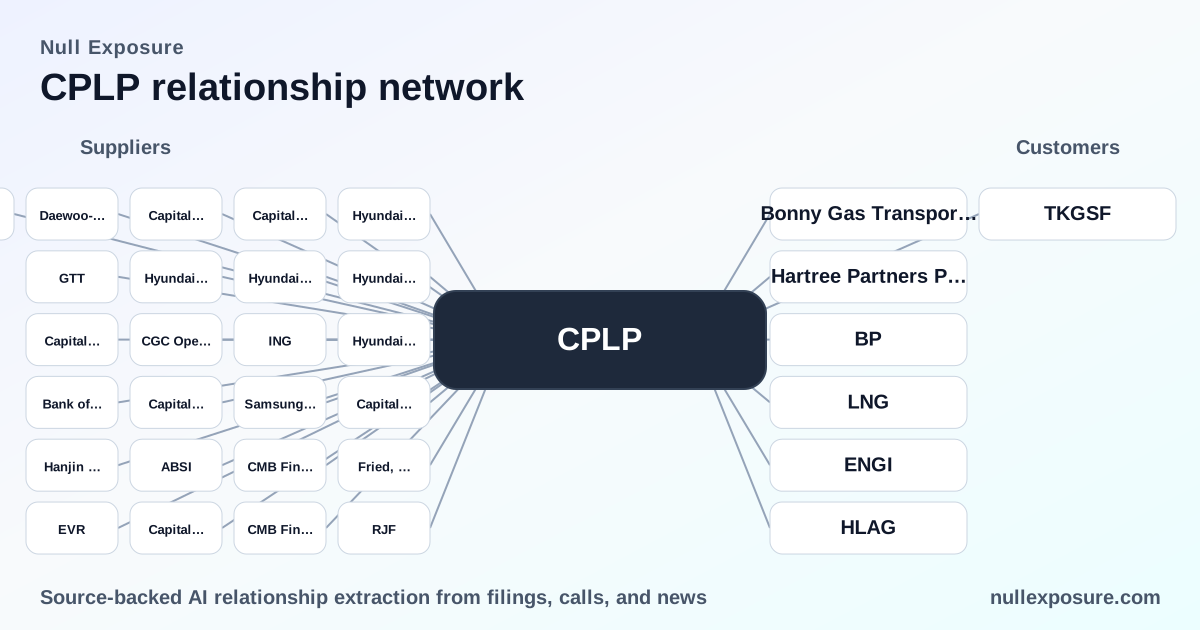
Capital Product Partners (CPLP): Customer Map and Commercial Implications
Capital Product Partners operates and monetizes a fleet of LNG carriers and other specialized vessels by chartering them to energy majors and utilities under multi-year time charters and bareboat agreements, often with extension options; the model converts ship ownership into predictable cash flow streams while exposing CPLP to mid-decade charter expiries and counterparty concentration risk. For investors, the critical inputs are charter length, counterparty quality, and option structures — these determine revenue visibility and refinancing flexibility. Visit the Null Exposure homepage for the full platform and context: https://nullexposure.com/
Quick take: what to watch in CPLP’s customer book
CPLP’s customer book is concentrated among global energy players and regional utilities, with contracts ranging from short market-linked time charters to decade-long fixed employments. Long-dated charters and extension options drive cash flow stability; clustered expiries in 2025–2027 create the primary re-contracting risk horizon.
- Contracting posture: Predominantly long-term (7–10 years) with extension options; mix of time charters and bareboat charters.
- Counterparty concentration: Energy majors (BP, Cheniere, Engie, Hartree) and large utilities (Tokyo Gas) dominate.
- Criticality of service: LNG carriers are mission-critical assets for energy supply chains, increasing the practical stickiness of charters.
- Maturity profile: Several charters mature in the 2025–2027 window, concentrated re-contracting risk.
Customer-by-customer: every relationship detected in the filings and press
Hartree Partners Power & Gas Company (UK) Limited
Capital Product Partners deployed an LNG carrier on a seven-year employment with Hartree, with a two-year extension option, establishing a multi-year revenue stream tied to a trading and power firm. Source: Offshore-Energy coverage (article noted in FY2023 reporting).
Hartree Partners Power & Gas Company (UK) Limited (delivery reference)
A separate report confirms delivery timing: the vessel was delivered 17 February 2023 and immediately began its seven-year employment with Hartree, exercisable for an additional two years, locking in near-term utilization. Source: LNG Industry (FY2023 delivery note).
Bonny Gas Transport Limited
CPLP placed a vessel on a one-year market-linked time charter followed by a seven-year bareboat charter with Bonny Gas Transport, which holds a three-year extension option, reflecting a structure that converts an initial market-rate period into a long-term capital lease. Source: LNGIndustry reporting (FY2024).
BP
Multiple entries report that two LNG carriers (Aristos I and Aristidis I) are under long-term time charters with BP Gas Marketing, with contractual expiries (including options) in October and December 2027, providing a major share of CPLP’s secure cash flows into the mid-decade window. Source: VesselFinder summary (FY2021) and Offshore-Energy summaries (FY2023).
BP Gas Marketing Limited
CPLP’s contractual relationship with BP Gas Marketing Limited specifically covers long-term time charters for at least two vessels, with optional periods pushing expiries toward late 2027, underscoring BP’s role as a top-tier charterer for the partnership. Source: VesselFinder article (FY2021).
LNG (generic / category reference)
One report identifies the LNG/C Aristarchos under a long-term time charter with Cheniere, expiring February 2025, a direct example of CPLP’s model of locking vessels to liquefaction and trading counterparties. Source: VesselFinder reporting (FY2021).
Cheniere Marketing International LLP
CPLP holds a long-term time charter with Cheniere Marketing International LLP for the Aristarchos vessel that runs through February 2025, illustrating a material revenue line tied to U.S. LNG export flows. Source: VesselFinder coverage (FY2021).
Cheniere (general reference)
Industry summaries note that Cheniere is one of the energy majors chartering CPLP’s LNG carriers, reinforcing the partnership’s exposure to global LNG commercialization counterparties. Source: Offshore-Energy reporting (FY2023).
Engie
Engie is listed among the energy majors that have taken long-term charters from CPLP, contributing to the partnership’s revenue diversification across European and Asian LNG buyers. Source: Offshore-Energy (FY2023).
Engie Energy Marketing Singapore Pte Ltd
Specific reporting identifies Engie Energy Marketing Singapore Pte Ltd as a charterer of CPLP’s Optional Vessels, part of a multi-relationship structure that included BP and Cheniere with an average remaining charter duration of roughly 6.3 years at the time of reporting. Source: VesselFinder (FY2021).
Hapag-Lloyd Aktiengesellschaft (HLAG)
CPLP obtained a right of first offer on six vessels from Capital Maritime & Trading Corp., including three 13,278 TEU eco-container vessels fixed to Hapag-Lloyd for 10 years, indicating strategic optionality in container trades as well as LNG. Source: VesselFinder acquisition summary (FY2021).
HLAG (duplicate entry)
Further commentary repeats the 10-year charter relationship for three eco container vessels and ROFO rights tied to expected deliveries between October 2022 and May 2023, affirming CPLP’s exposure beyond energy shipping. Source: VesselFinder (FY2021).
ENGIE (ticker-like entry)
A second entry reiterates that Optional Vessels built in 2021 were chartered to BP, Cheniere and Engie Energy Marketing Singapore with a remaining charter duration of about 6.3 years, highlighting the cohort-level duration profile for those assets. Source: VesselFinder (FY2021).
Hapag Lloyd Aktiengesellschaft (alternate tag)
The dataset lists Hapag-Lloyd again in relation to the ROFO and container vessel charters; this echoes the prior disclosure that CPLP secured optional acquisition routes tied to chartered container vessels, a commercial lever for fleet diversification. Source: VesselFinder (FY2021).
TKGSF (Tokyo Gas / inferred)
CPLP commenced a ten-year employment with Tokyo Gas, signaling a long-term utility contract and a stable revenue runway from a major Japanese gas company. Source: Offshore-Energy article on FY2024 investments.
Tokyo Gas
Tokyo Gas specifically took a vessel on a ten-year employment, confirming CPLP’s exposure to long-term Asian utility demand and providing a decade of charter revenue for that asset. Source: Offshore-Energy coverage of FY2024 activity.
What the customer mix means for investors
CPLP’s commercial book is weighted toward long-term contracts with investment-grade and strategic counterparties, giving the partnership predictable cash flows and supporting asset-backed financing. At the same time, the portfolio shows concentration among a handful of energy majors and utilities and a cluster of expiries and optional expirations concentrated in the 2025–2027 window, which creates a focal point for re-contracting risk and potential spot market repricing.
- Upside drivers: Extension options and ROFOs create re-leveraging and growth optionality; utility contracts (Tokyo Gas, Hartree) provide durable revenue.
- Downside risks: Concentrated counterparty exposure and mid-decade charter rollovers increase cash-flow volatility if multiple contracts reset into weaker market conditions.
For a deeper read on counterparties, charter timelines, and optionality that drive CPLP’s valuation dynamics, visit Null Exposure: https://nullexposure.com/
Final read
CPLP converts ownership of specialized vessels into contracted cash flow through multi-year charters with leading energy and utility counterparties. The arrangement delivers high revenue visibility but concentrates re-contracting risk around a predictable mid-decade window. Investors should monitor charter expiries, extension election activity, and the credit posture of major counterparties to assess forward earnings and refinancing capacity.