Capri Holdings: customer relationships after the Versace divestiture — what investors need to know
Capri Holdings monetizes globally through three commercial levers: direct retail and e-commerce sales, wholesale/reseller distribution, and brand licensing (royalties and advertising fees recognized over time). The company operates premium fashion brands (Michael Kors, Jimmy Choo, formerly Versace) and extracts cash both from product margins and recurring licensing streams, while shifting capital structure and strategic focus via discrete asset sales such as the completed Versace transaction. For investors this is a business that combines transactional product revenue with higher-margin, lower-capex licensing contracts—together defining revenue volatility, capital allocation flexibility, and strategic concentration risk.
Learn more about how we map counterparty exposure at https://nullexposure.com/
How Capri’s customer model actually works — the operating constraints that matter
Capri’s commercial posture is a hybrid of spot product sales and ongoing licensing. The company sells finished goods at a point in time through its retail stores and wholesale partners, while simultaneously licensing brand rights for product lines (watches, fragrances, eyewear, home goods) where revenue is recognized over time as access to the brand is provided. This duality creates two distinct cash profiles: immediate receipts from store/wholesale sales and recurring, more predictable royalties from licensees.
Key company-level signals:
- Licensing is material to the business model. Capri expressly generates royalty and advertising revenue through product and geographic licensing arrangements, and provides trademark access to third parties across its brands.
- Spot sales dominate retail/wholesale channels. Most retail and wholesale sales are point-in-time transactions with control transferring at sale.
- Global footprint reduces single-market dependency. Revenue is generated across the Americas, EMEA and Asia-Pacific regions.
- Customer concentration is low. No single customer accounted for 10% or more of total revenues in recent fiscal years, making individual counterparty loss unlikely to be existential.
- Roles are multi-faceted. Capri acts as seller, licensor and counterparty to distributors/resellers, which cushions commercial risk through channel diversification.
- Distribution is a primary revenue segment. Wholesale and distribution partners remain core to how the brands get to market.
These constraints shape counterparty exposure: licensing counterparties bring recurring revenue but contractual complexity, while wholesale customers drive volume and margin timing risk.
Counterparty map — the relationships the market has reported
Below I document every counterparty relationship surfaced in recent reporting and press coverage for Capri that affects investor analysis. Each entry is a concise, plain-English summary with a source reference.
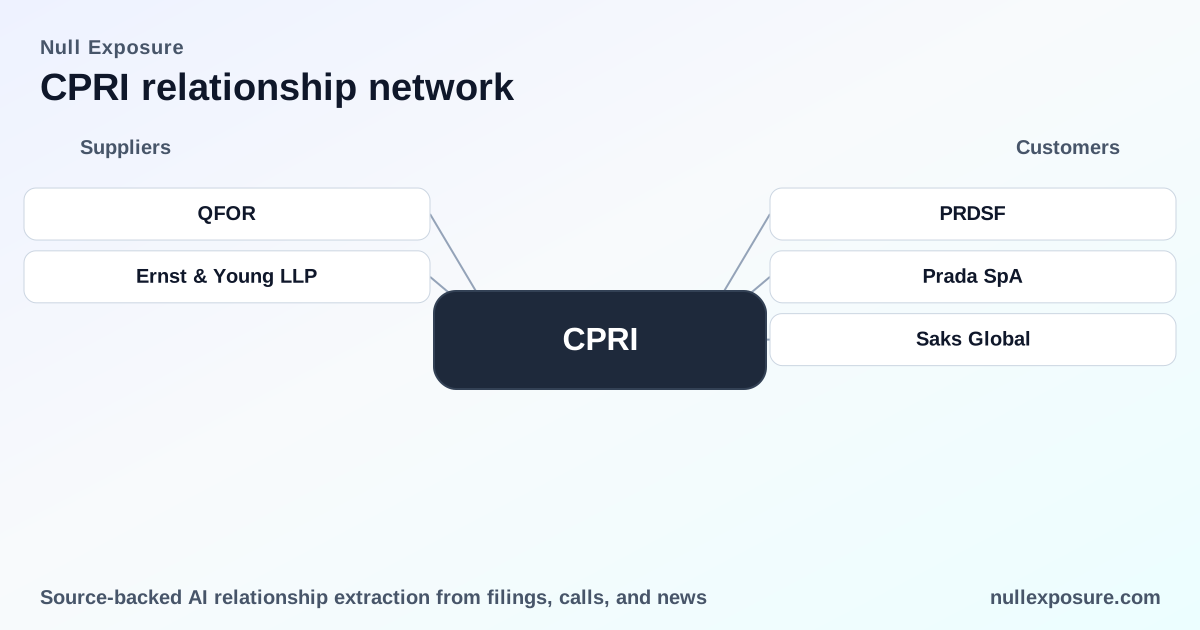
Prada S.p.A. / PRDSF — buyer of Versace
Capri completed a definitive sale of the subsidiaries that operated the Versace business to Prada for approximately $1.375 billion in cash, removing Versace from Capri’s continuing operations and classifying it as discontinued operations; the transaction materially simplifies Capri’s brand portfolio and provides a substantial cash infusion. Sources: Capri Holdings press release (Second Quarter Fiscal 2026 Results) and multiple news reports including The Globe and Mail and Yahoo Singapore reporting on the transaction (FY2025–FY2026 coverage).
Prada SpA (local reporting)
Multiple regional outlets reported the same transaction value in euro/dollar terms and the strategic rationale: consolidation in Italian luxury and a stronger focus for Capri on Michael Kors and Jimmy Choo after the sale. Source: Veja (Brazil) reporting on the negotiation and valuation (FY2025 news coverage).
Saks Global — wholesale/department store customer
Capri’s management commented in an earnings call transcript that the company is working constructively with the new management team at Saks Global to resume or expand shipments and is supportive of Saks’ strategy; this highlights Capri’s dependence on large luxury department-store relationships to move wholesale inventory. Source: Capri Holdings Q3 FY2026 earnings call transcript (InsiderMonkey, FY2026).
Fossil Group, Inc. (FOSL) — licensed brand partner (watch/jewelry categories)
Fossil Group lists Michael Kors among licensed brands it manufactures for, indicating a commercial relationship where Capri’s Michael Kors brand is monetized via third-party manufacturing and distribution agreements for watches, jewelry and other accessories. This underscores Capri’s licensing model for accessory categories. Source: Fossil Group press notices and earnings release scheduling mentioning licensed brands (FY2026).
Why the Versace sale changes the counterparty risk profile
The sale to Prada is the single most consequential customer/counterparty event in recent reporting. It removes a full brand from Capri’s portfolio, turning what was previously an internal operating segment into a one-time liquidity event and altering ongoing revenue composition. The net effect for investors:
- Balance sheet and liquidity improve through immediate cash proceeds, enabling debt reduction or reinvestment into core brands.
- Revenue concentration increases at the brand level because Capri now relies more heavily on Michael Kors and Jimmy Choo for future growth.
- Counterparty risk shifts from buyer-seller dynamics to licensing durability—post-sale, revenue will rely more on retail and license partners for the remaining brands.
Sources documenting completion and timing include Capri’s press release (Third Quarter Fiscal 2026 Results) and several market news outlets that reported the closing and strategic rationale (March–May 2026).
Practical implications for investors and operators
- Focus on licensing counters operational volatility. Licensing provides recurring revenue streams and is recognized over time, improving cash visibility relative to pure retail sales.
- Low customer concentration reduces single-buyer default risk, but brand concentration after the Versace sale increases business risk tied to consumer demand for Michael Kors and Jimmy Choo.
- Global distribution diversifies geographic exposure but creates currency and regional demand risk; management must execute region-specific retail and wholesale strategies.
- Wholesale relationships (department stores and distributors) remain strategically important as indicated by Capri’s public engagement with Saks Global; recovery or strength in these partners will materially affect wholesale flow-through.
If you want a concise counterparty exposure summary tailored to Capri’s balance sheet and covenant profile, visit https://nullexposure.com/ for our investor tools and reporting framework.
Bottom line — what to watch next
- Monitor royalty and licensing disclosures in upcoming quarters for stability of recurring revenue.
- Track wholesale partner performance (Saks, department stores) for inventory flow and margin impact.
- Watch capital allocation following the Versace sale: debt paydown versus reinvestment into core brand growth will determine medium-term return on invested capital.
Capri is now a leaner company with clearer monetization vectors: spot retail/wholesale cash plus predictable licensing income — investors should watch management’s use of proceeds and the resilience of wholesale and licensing partners.