Catalyst Pharmaceuticals (CPRX): Customer Relationships That Extend Commercial Reach
Catalyst Pharmaceuticals is a commercial-stage biopharma that licenses, sub-licenses and directly sells specialty neurology therapies—notably FIRDAPSE®, FYCOMPA® and AGAMREE®—to monetize through product sales in the U.S. and through strategic sub-license agreements internationally. The company captures margin on U.S. direct commercialization while leveraging sub-license partners to accelerate entry into Asia and Latin America, turning regulatory approvals held by partners into revenue streams beyond its domestic salesforce. For a concise market-edge read on partner exposure and customer relationships, visit https://nullexposure.com/.
Two partner wins to know: DyDo Pharma and KYE Pharmaceuticals
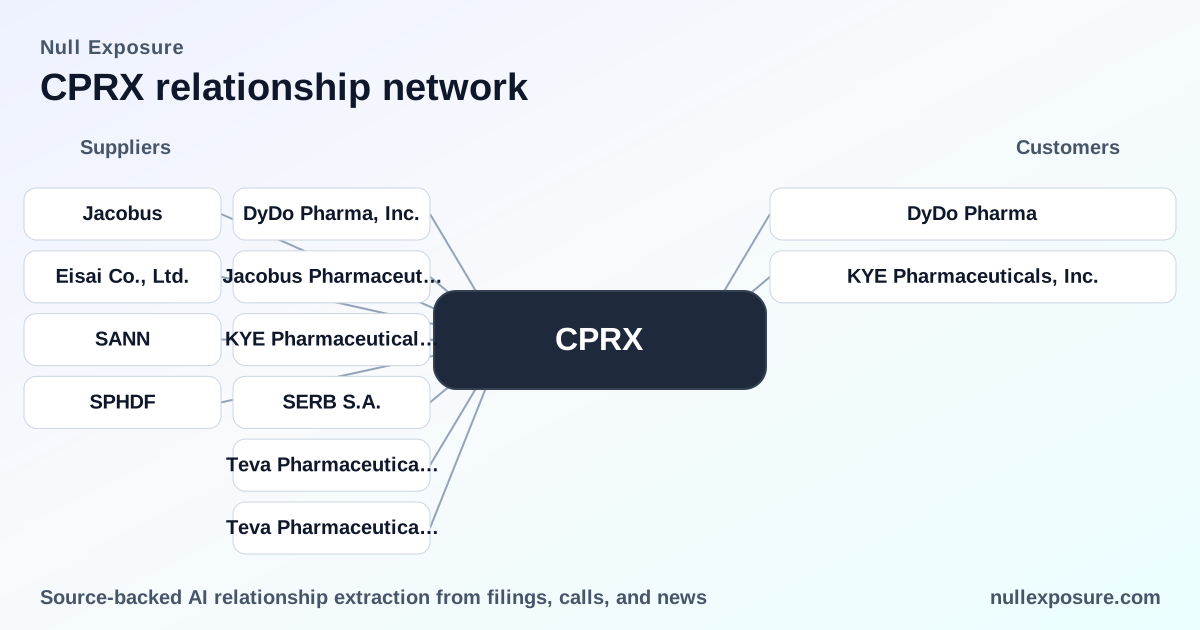
DyDo Pharma: Catalyst’s sub-licensee launched FIRDAPSE 10 mg tablets in Japan to treat Lambert‑Eaton myasthenic syndrome (LEMS), extending the product’s commercial footprint into a major APAC market. According to Catalyst’s February 25, 2026 press release on GlobeNewswire, DyDo Pharma executed the Japan launch under a sub-license arrangement announced in prior agreements.
KYE Pharmaceuticals, Inc.: KYE obtained Health Canada approval for AGAMREE, making it the first therapy approved in Canada to treat Duchenne muscular dystrophy (DMD). Catalyst reported this regulatory milestone in the same February 2026 investor release, identifying KYE as the sub-licensee responsible for Canadian commercialization of AGAMREE (GlobeNewswire, Feb 25, 2026).
Both relationships were also reflected in an 8‑K disclosure that summarized these partner developments and the related commercial milestones (8‑K republished on StockTitan, February 2026).
Why these partnerships matter to revenue and geography strategy
Catalyst’s use of sub-license agreements is a clear operational lever: the company keeps direct sales control in North America while transferring regional commercial execution to local partners where regulatory paths and reimbursement landscapes differ. This model conserves internal resources and accelerates time-to-market in foreign jurisdictions, while preserving a royalty or revenue-share flow when partners convert approvals into sales.
The company disclosed an amendment expanding its commercial territory for FIRDAPSE beyond North America to include Japan—and that, as of a December 2023 license amendment, most of Asia and Latin America are included upon PMDA acceptance of a Japan MAA for FIRDAPSE. This is a company-level signal that Catalyst is actively moving from a U.S.-centric seller toward a hybrid model combining direct U.S. commercialization with partner-led international sales.
What the company-level constraints reveal about operating posture
- Geographic expansion: Filing language and the 2026 press release confirm explicit territorial expansion into Japan, broad Asia and Latin America, signaling international revenue diversification is now material to the go-to-market plan.
- Direct U.S. commercialization: Catalyst still operates a field sales organization—approximately 27 personnel for FYCOMPA® and 41 personnel for FIRDAPSE®—indicating a sustained, resource-intensive U.S. commercial effort to support patient access and payor coverage.
- Seller contracting posture: Company disclosures state revenue recognition generally occurs at time of shipment, which is consistent with point-in-time product sales contracts and a traditional distributor/customer revenue model for manufactured product.
- Commercial maturity: Catalyst is in full commercial operations with three marketed products, generating steady topline and positive margins reported in the most recent fiscal metrics.
These are company-level signals drawn from the same filings and statements that announced partner activity; none of the constraints single out a partner unless the excerpt named that partner.
Relationship-by-relationship snapshot (concise)
DyDo Pharma — DyDo launched FIRDAPSE 10 mg tablets in Japan under a sub-license, opening a direct commercial channel for LEMS treatment in a key APAC market; this was announced in Catalyst’s February 25, 2026 press release (GlobeNewswire) and summarized in the company’s 8‑K (StockTitan, Feb 2026).
KYE Pharmaceuticals, Inc. — KYE secured Health Canada approval for AGAMREE, establishing the first approved DMD therapy in Canada and positioning KYE as Catalyst’s commercial partner there; Catalyst disclosed this regulatory milestone in its Feb 25, 2026 investor release (GlobeNewswire) and in the related 8‑K filing (StockTitan, Feb 2026).
Investor implications: upside, risk and what to monitor
Catalyst’s partner strategy delivers three clear investor takeaways:
- Opportunity: Faster international scale with lower capex. Sub-licensing accelerates access to new patient populations (Japan, Canada, broader Asia and Latin America) without the cost of building full local infrastructure.
- Concentration and counterparty risk: Revenue beyond the U.S. now depends on partner execution and local reimbursement outcomes. Partners’ commercial effectiveness and regulatory interactions are critical to realizing the incremental revenue projected from these territories.
- Operational maturity and predictability: Direct U.S. sales remain material and stable, supported by an established field force and point-of-sale revenue recognition policies that contribute to predictable cash flows in North America.
Monitor these near-term signals to judge trajectory: first full-quarter sales reported by DyDo in Japan, early AGAMREE uptake metrics in Canada, any revisions to royalty or revenue-share terms, and payer coverage decisions in newly entered markets.
Key risks and timing considerations
- Regulatory and reimbursement gating: International approvals and payer coverage timelines control the cadence of partner-derived revenues; approvals convert territory rights into monetizable sales only after payor acceptance.
- Partner execution: Local launch success depends on partner salesforce competence, patient identification, and distribution logistics—areas outside Catalyst’s direct control.
- Concentration across a small product slate: While three marketed products provide revenue diversity versus a single molecule, any material setback to one product or partner could have outsized effects on growth expectations.
Bottom line and next steps for due diligence
Catalyst is executing a pragmatic commercial model: retain U.S. direct sales where it has scale, outsource international launches to specialized partners to expand addressable markets quickly, and recognize revenue at shipment to maintain tidy cash conversion. DyDo’s Japan launch and KYE’s Canadian approval are concrete milestones that validate this strategy and expand the company’s revenue runway beyond North America.
For a compact, investor-focused view of partner exposure and customer relationships across specialty pharma companies, explore more at https://nullexposure.com/.