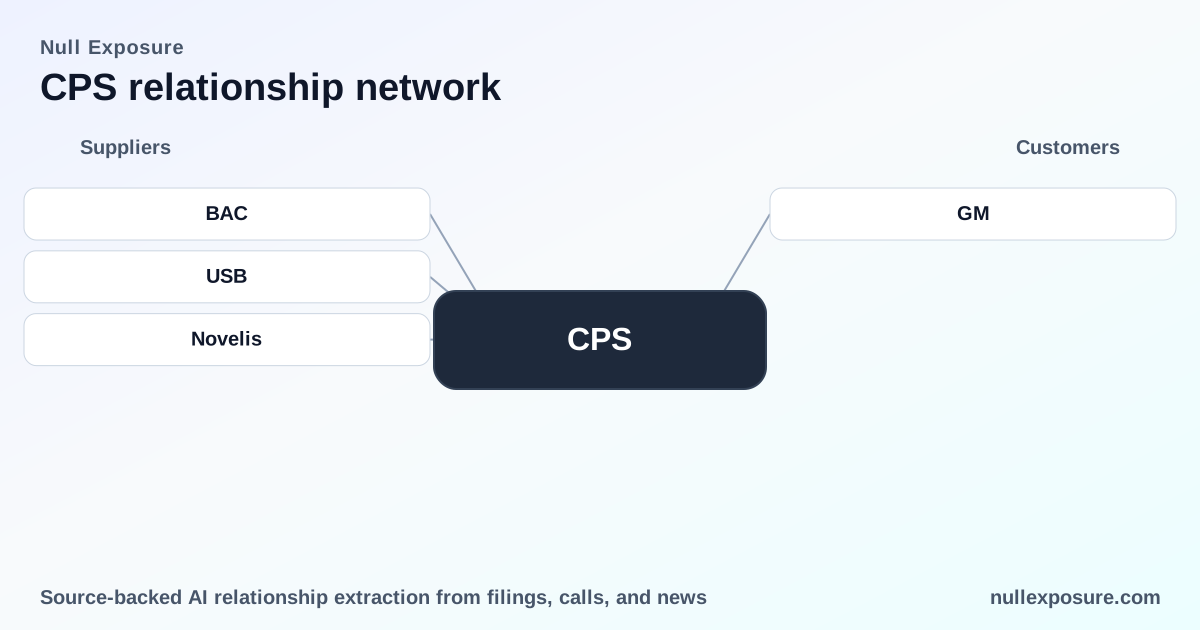
Cooper‑Standard (CPS): Customer relationships that anchor a supplier exposed to OEM cycles
Cooper‑Standard monetizes by designing and manufacturing sealing, fuel-supply and brake/fluid transfer systems sold primarily to global original equipment manufacturers (OEMs). The company converts engineering IP and scale manufacturing into recurring production contracts, generating $2.74 billion in trailing revenue and $201 million in EBITDA while remaining heavily concentrated in OEM channels. For investors evaluating customer risk and revenue durability, the headline is clear: customer quality is high but contract tenor is short, and revenue is geographically broad—an attractive combination for margin leverage in upcycles and a vulnerability during OEM production slowdowns. For a consolidated view of customer signals visit https://nullexposure.com/.
Company snapshot
- Cooper‑Standard is an automotive supplier focused on sealing and fluid systems; headquarters in Northville, Michigan.
- Financial scale: Revenue TTM $2.7409B, Market Cap ≈ $514M, EBITDA $201.4M.
- Profitability profile: Operating margin ~1.7% TTM and negative EPS on a trailing basis, reflecting cyclicality and capital structure dynamics.
What the customer signals tell investors Cooper‑Standard’s recent media and secondary sources document active, program‑level relationships with major OEMs and work on eco‑focused programs — evidence of engineering relevance and program wins with high‑quality counterparties. Below I summarize every relationship item in the provided results and link to the primary source language.
H2: General Motors recognition — Supplier of the Year (PR Newswire) H3: General Motors (listed as “General Motors”) — FY2025 Cooper‑Standard received General Motors’ 2024 Supplier of the Year Award at GM’s 33rd annual Supplier of the Year event in Phoenix, recognizing the supplier’s performance on GM programs. This public award underscores Cooper‑Standard’s program execution and scale within one of the largest North American OEMs. According to a PR Newswire release (first reported March 2026), GM presented Cooper‑Standard with the 2024 Supplier of the Year Award.
H3: GM (duplicate entry referencing same PR) — FY2025 The same PR indicates an identical fact: Cooper‑Standard was honored by GM for supplier performance on GM vehicle programs, reinforcing the earlier signal of deep program engagement. PR Newswire published the announcement in March 2026.
H2: Product innovation on a GM electric vehicle (SPE finalist) H3: General Motors (SahmCapital report) — FY2025 Cooper‑Standard’s quick connector with an integrated temperature sensor — used on a General Motors electric vehicle — was named an SPE Automotive Innovation Award finalist, highlighting the company’s role on EV components that carry technology premium and potential content growth per vehicle. SahmCapital reported this product recognition (article dated December 16, 2025, syndicated online and captured March 2026), which signals Cooper‑Standard is capturing higher‑value content on electrified platforms.
H3: GM (duplicate entry referencing the SPE finalist report) The duplicate SahmCapital entry reiterates that Cooper‑Standard’s quick connector is deployed on a GM EV and recognized by industry peers; this reinforces the company’s product R&D translating into program content on EVs. SahmCapital’s article (Dec 16, 2025) documents the finalist status.
H2: Partnership with Renault Group on low‑CO2 project H3: Renault Group (simplywall.st summary) — FY2026 Cooper‑Standard is collaborating with Renault Group on the Embleme project by supplying its FlexiCore thermoplastic body seal and FlushSeal sealing system to reduce vehicle CO2 emissions, indicating OEM demand for lighter, lower‑drag sealing systems. A simplywall.st company summary (captured May 2026) describes this engagement and situates Cooper‑Standard in Renault’s eco‑focused program work.
Operational constraints and what they mean for revenue durability The company disclosures and extracted constraints provide direct signals about how Cooper‑Standard sells and the risks embedded in that model. These are company‑level characteristics rather than relationship‑specific claims.
- Short‑term contract posture: The company discloses it commonly applies an exemption from disclosing remaining performance obligations because contracts typically have an original expected duration of one year or less. This indicates program flow‑through with frequent repricing or renewal cadence, which accelerates sensitivity to OEM order patterns and reduces long‑term visibility for investors.
- High OEM concentration: Approximately 86% of 2024 sales were to OEMs, reflecting deliberate positioning as a Tier‑1 supplier to large manufacturers; concentration benefits include scale and engineering lock‑in but raise counterparty risk and cyclicality.
- Geographic mix — North America important but global footprint substantial: In 2024, 59% of sales were generated in North America, while net sales outside the U.S. represented 78% of consolidated net sales when including certain non‑U.S. dollar denominated activity. The company operates as a global supplier, diversifying end‑market exposure but linking results to global vehicle production cycles.
- Seller role and product focus: Cooper‑Standard designs, manufactures and sells sealing and fluid handling systems as its primary revenue source, concentrating its technical and capital investments on a narrow set of product families that are critical to vehicle assembly.
Investor implications — upside, structural risks, and monitoring signals
- Upside drivers: OEM awards and product recognition from GM and Renault indicate successful program wins and engineering relevance, particularly as EV platforms demand new sealing and thermal management solutions. Product content per vehicle should rise on platforms that value light weight and integrated sensing.
- Structural risks: The short contract tenor reduces forward revenue visibility and increases exposure to OEM production swings and pricing pressure. High OEM concentration means a single OEM slowdown can materially impact results.
- Monitoring priorities: Watch order intake and program qualification announcements from GM, Renault and other OEMs; track gross margin trends and backlog disclosure (if provided) to assess pricing and content gains; follow geographic revenue splits for signs of end‑market recovery or weakness.
Practical takeaway and next analytical steps
- Customer quality is high: Multiple recognitions from GM and a project with Renault confirm Cooper‑Standard is winning and delivering on program‑level content with major OEMs.
- Visibility is limited: Short contract durations and OEM concentration require active monitoring of production schedules and program renewals to anticipate revenue swings.
- For deeper rolling surveillance of OEM program exposure and to track how supplier awards and product recognitions evolve into recurring revenue, see more at https://nullexposure.com/.
Conclusion Cooper‑Standard is a high‑quality Tier‑1 supplier with visible program traction on both North American and European OEM platforms, including EV content gains with GM and collaboration on Renault’s low‑CO2 program. The strategic tradeoff for investors is clear: engineering relevance and OEM penetration provide upside in vehicle production upcycles; short contract tenors and customer concentration amplify downside in downturns. Monitor OEM awards, program certifications and reported geographic revenue trends to convert the company’s product recognitions into conviction on revenue durability.