CPS Technologies (CPSH): Customer relationships that shape revenue durability and downside
CPS Technologies manufactures custom advanced materials and component solutions and monetizes primarily through multi-year, designed‑in product sales to systems houses and primes, supplemented by government R&D and development contracts that validate technology and seed future production work. Investors should view CPSH as a small-cap specialty supplier with sticky engineered revenues and concentrated customer exposure, offset by periodic non-dilutive government awards that improve development runway and commercial optionality. For a quick platform overview and monitoring tools, visit https://nullexposure.com/.
How CPSH actually sells — the operating model that matters
CPS sells custom, drawing-driven products rather than off-the-shelf commodity parts. Management states that virtually 100% of product sales are custom and the large majority are designed in and sold over multiple years, which creates revenue stickiness and long sales cycles but also means revenue is tightly coupled to a small set of engineered programs. Three customers accounted for 58% of revenue in 2024, which is material concentration and amplifies program-level volatility into the top line.
Key operating characteristics to price into models:
- Contracting posture: design‑in, long lead times, multi-year follow-on orders provide defensibility but slow visibility and lumpy bookings.
- Concentration risk: high customer concentration means single-program funding shifts materially affect quarterly results.
- Geographic reach: sales are global — United States, Europe and Asia — which diversifies end markets but keeps exposure to large systems houses and regional program timing.
- Revenue mix maturity: recurring production revenue from designed-in components sits alongside small, discrete government SBIR/STTR awards that are primarily technology development rather than immediate scale revenue.
Kinetic Protection — a defense prime relationship in transition
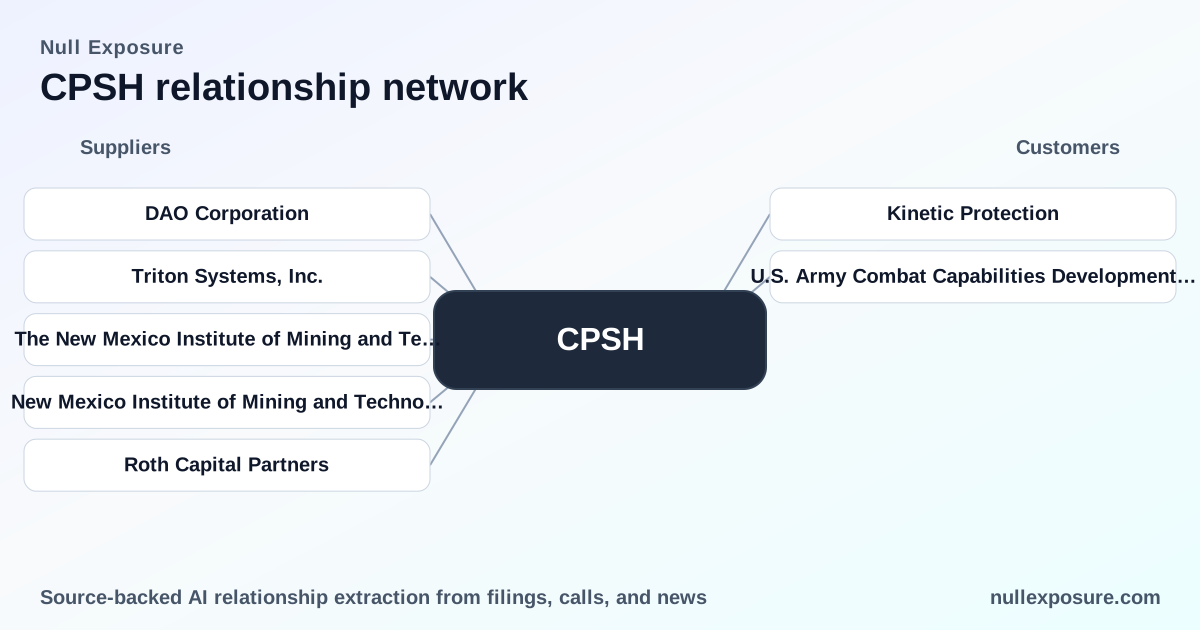
CPSH’s armor work with Kinetic Protection is a prime example of program-level timing driving results. Management disclosed the end of a U.S. Navy armor contract with Kinetic Protection in a 2024 Q3 earnings call, and later reported that Kinetic Protection — the prime contractor — expects orders supporting the U.S. Navy to resume in the latter half of the calendar year, following passage of the FY 2026 defense bill (comments repeated in Q4 2025 earnings call and related transcripts). This relationship is production‑oriented but subject to federal procurement timing and prime contractor ordering cycles. (Source: CPSH Q3 2024 and Q4 2025 earnings call remarks and public transcripts in early‑2026.)
U.S. Department of Energy — Phase I SBIR award for nuclear safety work
CPSH was awarded a Phase I SBIR contract from the U.S. Department of Energy’s Office of Nuclear Energy, demonstrating federal validation of a nuclear‑safety application for its materials and enabling early‑stage R&D funding without equity dilution. This Phase I award is development‑focused and signals route‑to‑market progress for energy sector applications rather than near‑term volume revenue. (Source: company announcement covered on QuiverQuant, May 2026.)
U.S. Army DEVCOM — Phase II STTR award and scale potential
CPSH secured a Phase II STTR contract funded by the U.S. Army Combat Capabilities Development Command (DEVCOM), reported in March 2026; press coverage cites a $1.15 million award to continue development of controlled‑fragmentation tungsten warhead technology. A Phase II STTR is larger and more advanced than Phase I and positions CPS to convert R&D success into prototype demonstrations that can lead to production contracts with defense primes. This award strengthens CPS’s defense pipeline but is still development stage relative to production revenue. (Source: company releases and coverage on QuiverQuant, Yahoo Finance and StockTitan, March 2026.)
What these relationships collectively signal for investors
Together, the customer mix and the government awards create a clear pattern: core revenue is driven by long‑lived, designed‑in production programs sold to large systems houses and defense primes, while government SBIR/STTR awards operate as non-dilutive technology catalysts that can open new markets or extend product roadmaps. The company‑level constraints are decisive:
- Long-term, designed‑in contracts give pricing power and customer stickiness but produce lumpy revenue recognition and long visibility horizons.
- Material concentration (three customers = 58% of 2024 revenue) increases sensitivity to individual program timing; a single prime’s ordering cadence can swing quarterly results.
- Large enterprise counterparties and global end markets imply rigorous qualification cycles and slow ramp but higher barriers to entry once qualified.
- Government R&D awards are important for de‑risking technical pathways and validating use cases in defense and energy but are not immediate revenue multipliers.
These characteristics should inform valuation multiples and scenario assumptions: treat SBIR/STTR awards as optionality and model revenue upside conservatively until production awards or recurring purchase orders are visible.
Short actionable checklist for monitoring CPSH execution
- Track Kinetic Protection / Navy order flow — watch management commentary and prime contractor announcements for firm orders and delivery schedules.
- Monitor progress and milestones on DOE SBIR and DEVCOM STTR programs; milestone achievements materially increase the probability of follow‑on funding or production contracts.
- Watch quarterly customer concentration trends — a diversification to reduce the three‑customer share below 50% would be de‑risking.
- Follow margin trajectory as production volumes scale and R&D spending normalizes; expansion will validate higher multiple assumptions.
Bottom line
CPS Technologies operates a highly engineered, customer‑concentrated business with valuable stickiness from designed‑in products and complementary government-funded R&D that validates new avenues for commercialization. The immediate investor decision hinges on conviction in CPS’s ability to convert development awards into recurring production contracts and to manage concentration risk while scaling margins. For tracker tools and deeper relationship analytics, see https://nullexposure.com/.
Bold takeaways: revenue stickiness exists but is program‑timing dependent; government awards materially de‑risk technology but do not replace production revenue; concentration is the principal near‑term risk.