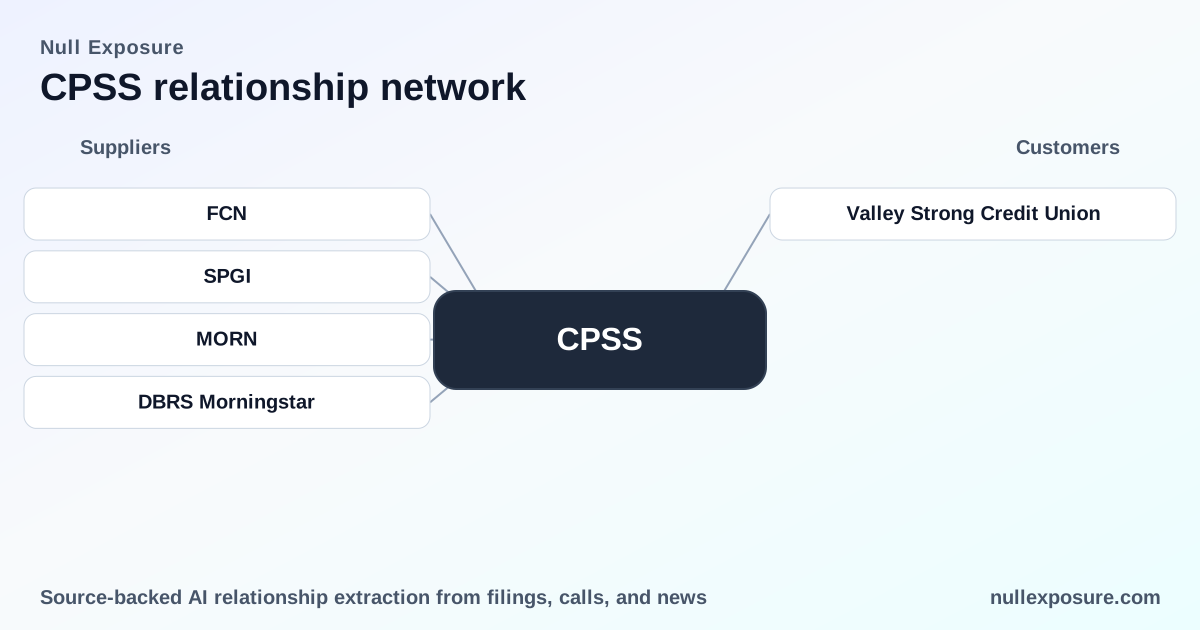
CPSS: How Consumer Portfolio Services monetizes dealer-originated auto credit and the Valley Strong forward flow
Consumer Portfolio Services (NASDAQ: CPSS) is a specialized finance company that purchases and services retail automobile contracts and funds them largely through securitizations and forward-flow arrangements with credit unions and other partners. The company monetizes originating margins, ongoing servicing fees, and sale proceeds from asset-backed financings while retaining credit performance exposure on its portfolio. For investors, the recent $900 million forward flow with Valley Strong Credit Union is a capacity and origination amplifier that changes growth and funding dynamics without a wholesale shift in CPSS’s business model. For a concise view of CPSS customer relationships and operational constraints, see more at https://nullexposure.com/.
What the Valley Strong deal concretely means for CPSS
Valley Strong Credit Union: CPSS announced it began a new forward-flow program with Valley Strong Credit Union on December 12, 2025, structured to originate and service prime automobile loans using CPS’s AI-enhanced loan and collections systems and potentially expand annual origination volumes by up to $900 million. According to a GlobeNewswire release republished by The Manila Times (Jan 13, 2026), CPS will leverage its proprietary, AI-enhanced systems on behalf of Valley Strong to originate and service loans (https://www.manilatimes.net/2026/01/13/tmt-newswire/globenewswire/cps-announces-new-900-million-forward-flow-agreement/2257951). Investing.com’s SEC-filings coverage (May 2026) and a Market/StockTitan synopsis also referenced the $900M forward flow as the driver of origination growth (https://m.ng.investing.com/news/sec-filings/consumer-portfolio-services-director-william-b-roberts-resigns-93CH-2327123?ampMode=1; https://www.stocktitan.net/news/CPSS/cps-announces-345-61-million-senior-subordinate-asset-backed-8i3wm4xy7i08.html).
Key relationship takeaway: the Valley Strong agreement is a forward-flow origination and servicing partnership that adds scale and diversifies CPSS’s origination channels while keeping CPSS in a servicing and underwriting role.
How CPSS’s operating model and partner constraints shape outcomes
CPSS’s relationship architecture and corporate constraints are consistent and predictable:
- Contracting posture: long-term financing through securitizations. CPSS generally finances originated contracts on a long-term basis via securitizations; maximum purchased contract terms can reach 78 months depending on program and underwriting factors. This implies a funding profile that is sensitive to ABS markets and structural liquidity windows.
- Counterparty profile: individual sub-prime borrowers as the core exposure. CPSS focuses on vehicle purchasers who typically do not qualify at large banks or captive finance companies; that positions credit risk at the borrower level rather than concentrated single-counterparty exposures.
- Geographic concentration: U.S.-centric, with state-level clustering. Sales concentrate in the United States with particular weight in California, Florida, and Texas, producing regional credit-cycle sensitivity.
- Materiality: low dealer concentration. No single dealer accounted for 2% of purchased contracts during 2024, signaling dealer diversification and limited single-dealer counterparty risk.
- Role mix: both service provider and seller. CPSS collects base servicing fees for third-party receivables and also sells pools into special-purpose vehicles for securitizations—so revenue streams include servicing fees, originations, and sale proceeds.
- Segment posture: specialty finance focused on auto contracts. The firm operates as a specialty finance provider buying and servicing retail automobile contracts, not as a broad consumer lender.
These constraints are company-level signals that define contract lifetime, funding structure, and sensitivity to ABS markets and regional credit cycles; they are not assigned to an individual customer unless explicitly named.
Why the Valley Strong flow matters for the investment case
The $900 million forward flow is meaningful on three fronts:
- Growth capacity: it materially increases CPSS’s potential annual originations without CPSS having to retail-distribute itself, using Valley Strong as a distribution partner while CPSS provides originations and servicing know-how (GlobeNewswire/Manila Times, Jan 13, 2026).
- Margin mix: forward flows can reallocate risk and return—CPSS captures servicing fees and origination gains while shifting securitization economics; this should support fee income but also requires disciplined underwriting to maintain net interest and loss performance.
- Funding elasticity: by pairing originations with forward agreements, CPSS can scale originations while managing balance-sheet duration via sale/sponsor structures rather than relying solely on warehouse lines or retained credit.
Financial context strengthens the view: CPSS reported TTM revenue of approximately $198.9 million, a trailing PE of 11.8, forward PE of 5.2, and a Price-to-Book of 0.67—valuations consistent with a small-cap specialty finance firm with modest profitability and higher leverage to credit cycles (Company overview, latest quarter 2025-12-31).
Relationship-by-relationship review (all identified customers)
Valley Strong Credit Union — CPSS began a forward-flow program on December 12, 2025 under which CPS will use its AI-enhanced loan and collections systems to originate and service prime automobile loans, with the program capable of expanding origination volumes by up to $900 million (GlobeNewswire/Manila Times, Jan 13, 2026; Investing.com SEC coverage, May 2026; StockTitan summary, Mar 2026). Links: https://www.manilatimes.net/2026/01/13/tmt-newswire/globenewswire/cps-announces-new-900-million-forward-flow-agreement/2257951; https://m.ng.investing.com/news/sec-filings/consumer-portfolio-services-director-william-b-roberts-resigns-93CH-2327123?ampMode=1; https://www.stocktitan.net/news/CPSS/cps-announces-345-61-million-senior-subordinate-asset-backed-8i3wm4xy7i08.html.
Risk considerations that flow from relationships and constraints
- ABS market and securitization risk: CPSS finances via securitizations; a stressed ABS market or higher funding spreads would compress net yields and could slow the pace of forward-flow rollouts.
- Regional credit cycles: geographic concentration in CA/FL/TX creates exposure to localized employment or housing-driven credit deterioration.
- Credit-performance sensitivity: serving sub-prime and thin-file borrowers increases default volatility and requires active collections; the value of the AI-enhanced servicing platform is therefore economically material.
- Fee concentration risk: servicing and origination fees are meaningful parts of other income; declines in third-party servicing fee volumes can depress profitability.
Bottom line and practical next steps for investors
Consumer Portfolio Services is a compact, specialty auto-finance operator whose forward-flow relationships—exemplified by the Valley Strong $900M deal—are core levers for scaling originations without proportionate balance-sheet expansion. The deal increases near-term growth optionality while leaving CPSS’s core funding and servicing model intact. Investors should monitor ABS market conditions, regional credit performance in CA/FL/TX, and quarterly disclosures on volumes and fee income to assess whether the forward flow translates into durable earnings expansion.
For a deeper, structured view of CPSS customer relationships and to track how partnerships like Valley Strong move CPSS’s origination and servicing economics, visit https://nullexposure.com/.