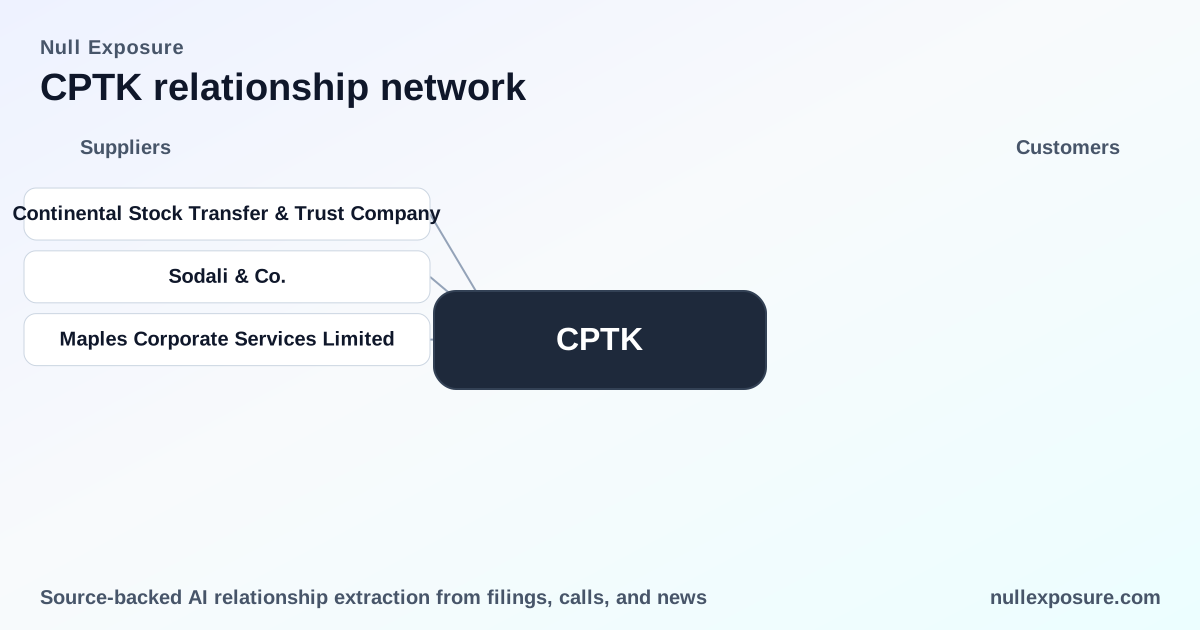
CPTK customer relationships: sponsor transactions and what they mean for investors
Crown PropTech Holdings (CPTK) operates as a SPAC-born real estate technology consolidator that monetizes through rolled-up operating companies, sponsor equity, and warrant structures that convert into meaningful ownership stakes across its capital base. Sponsor share purchases and private placement warrants are a material feature of CPTK’s capital formation and control profile, shaping dilution, governance incentives, and downstream investor returns.
For a deeper view of CPTK counterparty exposure and sponsorship dynamics, visit https://nullexposure.com/.
Why sponsor transactions matter for an investor evaluating CPTK
Sponsor-related transactions are not peripheral for SPAC-origin companies; they define initial control, capital commitments, and the timing of dilution. Large blocks of Class B shares and private placement warrants concentrate economic upside and can compress or expand public shareholder returns depending on exercise, transfer, or resale activity. Assessing CPTK’s counterparties and the timing of their purchases delivers insight into governance alignment and future capitalization events.
Every reported customer-related relationship (readable summaries)
CIIG Management III LLC — SpacInsider report (headline post, FY2023)
CIIG Management III LLC entered into a securities assignment agreement to purchase 5,662,000 Class B ordinary shares and 250,667 private placement warrants from CPTK, a transaction reported in May 2026 as relating to FY2023 activity. According to SpacInsider’s headline coverage, this purchase transfers a sizeable sponsor-related equity block and related warrant positions into CIIG Management III LLC’s control (https://www.spacinsider.com/news/headline-post/crown-proptech-cptk-sells-sponsor-shares).
CIIG Management III LLC — SpacInsider intelligence piece (FY2023)
A separate SpacInsider intelligence article documents the same securities assignment: CIIG Management III LLC purchased 5,662,000 Class B ordinary shares and 250,667 private placement warrants tied to CPTK’s sponsor capital structure. The second article reinforces the transaction’s scale and timing as reported on May 2, 2026 (https://www.spacinsider.com/news/intel/crown-proptech-cptk-sells-sponsor-shares).
Crown PropTech Sponsor, LLC — SEC S‑1 disclosure (FY2021)
Crown PropTech Sponsor, LLC agreed in the company’s S‑1 filing to purchase 4,000,000 Private Placement Warrants (4,400,000 if the over‑allotment is exercised) at $1.50 per warrant, for an aggregate purchase price of $6,000,000 (or $6,600,000) as part of the IPO private placement that closed with the public offering. The S‑1 documents the sponsor’s initial capital commitment and the contractual warrant economics that shape CPTK’s early ownership and incentive architecture (SEC S‑1 filing, FY2021: https://www.sec.gov/Archives/edgar/data/1827899/000095010321000758/dp144467_s1.htm).
What these relationships collectively signal about CPTK’s operating model
- Contracting posture: Sponsor and sponsor‑adjacent entities constitute active counterparties in equity and warrant transfers, indicating a contracting posture centered on negotiated sponsor sales and assignments rather than simple market-driven dispersion. These are bilateral securities assignments and private placements rather than open market transactions.
- Concentration: The transactions involve multi‑million share and warrant blocks, which represent a concentrated holder base in the sponsor ecosystem. Concentrated sponsor holdings create single‑party influence over dilution timing and resale flows that can materially affect public float dynamics.
- Criticality: Sponsor agreements are critical to CPTK’s capital structure and governance, not its day‑to‑day operations, but they are material to investor outcomes because of dilution, potential control shifts, and cash injections tied to warrant exercises or sponsor purchases.
- Maturity: The timeline spans the IPO era (FY2021 S‑1) through subsequent sponsor share reassignment activity (FY2023 reporting surfaced in 2026), reflecting a multi‑year evolution of sponsor capital positions as the company moved from formation toward post‑IPO capitalization events.
Note: there are no explicit contractual constraints flagged in the available results; this absence is itself a signal that public filings and press coverage emphasize equity/warrant transactions rather than restrictive supplier or customer covenants.
Investment implications — where this influences valuation and risk
- Dilution pathway is explicit and quantifiable. The sponsor purchase prices and warrant counts reported in the S‑1 provide a floor for potential cash inflows and dilution mechanics; investor returns must be modeled with these warrant economics in mind.
- Control and resale risk are non‑trivial. Large single‑party blocks create the risk that secondary transfers or lockup expirations drive volatility in public shares. The recent securities assignment to CIIG Management III LLC both consolidates and re‑allocates that risk.
- Sponsor incentives matter for execution. Sponsor entities with sizable retained positions inherently link sponsor upside to company performance; this alignment can drive active support or, conversely, incentive-driven behavior around liquidity events.
Practical diligence checklist for operators and investors
- Review the S‑1 sponsor warrant economics and model exercises at multiple price points.
- Map lockup terms and resale restrictions attached to transferred Class B shares and warrants.
- Monitor ownership filings post‑transaction to observe whether CIIG Management III LLC reduces concentration via sales or holds for conversion.
For a consolidated view of sponsor flows and how they influence public float and governance, see our platform at https://nullexposure.com/.
Bottom line
Sponsor share purchases and private placement warrants are central to CPTK’s capital story. The S‑1 establishes the foundational warrant economics and sponsor commitment; later reported assignments to CIIG Management III LLC demonstrate active repositioning of those sponsor interests. For investors and operators, these relationships are a direct lever on dilution, control, and the timing of liquidity — factors that should be baked into valuation, governance monitoring, and risk management.