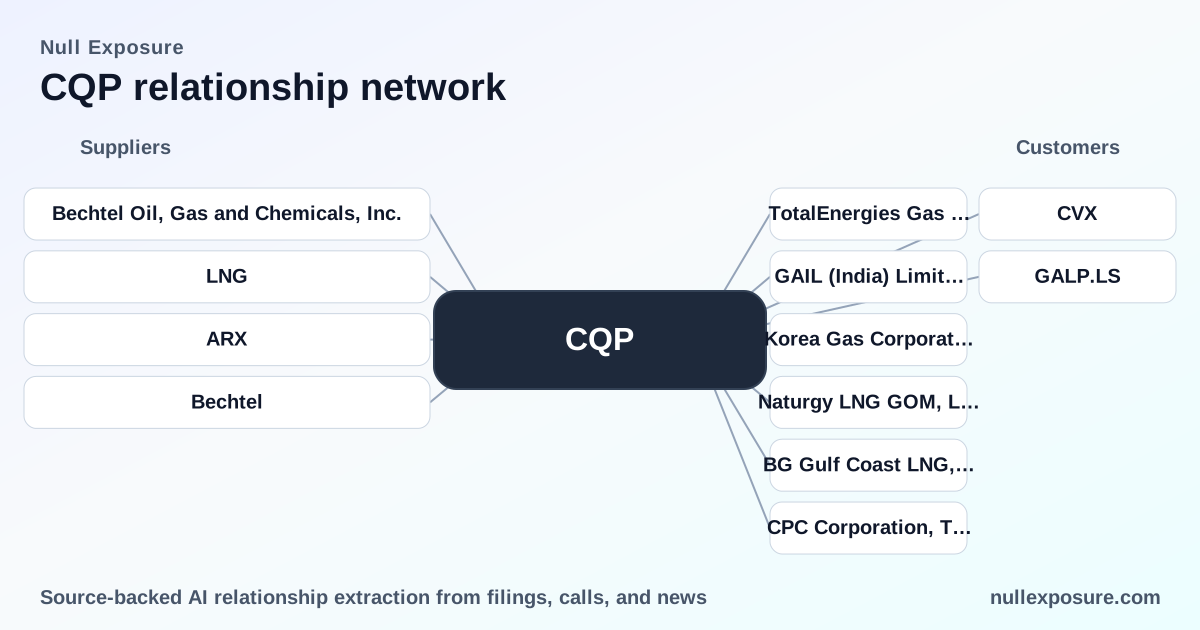
Cheniere Energy Partners (CQP): customer relationships that underpin recurring cash flows
Cheniere Energy Partners monetizes regasification and liquefaction capacity by selling long‑term, fee‑based LNG services and cargoes to integrated energy companies, utilities and trading firms; its business model is fundamentally anchored on long‑dated SPAs and terminal use agreements that convert capacity into predictable cash flows. Investors evaluating CQP should focus on concentration among a handful of large counterparties, the geographic breadth of offtake (North America and APAC highlighted), and a small number of material customers that account for double‑digit shares of consolidated revenue. For direct access to our relationship signals and source links, visit the Null Exposure homepage: https://nullexposure.com/
Why the customer roster matters for valuation
CQP’s revenue profile is highly contractual and inherently asset‑backed: fixed fees under SPAs and TUAs limit volume risk and preserve margin on committed capacity, while spot exposure remains secondary. The FY2024 10‑K lists multiple customers that each contribute double‑digit percentages to consolidated revenue, creating both revenue stability and concentration risk—a combination that directly affects credit metrics and dividend sustainability.
Key takeaways up front:
- Long‑term contracts dominate the company’s commercial mix and support predictable cash flows.
- A small number of customers account for material revenue shares, amplifying counterparty concentration risk.
- Counterparties are large, global energy companies and national utilities, consistent with CQP’s focus on secure, institutional offtake.
The top counterparties that move the numbers
According to Cheniere’s FY2024 Form 10‑K, several counterparties each accounted for 10% or more of consolidated revenues; the filing and related public commentary define the core customer footprint below.
TotalEnergies Gas & Power North America, Inc.
Cheniere’s 2024 Form 10‑K shows TotalEnergies accounted for roughly 11% of consolidated revenues and holds a long‑term Terminal Use Agreement (TUA) for 1 Bcf/d that requires fixed monthly payments whether capacity is used or not, making this a material, fee‑based relationship. (Source: CQP FY2024 Form 10‑K)
BG Gulf Coast LNG, LLC and affiliates
BG Gulf Coast is listed in the FY2024 10‑K as accounting for about 22% of consolidated revenues, the single largest customer share disclosed and a clear concentration point for revenue and counterparty exposure. (Source: CQP FY2024 Form 10‑K)
GAIL (India) Limited
GAIL is reported as contributing approximately 15% of consolidated revenues in FY2024, reflecting Cheniere’s penetration into South Asian utility markets through long‑dated commercial commitments. (Source: CQP FY2024 Form 10‑K)
Korea Gas Corporation (KOGAS)
Korea Gas Corporation also represented about 15% of revenues in FY2024, underscoring the company’s strategic placements into East Asian utility offtake corridors. (Source: CQP FY2024 Form 10‑K)
Naturgy LNG GOM, Limited
Naturgy accounted for about 14% of consolidated revenues in FY2024, further demonstrating that a handful of large contracts drive a substantial portion of Cheniere’s top line. (Source: CQP FY2024 Form 10‑K)
Recent contract wins and one‑off payments that matter
CPC Corporation (news: Sahm Capital, March 2026)
A March 2026 note observed that Cheniere signed a new long‑term LNG supply contract with Taiwan’s CPC Corporation following capacity additions on Train 5; this contract expands CQP’s Asia‑Pacific footprint. (Source: Sahm Capital, March 26, 2026)
CPC Corporation, Taiwan (news: Intellectia, March 2026)
Independent coverage in March 2026 reported a long‑term SPA with CPC Corporation, Taiwan for up to 1.2 MTPA of LNG, reinforcing Cheniere’s strategy of layering new long‑term sales onto additional liquefaction capacity. (Source: Intellectia news, March 2026)
Chevron U.S.A. Inc. (press release / Cheniere IR, FY2023)
Cheniere’s investor press release for FY2022/FY2023 results disclosed that Chevron paid a $765 million lump‑sum as part of an early termination of a TUA, which positively impacted consolidated adjusted EBITDA for the periods reported. That one‑time payment is tangible evidence that TUAs can produce lump‑sum economic events that affect near‑term earnings. (Source: Cheniere press release, FY2023 reporting)
CVX (duplicate entry — Cheniere press release, FY2023)
The same Cheniere release is captured under the CVX ticker name, reiterating the $765 million lump‑sum recognition tied to Chevron/CVX and the early TUA termination that materially affected consolidated results in the reported period. (Source: Cheniere press release, FY2023 reporting)
New SPAs and the Galp commitment
GALP.LS (earnings call excerpt, 2024 Q2)
During the 2024 Q2 earnings call Cheniere announced it entered a long‑term SPA with Galp for approximately 0.5 MTPA over 20 years, a structural offtake that supports long‑dated utilization of liquefaction capacity. (Source: CQP 2024 Q2 earnings call)
Galp (duplicate entry — earnings call, 2024 Q2)
The same earnings call entry is recorded twice in the results, reinforcing the 0.5 MTPA / 20‑year SPA with Galp as an active, long‑dated customer commitment. (Source: CQP 2024 Q2 earnings call)
Constraints and commercial posture: what drives the model
Cheniere’s public filings and voice‑of‑management commentary make the company’s commercial constraints and strengths explicit:
- Contract type: long‑term — Management states that roughly 80% of anticipated production through the mid‑2030s is covered by long‑term SPAs, establishing cash flow visibility and lowering merchant volume risk. (Company filing language cited in constraints)
- Counterparty type: large enterprises — Customers are principally integrated energy companies, utilities and trading firms, a profile that supports credit quality and contract enforceability. (Company filings)
- Geographic reach: global, with clear NA and APAC exposure — The company sells FOB from Sabine Pass (North America) and has multiple SPAs with Asian utilities, reflecting a global offtake strategy. The FY2024 10‑K specifically documents SPAs with BG Gulf Coast (North America) and KOGAS (APAC) as examples. (Company filings)
- Materiality and concentration — Multiple counterparties each represent 10%+ of consolidated revenue, concentrating counterparty risk while simultaneously providing material, fee‑based cash flows.
- Relationship role and stage — Cheniere consistently operates as the seller of LNG and regasification capacity, with most long‑term SPAs in active delivery or ramp‑up stages.
These constraints are company‑level signals that explain why Cheniere trades more like an asset‑intensive utilities/transportation hybrid than a commodity merchant.
What investors should watch next
- Counterparty concentration: the top five disclosed counterparties together represent a sizeable portion of consolidated revenue; a material change in any one of those contracts would affect cash flow and credit metrics.
- Contract renewals and early terminations: the Chevron lump‑sum demonstrates both risk and opportunity from contract exits; monitor renewal cadence and TUA negotiation terms.
- Capacity additions and new SPAs: Train‑level capacity increases (e.g., Train 5) are catalysts when paired with long‑term SPAs, as seen with CPC and Galp announcements.
For a consolidated view of Cheniere’s counterparties and the primary source evidence behind these relationships, see our relationship dashboard: https://nullexposure.com/
Bottom line
Cheniere’s customer portfolio is contract‑heavy, concentrated, and dominated by large global counterparties, which creates predictable, fee‑based revenue but leaves the company exposed to a small number of material counterparties. Investors should value CQP through the lens of contract durability, counterparty credit, and the pace of capacity commissioning and SPA roll‑out.