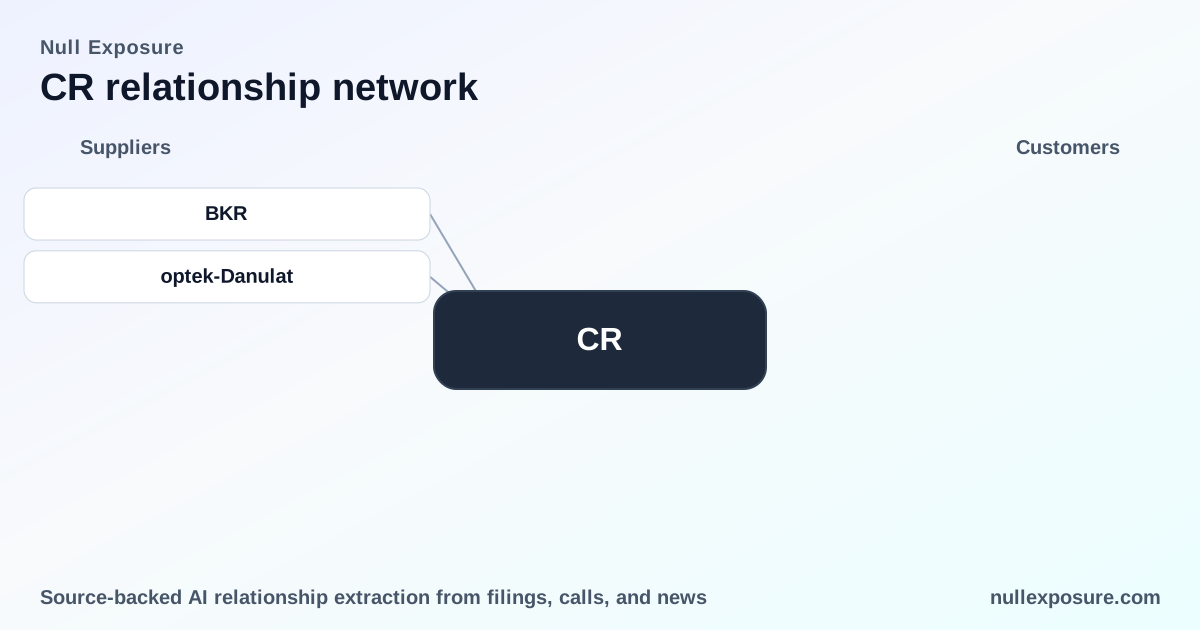
Crane Company (CR): Customer relationships that anchor aerospace defense and nuclear exposure
Crane Company manufactures and sells engineered industrial components — valves, pumps, actuators and systems — and monetizes through direct product sales, long-term contract revenue and sizable backlog in mission-critical aerospace, defense and process markets. Its operating model is production-heavy, global in scope and skewed toward engineered, often sole-sourced content that converts backlog into multi-year revenue. For a focused view of customer counterparty exposure and the implications for investors, read on. For an ongoing feed of relationship intelligence visit https://nullexposure.com/.
How Crane makes money — a succinct investor thesis
Crane is a manufacturing-led industrial platform: it wins engineered design and production contracts for critical systems (aerospace braking systems, valve packages for nuclear reactors, lubrication systems) and recognizes revenue over time from those contracts. The company’s backlog and long-term contract posture drive forward revenue visibility — the company reported a backlog of $1,240.2 million as of December 31, 2024, with approximately 81% expected to convert to revenue in 2025 and a further 15% in 2026, creating a near-term revenue runway. Financial scale is material: market capitalization is roughly $9.86 billion with trailing revenue of about $2.44 billion, positioning Crane as a meaningful vendor to government and large industrial customers.
Direct customer relationships to know right now
Crane publicly highlighted two customer relationships in its recent communications. Both illustrate the company’s dual exposure to defense prime programs and large-scale nuclear construction.
United States Air Force — direct defense customer on F-16 program
Crane disclosed that it will begin production for an F-16 brake control project in 2026 and that it received a follow-on order from the United States Air Force as part of those program wins. This positions Crane as a supplier on a recurring military platform, reinforcing its role as a government counterparty vendor for aerospace safety-critical hardware. According to the Q4 2025 earnings call transcript on Fool.com (April 21, 2026), Crane confirmed the production start and the award of follow-on orders.
Westinghouse — strong valve footprint on AP1000 reactor activity
Crane affirmed a very strong position with Westinghouse on the AP1000 reactor program within its valve business, and referenced expected starts in Europe associated with new construction demand. That comment signals Crane’s exposure to nuclear new-build cycles via large OEMs and its ability to capture project-level valve work. The remark was made during Crane’s Q4 2025 earnings call (Fool.com transcript, April 21, 2026).
What these relationships mean for revenue quality and risk
Crane’s customer roster — as illustrated by the Air Force and Westinghouse — implies several structural characteristics for investors:
- Contracting posture: The company recognizes a meaningful portion of revenue from long-term contracts and progress-based performance obligations, which supports revenue visibility but increases dependency on execution and milestone delivery. Audit language around long-term contract accounting confirms management treats these engagements as extended performance obligations.
- Customer concentration and criticality: Crane operates in mission-critical, often sole-sourced niches (for example, complex lubrication and brake systems), making individual programs high-impact to segment results when awards are material. Government and large OEM customers represent concentrated, high-importance relationships.
- Maturity and predictability: Backlog conversion rates (81% in the immediate next year) create predictable revenue flows, but they rely on program timelines and customer-funded starts that can shift with defense budgets or nuclear project approvals.
- Global footprint: Almost half of sales occur outside the U.S. (net sales outside the U.S. were 43.2% in 2024), so Crane’s program execution and supply chain are exposed to regional construction cycles and export/compliance regimes.
Company-level signals from contract and counterparty disclosures
The following constraints and disclosures are best read as company-level operating signals rather than relationship-specific claims:
- Crane emphasizes long-term contract revenue recognition, with management explicitly evaluating progress-based transfer of control for performance obligations.
- The firm has revenue contracts with the U.S. government, and also sells to government entities indirectly through subcontracts, signaling multiple government revenue channels.
- The business is global by design: substantial non-U.S. revenues and named product lines (e.g., Vian lubrication systems) that are used on international commercial and military aircraft.
- Role definitions are straightforward: Crane is both a manufacturer and seller of engineered components, operating within the manufacturing segment of specialty industrial machinery.
- Scale of programs is material: backlog of $1.24 billion implies spend-band exposure at or above the $100 million+ level for program clusters, underpinning the company’s medium-term revenue outlook.
Investment implications — upside drivers and watch points
Crane’s customer mix offers high-quality revenue visibility and exposure to secular themes (defense recapitalization, nuclear new-builds, aftermarket safety upgrades). Key investment implications:
- Upside drivers: backlog conversion, follow-on orders from defense primes, and incremental reactor starts in Europe can drive margin-accretive revenue given Crane’s position in valves and engineered assemblies.
- Execution risk: long-term contracts require disciplined program management; missed milestones or production issues translate to revenue timing shifts and potential rework costs.
- Concentration & geopolitical risk: reliance on government programs and large OEMs concentrates performance risk, and the global footprint exposes the company to regional program timing and export controls.
- Valuation context: the company trades with a trailing P/E around 31.5 and an EV/EBITDA of ~21.3, which prices an expectation of continued high-quality execution and backlog realization.
For a continuous, structured view of Crane’s customer relationships and the implications for credit and revenue risk, visit https://nullexposure.com/ to see how these connections evolve alongside program awards and backlog movement.
Bottom line
Crane’s recent disclosures articulate a clear commercial stance: highly engineered, long-term government and OEM contracts that create predictable near-term revenue via a sizable backlog, but that also concentrate execution risk in a few mission-critical programs. The United States Air Force contract for F-16 brake controls and a strong position with Westinghouse on AP1000 valves are emblematic of this model — they drive revenue visibility but demand flawless program delivery. Investors should weigh backlog conversion and program execution as primary drivers of short-to-medium-term performance.