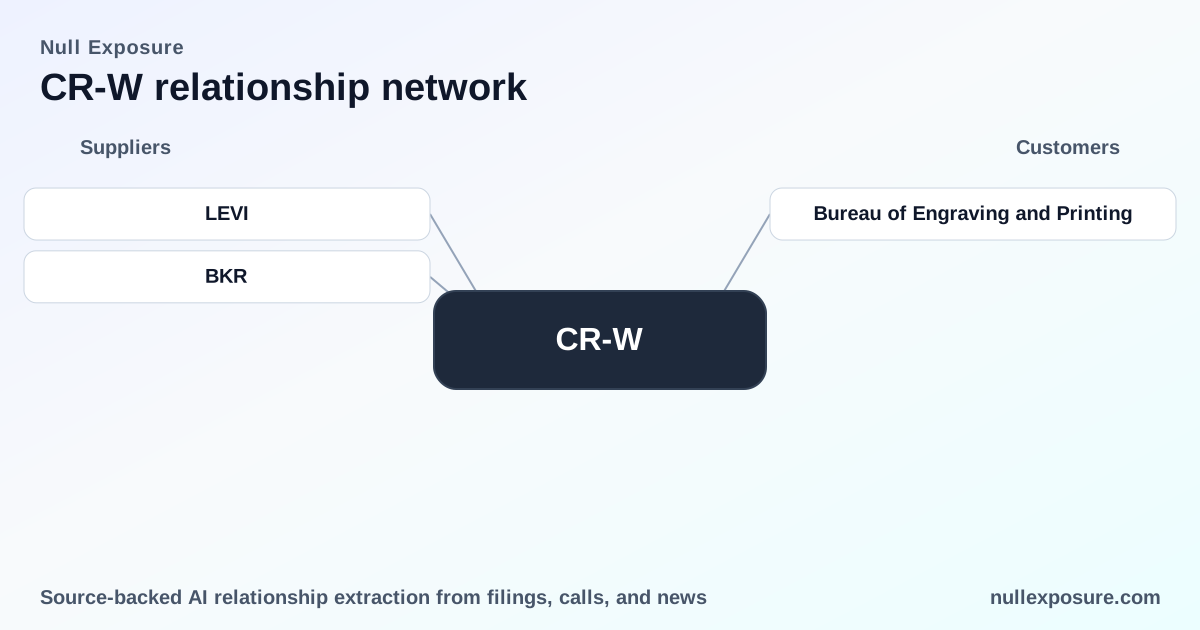
Crane Currency (CR‑W) — Customer Intelligence: Bureau of Engraving and Printing
Thesis — Crane Currency operates as a specialized supplier of currency substrate and security features to sovereign and minting institutions, monetizing through proprietary materials, brand-positioned exclusivity and long‑run supply relationships that embed high switching costs. The company’s commercial posture centers on defending traditional banknote paper as a distinct product category versus polymer alternatives, and that positioning drives both pricing power and concentration risk for investors evaluating customer exposure.
Learn more at https://nullexposure.com/.
The single relationship that defines the customer book today
- Bureau of Engraving and Printing (BEP): Crane Currency is identified as the exclusive provider of currency paper to the U.S. Bureau of Engraving and Printing, with the company actively promoting traditional paper over polymer banknote substrates. This is presented in an essay referenced by Central Banking and reported by Coin World in March 2026 (the underlying commentary ties back to FY2021 themes). (Source: Coin World, March 9, 2026, citing an essay in Central Banking.)
Why the BEP relationship matters to investors
The BEP contract is not a typical commercial sale — it represents an operationally critical supply line to the U.S. federal currency-production process. Exclusivity to the BEP implies elevated revenue concentration and strategic importance, because currency paper is both mission‑critical and high‑barrier to replace. The company’s public defense of traditional paper over polymer reveals a deliberate product strategy designed to preserve incumbency and margins against substitution risk. (Source: Coin World / Central Banking essay reference, FY2021 / reported March 2026.)
What the BEP link says about Crane’s operating model
- Contracting posture: Exclusive supplier status signals negotiated, durable supply arrangements with strong vendor integration. That posture favors predictable recurring revenue but creates dependency on a small number of sovereign clients for a disproportionate share of value capture.
- Concentration: Being sole supplier to a major national printer concentrates customer risk; any policy change at the BEP or a shift toward alternative substrates would have an outsized top‑line impact.
- Criticality: Currency paper is a non‑discretionary input for banknote issuance. The product’s criticality supports premium pricing and operational prioritization but also invites intense scrutiny and compliance obligations.
- Maturity and differentiation: The company’s active defense of "traditional paper" versus polymer positions the product as mature but differentiated through embedded security features and institutional trust — a defensive moat rather than a high‑growth market expansion strategy. (Source: Coin World reporting on Central Banking essay, FY2021 / March 2026.)
Risk and upside framed for investors
- Key upside: Long‑duration exclusivity and the entrenched nature of paper currency procurement offer steady, inflation‑linked revenue streams and high customer switching costs. This supports predictable cash generation for valuation models.
- Key risks: Customer concentration risk and technology substitution are the two dominant negatives. If central banks accelerate a shift to polymer substrates or if procurement policy changes, revenue volatility would increase materially. Regulatory or security failures in supply could prompt contract termination or reputational damage disproportionate to the company’s size. (Source: Coin World / Central Banking essay, FY2021; reporting first seen March 2026.)
Relationship rundown — concise investor notes
- Bureau of Engraving and Printing — Crane Currency is reported as the exclusive supplier of currency paper to the BEP; the company publicly advocates for traditional paper versus polymer banknotes in industry commentary. This exclusivity underpins strategic importance and revenue concentration for Crane. (Source: Coin World, March 9, 2026, referencing an essay in Central Banking tied to FY2021.)
Constraints and what is not recorded
The customer feed returned no explicit contractual constraints such as contract durations, minimum purchase commitments, penalty clauses, or termination rights. Absent discrete constraint disclosures in the record, treat contracting characteristics as company‑level signals inferred from public commentary and exclusivity claims rather than formally documented terms. In practice, that means:
- Analysts should model for long‑dated, high‑certainty revenue from sovereign supply while stress‑testing for abrupt policy shifts.
- Valuation scenarios should reflect both the cash‑flow stability of exclusivity and the non‑trivial downside from substrate substitution or procurement policy changes.
Bottom line for operators and investors
Crane Currency’s relationship with the BEP is strategically valuable and operationally critical, underpinning a business model that extracts premium pricing from entrenched procurement channels. The same exclusivity that supports margin durability also concentrates risk; investment theses should balance the low‑volatility cash flow characteristics of a monopoly supplier against policy and technology substitution scenarios. For deeper customer intelligence and to compare this relationship across other sovereign supply arrangements, visit https://nullexposure.com/.
Key takeaway: Exclusive supply to a national currency printer is a strong commercial asset — but it is also a concentration risk that requires active governance and scenario planning in any investment model.