CRA International (CRAI) — how customer engagements drive the business and what investors should prize
CRA International is a specialist economic, financial and management consulting firm that monetizes expertise through fee-for-service advisory work: time-and-materials engagements, short-duration contracts, repeat retainers and discrete auction/independent‑evaluator mandates for utilities and large corporations. Its revenue model is services-led, concentrated in North America but supported by global capability, with profit margins driven by utilization and high-value regulatory and M&A advisory work. For a quick company-level reference, see the firm’s profile at NullExposure: https://nullexposure.com/.
How CRA converts expertise into cash
CRA sells professional services to large enterprises, government agencies and utilities, recognizing revenue when services are delivered and invoiced. The company reports that most work is charged on a time-and-materials basis and contracts typically have original terms of one year or less, which constrains deferred revenue but keeps invoicing and cash conversion rapid. Institutional ownership is high and the firm carries attractive returns on equity, reflecting a scalable human-capital business that benefits from repeat engagements and selective high-fee assignments.
Recent client engagements investors should know
Below I catalogue every named client relationship surfaced in the recent signal set and provide a concise summary of CRA’s role in each, with source references.
-
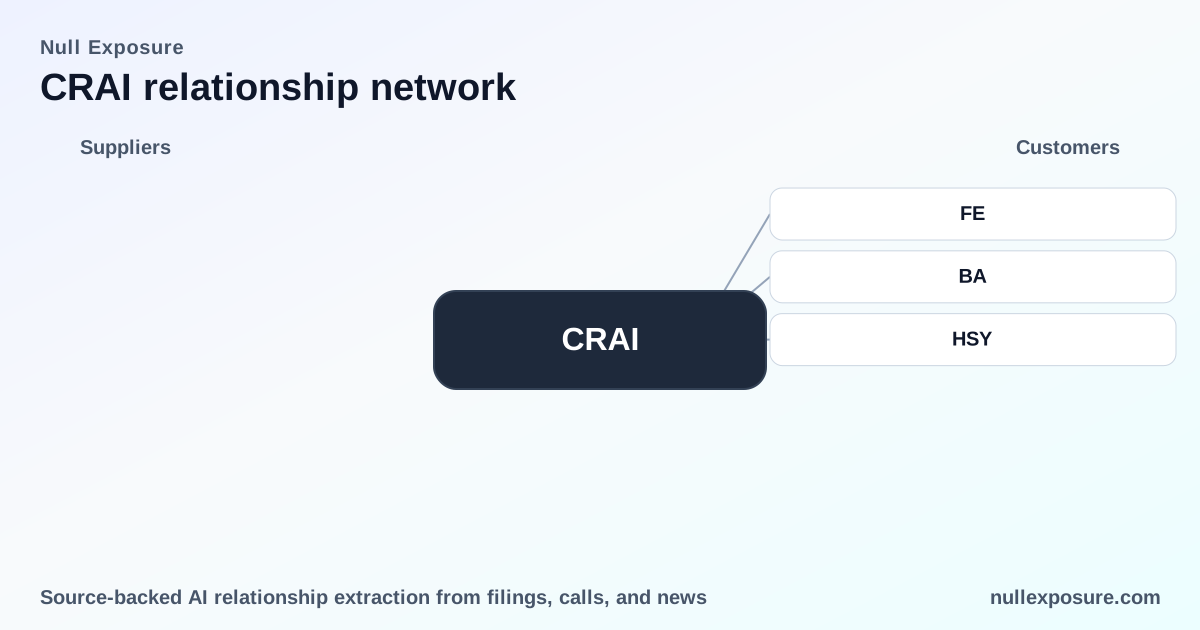
FirstEnergy / FE — CRA has been engaged as the auction manager and independent evaluator for FirstEnergy Pennsylvania’s Default Service Program (DSP‑VI). This is a fee-bearing role where CRA runs procurement auctions for default supply, a recurring professional-services engagement tied to regulated utility procurement cycles. According to an ad-hoc market notice (March 9, 2026), CRA will manage the DSP‑VI auction for FirstEnergy Pennsylvania. (Ad-hoc News, Mar 9, 2026: https://www.ad-hoc-news.de/boerse/ueberblick/cra-international-stock-key-dates-and-catalysts-on-the-horizon/68556885)
-
FirstEnergy Pennsylvania Electric Company — The company’s Pennsylvania electric affiliate formally announced auctions for full‑requirements default supply and identified CRA as the Independent Evaluator and Auction Manager, a structured procurement assignment with defined deliverables and timeline. StockTitan published a notice describing CRA’s role in managing FE PA’s auction process (Mar 2026). (StockTitan news, Mar 2026: https://www.stocktitan.net/news/CRAI/first-energy-s-pennsylvania-default-service-program-dsp-vi-auctions-30dui5ca9dbz.html)
-
FirstEnergy (Ohio subsidiaries) — CRA was named Auction Manager for FirstEnergy’s Ohio standard service procurement covering Ohio Edison, The Cleveland Electric Illuminating Company and The Toledo Edison Company, a similar utility auction mandate executed in the Ohio retail market. The announcement was reported in early May 2026. (Intellectia/News feed, May 2, 2026: https://intellectia.ai/en/stock/CRAI/news)
-
Ohio Edison Company — As one of the named Ohio standard‑service utilities, Ohio Edison will use the auction process administered by CRA to procure full‑requirements service for its Standard Service Offer customers, a procurement engagement that pays fees for auction administration and evaluation. (Intellectia/News feed, May 2, 2026: https://intellectia.ai/en/stock/CRAI/news)
-
The Cleveland Electric Illuminating Company — CRA’s role with Cleveland Electric is identical in structure to the other Ohio affiliates: running auctions and fulfilling independent‑evaluator responsibilities for standard-service procurement. (Intellectia/News feed, May 2, 2026: https://intellectia.ai/en/stock/CRAI/news)
-
The Toledo Edison Company — Included in the Ohio auction slate, Toledo Edison’s standard-service procurement will be managed by CRA, reinforcing the firm’s position as a repeat provider for utility auction services across jurisdictions. (Intellectia/News feed, May 2, 2026: https://intellectia.ai/en/stock/CRAI/news)
-
The Hershey Company (HSY) — CRA retained by Hershey to advise on its acquisition of LesserEvil, providing M&A advisory support and deal economics analysis; this is representative of CRA’s litigation/regulatory and transaction advisory work with large consumer‑goods clients. Management discussed this client engagement on the Q4 2025 earnings call. (Q4 2025 earnings call transcript, Mar 7, 2026)
-
Boeing (BA) — A global CRA team supported Boeing with submissions to competition authorities in connection with Boeing’s acquisition of Spirit AeroSystems, indicating CRA’s cross-border antitrust and competition advisory capability on large aerospace transactions. Management highlighted the Boeing engagement during the Q4 2025 earnings call. (Q4 2025 earnings call transcript, Mar 7, 2026)
What the client mix and contract language tell investors
The relationship set demonstrates three revenue drivers: regulated-utility procurement work (auctions/independent evaluation), high-fee corporate M&A/competition advisory, and recurring consulting for large enterprises. These drivers connect directly to the following company-level operating characteristics derived from CRA disclosures:
- Contracts are predominantly short-term and recognized as revenue when invoiced, which produces fast cash conversion but limited revenue backlog. Evidence: company disclosure on practical expedient for contracts one year or less.
- Time-and-materials pricing is the core billing model, which links realized revenue to utilization and staff-hours rather than fixed recurring fees. Evidence: management description of charging clients on a time‑and‑materials basis.
- Client base includes government agencies and large enterprises, which raises the average contract size and contract credibility while also exposing CRA to procurement cycles and public-sector scheduling. Evidence: filings noting thousands of engagements across domestic/foreign government agencies and major corporations.
- North America is the primary revenue geography, but CRA presents itself as a global firm with cross-border mandates (e.g., competition submissions for Boeing), indicating both regional concentration and international capability. Evidence: segment reporting showing US-dominant consulting revenues and company statements about global operations.
- The firm operates as a services segment business — one operating segment focused on consulting services — with high institutional ownership and repeat business cited by management as a driver of stability.
Risk and upside considerations for investors
- Upside: High-margin advisory on complex regulatory, competition and M&A mandates (Boeing, Hershey) support pricing power and episodic revenue spikes; utility auction mandates are predictable fee revenues when secured.
- Risk: The short-term, time-and-materials contract posture increases sensitivity to utilization and client churn; utility and government procurement timing introduces lumpiness. Concentration in North America increases exposure to regional regulatory cycles.
Bottom line: what to watch next
- Contract wins and renewal cadence for utility auction mandates will signal near-term fee visibility.
- Utilization and the pipeline of high-fee transactional mandates determine margin leverage and EPS growth.
- Quarterly commentary on repeat business and government work will indicate stability of the revenue base.
For a consolidated view of CRA’s signals and to track new client disclosures as they surface, visit the firm’s profile at NullExposure: https://nullexposure.com/.
Bold takeaways: CRA’s business converts specialized advisory expertise into cash through short‑term, time‑and‑materials engagements with large enterprises and government/utility clients; recent wins with FirstEnergy affiliates, Hershey and Boeing illustrate a balanced mix of stable utility procurement work and high-value transactional advisory that underpins the company’s profitability.