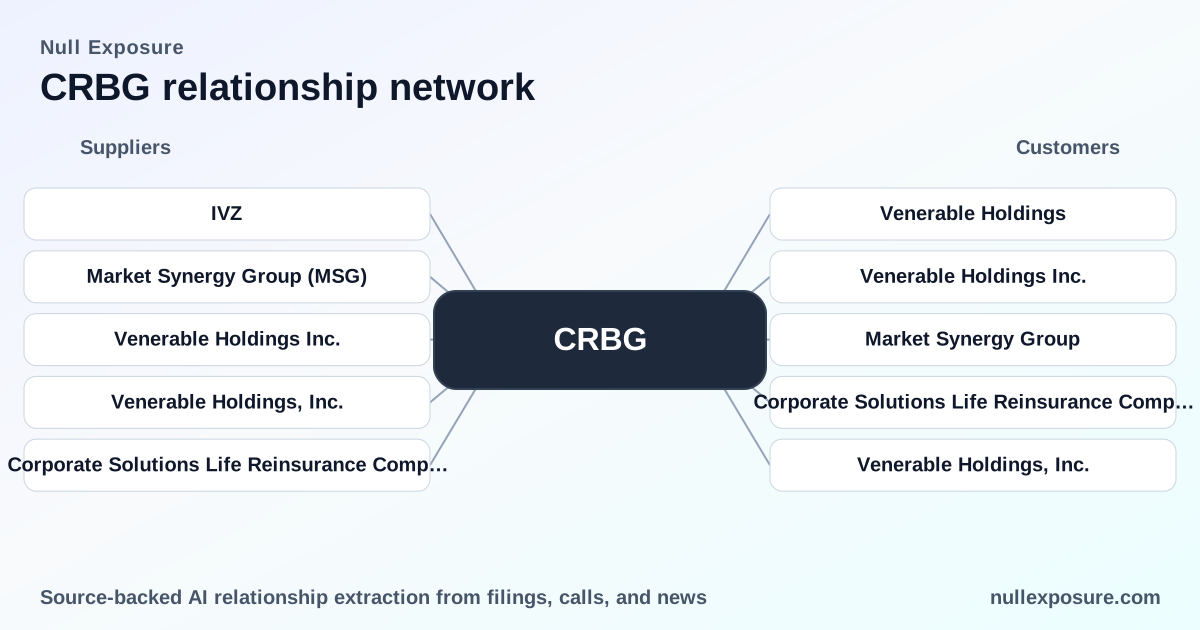
Corebridge Financial (CRBG): Customer relationships that shape the retirement franchise
Corebridge Financial operates as a U.S.-focused provider of retirement solutions and life insurance, monetizing through insurance premiums, investment management fees, and ongoing advisory and reinsurance arrangements tied to annuities and employee-benefit products. The company combines long-duration insurance liabilities with fee-bearing investment services, generating recurring cash flow from premiums and management fees while selectively transferring risk via reinsurance and asset sales. For a quick company snapshot, Corebridge reported roughly $18.6 billion in trailing revenue and a market capitalization near $12.4 billion as of the latest quarter. For further research and tools, visit the Null Exposure homepage: https://nullexposure.com/.
Executive takeaway: commercial logic and strategic priorities
Corebridge’s customer relationships fall into two clear buckets: institutional counterparties that take annuity and asset-management capacity off Corebridge’s balance sheet, and distribution partners that sell Corebridge products to individual and retirement-plan clients. The corporate playbook over 2025–2026 emphasized delevering variable annuity exposure and concentrating the business around retirement solutions — that shifts counterparty risk from Corebridge to acquirers and reinsurers while preserving fee economics from services and product distribution. Investors should view Corebridge as a liability-lighting, fee-generating franchise with material exposure to North American annuity and retirement markets.
How constraints shape the customer book
Corebridge’s contractual and market profile is evident across public disclosures and press coverage. These signals describe operating realities investors must price into the stock.
- Long-term contracting posture: Corebridge operates long-duration insurance lines and maintains entities licensed for long-term business; its contracts and reserve dynamics reflect extended liability horizons rather than short transactional revenue.
- Counterparty mix skews to individuals: A large share of product distribution is to mass-affluent and high-net-worth individuals for retirement accumulation and income; individual annuity holders are a primary end-market.
- Geography concentrated in North America with selective global operations: Revenues are overwhelmingly North America-focused, although investment-management activities extend into Europe and Asia through joint ventures and subsidiary operations.
- Dual commercial roles—seller and service provider: Corebridge sells retirement and insurance products while also providing investment advisory and administrative services to institutional clients (including AIG-related entities), producing both premium and fee income.
- Active, moderate spend relationships: Reported advisory fee income in recent years sits in the low millions, signaling active but not outsized counterparty spend bands for certain institutional service arrangements.
Taken together, these constraints frame a business that is asset-liability intensive, distribution-dependent, and increasingly inclined to transfer balance-sheet risk through selective reinsurance and asset sales.
Customer relationships that matter (compact, source-linked)
Below I cover every counterparty relationship cited in public coverage during 2025–2026, with a short plain-English summary and citation.
AllianceBernstein (AB)
AllianceBernstein will receive over $100 billion of Corebridge general and separate account assets during 2027 as part of a transfer of asset-management responsibilities tied to Corebridge guarantees. This is a material institutional asset-management handoff that reduces Corebridge’s on‑balance-sheet market risk while preserving fee arrangements for asset servicing. According to an Investing.com note dated May 2, 2026, the AB transaction centers on large AUM transfers connected to Corebridge’s guarantees.
Venerable Holdings, Inc.
Venerable completed a multi-part transaction with Corebridge covering reinsurance and an asset-management divestiture, effectively taking on a large swath of Corebridge’s variable-annuity exposure and purchasing SunAmerica Asset Management. Corebridge used the deal to align around core retirement solutions and to remove variable annuity risk from the balance sheet. Simply Wall St and related coverage referenced Corebridge’s January 5, 2026 announcement about those reinsurance and sale transactions.
Corporate Solutions Life Reinsurance Company (Venerable subsidiary)
Corporate Solutions Life Reinsurance Company, an insurance subsidiary of Venerable, closed the final portions of the variable-annuity reinsurance deal with Corebridge, directly assuming a tranche of variable-annuity liabilities previously carried by Corebridge. This subsidiary-level transfer operationalizes Corebridge’s liability reduction strategy and shifts reserve and capital requirements away from Corebridge. Reinsurance News reported the closing on March 9, 2026.
Market Synergy Group (MSG)
Market Synergy Group distributes Corebridge’s Power Select Index Annuities and is the exclusive distribution channel for a new cryptocurrency-linked index offered inside those annuities, expanding product differentiation through distributor relationships. That distribution partnership targets independent marketing organizations and amplifies Corebridge’s retail reach into indexed annuities. Life & Health and 401kSpecialist coverage in March–May 2026 noted the arrangement and MSG’s role.
Why these relationships change the investment thesis
Corebridge’s recent transactions show a deliberate shift from principal risk to fee and distribution economics. Offloading variable-annuity liabilities to Venerable (and a Venerable reinsurance affiliate) reduces long-term capital volatility and frees up management bandwidth to focus on retirement solutions and fee-bearing services. The AllianceBernstein AUM transfer further externalizes investment risk while creating ongoing servicing and advisory opportunities. Net effect: lower earnings volatility from guarantees but also a recalibration of growth and fee margins.
Risks that flow from the partner map
- Concentration risk: Heavy North American revenue concentration and reliance on a small set of strategic counterparties expose Corebridge to regional economic cycles and partner execution risk.
- Execution and counterparty credit: The benefit of liability transfers depends on counterparties (e.g., Venerable, AB) fulfilling long-term commitments; any counterparty performance or capital stress would transmit to Corebridge.
- Distribution pressure: Product innovation (for example, crypto-linked indices) requires successful distributor uptake through partners such as MSG; distribution execution will influence product economics and retention.
Closing guidance for investors
Corebridge is executing a recognizable playbook: trim guarantee exposure, monetize asset-management relationships, and concentrate on distribution and advisory fees. That repositioning reduces capital intensity but shifts the earnings base toward recurring fees and the quality of distribution partners. For a deeper look at counterparties, transaction documents, and time-stamped press coverage, consult primary reporting and the company’s filings. If you want ongoing coverage and alerts on Corebridge relationships and counterparty developments, see Null Exposure for research tools and updates: https://nullexposure.com/.
Bold takeaway: Corebridge’s 2025–2026 partner deals materially reduce annuity balance-sheet risk and convert capital into fee and servicing economics—investors should revalue the stock for lower earnings volatility but also for the sustainability of fee flows and distributor execution.