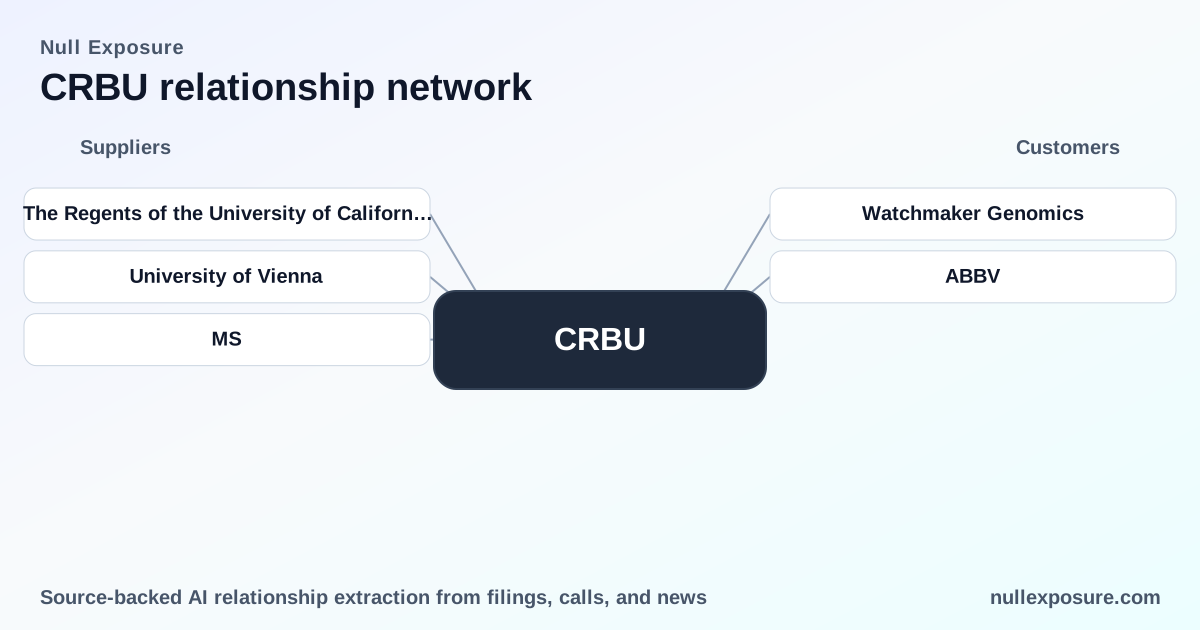
Caribou Biosciences (CRBU): Licensing-first model, partnership-driven revenue
Caribou Biosciences commercializes foundational CRISPR-Cas9 intellectual property and advances its own therapeutic pipeline while monetizing through licensing and collaboration agreements. The company’s revenue profile is dominated by upfront payments, sublicenses and milestone-triggered receipts from partners and licensees rather than product sales, giving Caribou a capital-efficient but partnership-dependent cash flow pattern. For investors evaluating customer risk, the core thesis is simple: Caribou is a licensing platform with high revenue concentration and binary collaboration exposures that drive near-term liquidity and long-term optionality.
If you want a quick view of how this analysis was assembled, visit https://nullexposure.com/ for a concise relationship mapping and original sourcing.
How Caribou’s operating and monetization model actually works
Caribou operates as a hybrid: it is a clinical-stage biotech advancing internal therapeutic candidates while simultaneously licensing its CRISPR-Cas9 IP portfolio. Licensing and collaboration agreements are the primary revenue engine, delivering upfront payments and deferred revenue that bridge development cash needs. Company disclosures indicate over 30 sublicenses — both exclusive and non-exclusive — are in place and that license and collaboration fees are a major revenue source while internal product candidates are being developed.
This structure produces distinct contract characteristics for investors to monitor:
- Contracting posture — licensing-heavy. Revenues are structured as license and collaboration fees rather than product sales, so cash flow cadence is driven by deal signing and milestones.
- Concentration — materially concentrated. Company-level disclosures show licensees accounted for a large share of revenue (roughly two-thirds of revenue in 2024 and over 70% in 2023), which creates single-counterparty risk for headline periods.
- Criticality — high for near-term liquidity. Sublicense revenue is an important source of funding while Caribou advances its pipeline; loss or termination of a major partner has an outsized effect on reported licensing revenue.
- Maturity — established licensing program. The breadth of sublicenses and historical upfront receipts reflect a mature intellectual property commercialization strategy rather than an early-stage ad hoc partner program.
- Counterparty mix — includes commercial and public payor considerations. Disclosures reference government healthcare program pricing and rebate dynamics as a potential factor for net pricing of future therapeutics, signaling a need to manage payer and regulatory exposure.
Customer relationships that matter — the complete roster from available reporting
Watchmaker Genomics — commercial license for CRISPR-Cas9 use in NGS (March 2026)
Watchmaker Genomics executed a non‑exclusive license with Caribou for foundational CRISPR-Cas9 intellectual property specifically for next‑generation sequencing (NGS) library preparation, a transaction positioned to increase throughput and reduce sequencing cost per sample. This is a technology‑use license rather than a therapeutic collaboration and was announced in March 2026 in press releases and market reports. (Source: MarketScreener and corporate press release, March 9, 2026.)
AbbVie — historic strategic collaboration, later termination and financial impact (FY2021 and FY2025 reporting)
Caribou began a partnership with AbbVie that included a $30 million upfront payment in 2021, reflecting a classic biotech collaboration structure where upfront and deferred revenue support development. Subsequent reporting indicates that the termination of the AbbVie collaboration was the primary driver of a decline in licensing and collaboration revenue from $34.5 million in 2023 to $10.0 million in 2024, with roughly $20.8 million of prior-year deferred revenue attributable to the AbbVie relationship. (Source: MedCityNews coverage of the 2021 deal; reporting in The Globe and Mail on financial results for FY2024/2025.)
What these relationships imply for revenue volatility and valuation
The Watchmaker license illustrates Caribou’s ability to monetize platform IP outside of direct therapeutics, extending addressable revenue streams into adjacent genomics workflows. That is strategic diversification, but the core commercial profile remains licensing-centric, which produces lumpier revenue recognition tied to discrete deals.
By contrast, the AbbVie relationship highlights the downside of a concentrated partner book: a single collaboration can create material deferred revenue that, when terminated, materially compresses reported licensing revenue. Investors should treat Caribou’s licensing receipts as comparably volatile to milestone-driven biotech partnerships rather than recurring product revenues.
Risk factors and what to watch in quarterly disclosures
- Concentration risk is structural. Company disclosures identify licensees that together represented a high percentage of revenue and contract assets in recent years; monitor quarterly updates for the composition of those top licensees.
- Contract type is mostly licensing. Revenue duration and predictability are limited by the non-recurring nature of many license payments; renewal and new sublicensing activity are the primary levers for stability.
- Payer and government considerations affect future product economics. Filings reference mandatory discounts or rebates required by government healthcare programs as a potential constraint on net pricing of eventual therapeutics—relevant for projections of product margins once Caribou transitions from licensing to product revenues.
- M&A or new collaborations alter the profile quickly. A single large new partner or a return to large-scale collaborations could materially change revenue visibility; conversely, further terminations would compress near-term revenue materially.
For a consolidated view of partner-level disclosures and to track future updates, see https://nullexposure.com/ for a relationship intelligence dashboard.
Quick investment takeaways
- Caribou is a licensing-first biotech with significant near-term revenue dependence on collaborations and sublicenses. That profile supports non-dilutive cash inflows but produces high volatility in year‑to‑year reported revenues.
- Revenue concentration is a limiting valuation factor. Licensees represented a very large share of recent revenue, so single-partner outcomes strongly influence earnings and cash runway.
- Deal scope matters: technology‑use licenses (like Watchmaker) diversify revenue types, while therapeutic collaborations (like AbbVie) bring larger but more binary deferred revenue streams.
- Active monitoring of deal announcements and quarterly disclosures is essential. Valuation and risk change materially with each new agreement or termination.
Caribou’s strategy delivers optionality: a mature IP licensing machine that funds pipeline progress, but one whose investor returns will be driven by deal cadence and the company’s success in converting platform science into durable product franchises. For a concise, updated mapping of Caribou’s partner relationships and source references, visit https://nullexposure.com/.