California Resources (CRC): Customer Relationships and What They Mean for Investors
California Resources Corporation is an independent oil and gas E&P operator that monetizes through the sale of crude oil, natural gas and NGLs into California refining markets, supplemented by electricity sales and an expanding carbon management business branded Carbon TerraVault (CTV). Revenue today is dominated by commodity sales into a concentrated set of large refiners and marketers, while CTV provides a strategic route to diversify cash flows through CO2 transportation, sequestration and decarbonization services. For research access to the underlying signals in this write-up, visit https://nullexposure.com/ for a concise intelligence feed.
How CRC earns and how its customer model operates
CRC derives substantially all of its core revenue from selling hydrocarbons to California buyers. The company sells crude oil, natural gas and NGLs to marketers and California refiners, and it has historically contracted both for delivery commitments and index-based short-term sales. CRC’s 2024 disclosures show a mix of delivery commitments extending across multi-year periods alongside predominately index-based contracts priced at delivery, indicating a hybrid contracting posture that balances predictability and spot exposure.
Operationally, CRC is highly California-centric: it sells nearly all its crude to in-state refiners and operates in a regulatory environment that imposes both cost and project constraints. Customer concentration is a material and recurring characteristic of the business—four customers accounted for roughly two-thirds of oil and gas sales in 2024—creating clear counterparty concentration risk but also bargaining scale with large enterprise buyers. The company’s push into carbon management positions CTV to sell services to large power producers and other emitters in California, turning part of CRC’s subsurface and transport expertise into fee-based services.
Key operating signals to remember:
- Contracting posture: CRC discloses both multi-year delivery commitments and a majority of index-based, less-than-one-year contracts; the business therefore blends long-term delivery obligations with short-term and spot pricing. (Source: CRC 2024 10‑K)
- Concentration & criticality: A small number of large customers historically account for a high share of sales—67% in 2024—representing both revenue concentration and strategic importance of each counterparty. (Source: CRC 2024 10‑K)
- Geography & regulation: Operations and sales are almost exclusively in California, exposing CRC to state-level regulatory drivers and refinery capacity changes. (Source: CRC 2024 10‑K)
- Role & segment: CRC is primarily a seller of oil, gas and NGLs; carbon management is a nascent, complementary product line anchored to its core infrastructure strengths. (Source: CRC 2024 10‑K)
For a focused view on counterparties, read on—each named relationship from public signals is summarized below.
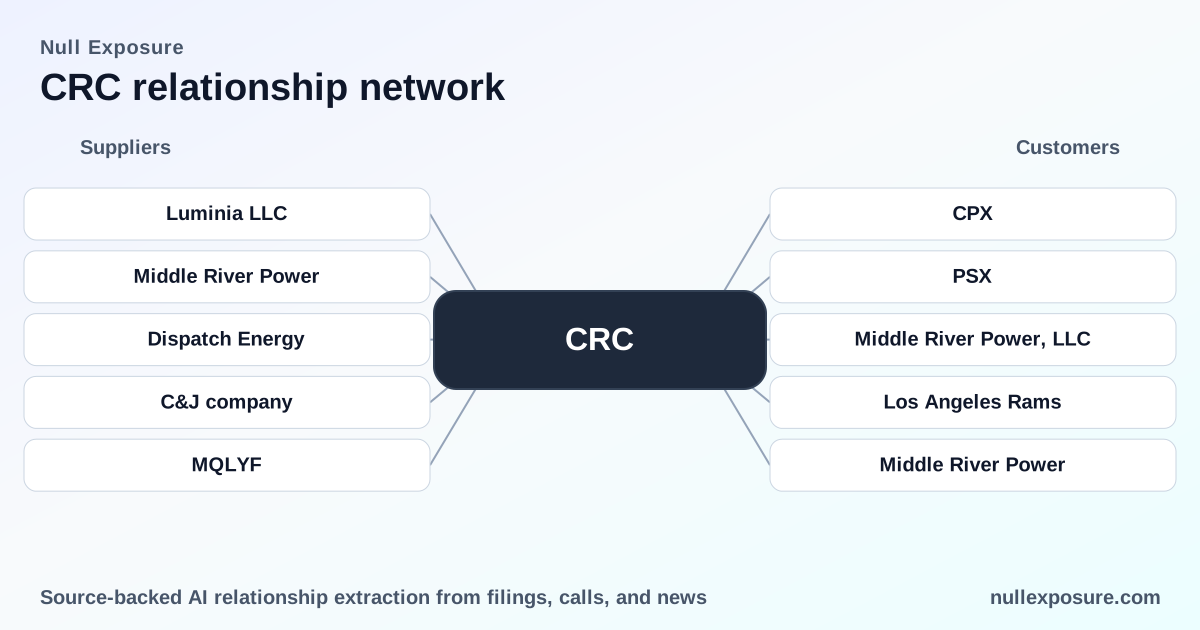
Who CRC is doing business with — the customer list explained
Capital Power (TSX: CPX) — La Paloma MOU for carbon management
CRC’s Carbon TerraVault signed a memorandum of understanding to provide carbon management services for Capital Power’s La Paloma generation facility in Kern County, positioning CRC as a potential CO2 transportation and sequestration partner for an operating power plant. This engagement reflects CRC’s strategy to commercialize CTV with large, creditworthy power producers. (Source: GlobeNewswire, November 4, 2025)
Phillips 66 (PSX) — refinery buyer; Wilmington closure impact
Phillips 66’s Wilmington refinery historically purchased CRC volumes: CRC disclosed that, in the six months after the Aera merger, approximately 8% of its production was sold to the Wilmington refinery, which Phillips 66 announced would close in late 2025—a discrete risk to local offtake capacity and short‑term sales mix. (Source: CRC 2024 10‑K, October 2024 disclosure)
Middle River Power, LLC — exclusive CO2 transport and sequestration MOU
CRC announced an MOU to serve as the exclusive CO2 transportation and sequestration provider for Middle River Power’s California facilities, reflecting a move to lock CTV into multi-facility power producer relationships and to position CRC as a one-stop carbon-services vendor for independent power producers. (Source: GlobeNewswire, December 16, 2025)
Los Angeles Rams — low‑carbon product retirement for offsetting
CRC worked with the Los Angeles Rams to analyze the team’s energy and travel emissions and retire high‑integrity environmental products on the Rams’ behalf in 2025, illustrating CRC’s go‑to-market for low‑carbon products and voluntary offset retirement services for large institutional customers. (Source: Los Angeles Rams, team news post recounting 2025 activities; referenced in CRC communications 2026)
What these relationships tell investors about upside and risk
CRC’s commercial footprint has two clear dimensions: a core commodity business that sells into a small set of large in‑state buyers, and a growing service business around carbon management that sells to large power producers and institutional buyers.
- Upside drivers: Carbon TerraVault provides a pathway to diversify from commodity price exposure into fee-based, infrastructure-backed CO2 services with multi-year service potential if project development and permitting proceed. Recent MOUs with Capital Power and Middle River Power are practical commercial proofs of concept. (Source: GlobeNewswire, Nov–Dec 2025)
- Concentration and short‑term price exposure: The core oil/gas business retains high counterparty concentration and meaningful spot/index pricing exposure, as CRC simultaneously holds delivery commitments and predominantly index‑based contracts, which translates to volatility in gross margins tied to California refinery demand and local infrastructure availability. (Source: CRC 2024 10‑K)
- Regulatory and local market risk: CRC’s in‑state focus concentrates regulatory, environmental and refinery capacity risk within California; the announced Wilmington refinery closure is a tangible example of how changes in local refining capacity can reallocate offtake and pricing dynamics. (Source: CRC 2024 10‑K; Phillips 66 public disclosure)
Bottom line for investors and operators
CRC is a commodity operator with concentrated, large‑counterparty customers and a clear strategic pivot into carbon management that converts subsurface and logistics capability into recurring service revenue. That combination delivers a binary investment profile: stable cash generation when commodity markets and regional refinery demand are supportive, and incremental upside if CTV scales into contracted CO2 services with creditworthy power producers.
If you want deeper counterparty exposure charts and time‑series tracking for CRC’s disclosed MOUs and customer concentration, visit https://nullexposure.com/ for the full intelligence feed and historical signal view.
Key takeaways:
- Concentration is material and persistent—a few large customers drive the majority of sales. (Source: CRC 2024 10‑K)
- Contracting is hybrid—multi‑year delivery commitments coexist with shorter-term, index‑based sales, producing both commitments and price exposure. (Source: CRC 2024 10‑K)
- Carbon TerraVault is a strategic adjacent business that converts CRC’s resource and transport assets into fee revenue with large power producers (Capital Power, Middle River Power) and institutional buyers (e.g., Los Angeles Rams). (Sources: GlobeNewswire Nov–Dec 2025; Rams communications 2026)
This is a concise commercial map of CRC’s customer relationships and the operating constraints that underlie valuation sensitivity and strategic upside. For subscription-level signal feeds and company‑wide relationship matrices, see https://nullexposure.com/.