Circle Internet Group (CRCL): Customer Relationships That Drive USDC Adoption
Circle operates a payments and market-infrastructure platform built around the USDC stablecoin and related fiat-linked products; it monetizes through transaction and settlement fees, distribution partnerships, and platform services to institutional counterparties and marketplaces. Revenue depends on scale of USDC flows, distribution partners that route settlement, and institutional integrations that embed Circle’s rails into legacy financial infrastructure. For a concise profile and relationship monitoring, visit https://nullexposure.com/.
Why customers matter for Circle’s valuation story
Circle’s competitive position is a function of two intertwined vectors: distribution breadth (exchanges, fintechs, PSPs) that create transaction volume, and institutional adoption (financial market infrastructures and enterprise platforms) that embed USDC into high-value settlement chains. Investors should read customer disclosures not as symbolic wins but as forward-looking volume channels: partnerships with exchanges and banks translate into recurring settlement revenues, while MoUs with market operators unlock use cases with multi-year runway.
How I read the relationship set: commercial posture and concentration
Circle’s relationship map shows a dual strategy: deep, revenue-heavy distribution partners alongside strategic infrastructure integrations that expand use into regulated financial markets. This implies:
- Contracting posture: commercial agreements span multi-year strategic partnerships and MoUs with market operators, indicating a mix of binding and exploratory commitments.
- Concentration: distribution economics are concentrated — a handful of partners capture a large share of distribution flows — which amplifies revenue upside but also client concentration risk.
- Criticality: relationships with exchanges, payment networks, and market operators are critical to USDC utility; losing a major partner would materially affect on-chain settlement volumes.
- Maturity: partnerships range from early-stage integrations and MoUs to scaled distribution arrangements; the set includes established infrastructure players alongside newer fintech entrants.
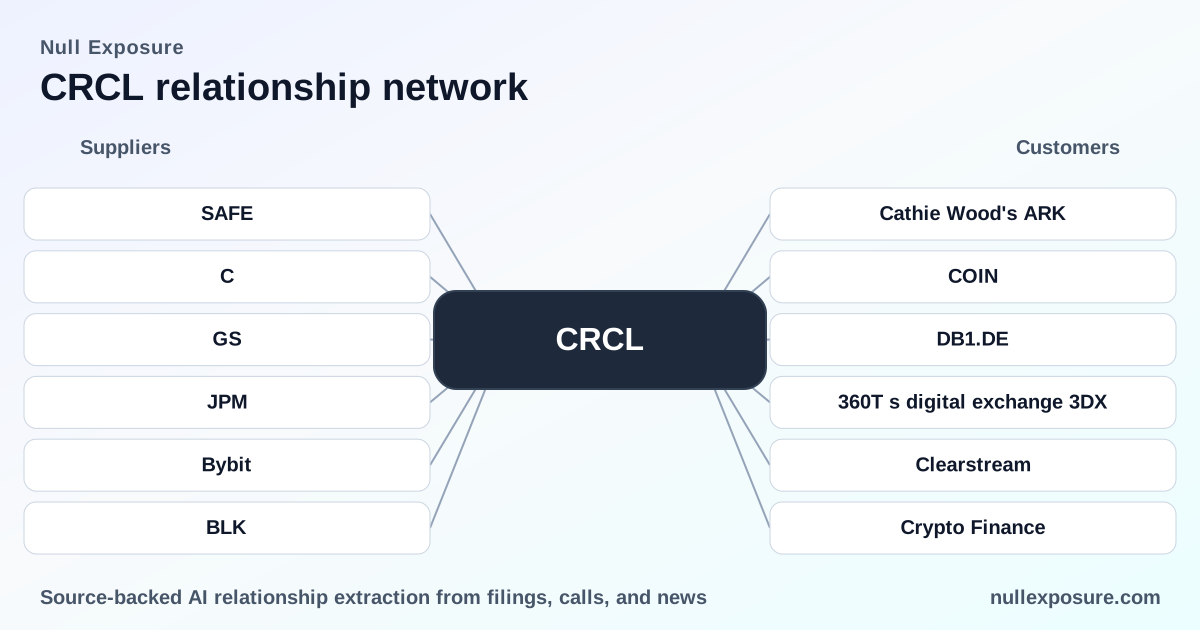
The customer relationships — what each connection means for Circle
Below I walk through every relationship flagged in the public reporting and news pool.
Mesh (MESH)
Mesh has expanded USDC settlement with Circle to streamline global crypto payments, representing a distribution partner that pushes USDC into payments rails. Markets coverage (Finviz aggregation, April 2026) documented Mesh’s expanded settlement activity with Circle. (https://finviz.com/news/325714/wolfe-research-bearish-on-circle-internet-group-crcl-on-lower-ebitda-expectations)
Deutsche Börse Group (DB1.DE)
Deutsche Börse signed a Memorandum of Understanding with Circle to explore using Circle’s EURC and USDC within its market infrastructure, signaling institutional adoption potential in European capital markets. MarketsMedia reported the MoU on March 9, 2026. (https://www.marketsmedia.com/deutsche-borse-circle-advance-stablecoin-adoption-in-europe/)
360T / 3DX (part of Deutsche Börse)
The parties intend initial focus on listing and trading stablecoins on 360T’s digital exchange (3DX), which positions Circle to gain distribution inside an established FX and OTC venue for institutional clients. MarketsMedia covered the 3DX focus as part of the Deutsche Börse collaboration (Mar 9, 2026). (https://www.marketsmedia.com/deutsche-borse-circle-advance-stablecoin-adoption-in-europe/)
Clearstream (Deutsche Börse post-trade)
Clearstream will enable institutional-grade custody via Deutsche Börse’s post-trade business as part of the collaboration, offering Circle access to established custody rails for institutional settlement. MarketsMedia described this custody link in the MoU coverage (Mar 9, 2026). (https://www.marketsmedia.com/deutsche-borse-circle-advance-stablecoin-adoption-in-europe/)
Crypto Finance (sub-custody partner)
Crypto Finance, as an institutional crypto provider within Deutsche Börse’s ecosystem, was named as part of the initial market-facing distribution plan, which supports institutional custody and trading workflows for Circle’s stablecoins. MarketsMedia reported Crypto Finance’s role on March 9, 2026. (https://www.marketsmedia.com/deutsche-borse-circle-advance-stablecoin-adoption-in-europe/)
Cathie Wood’s ARK
Cathie Wood’s ARK reportedly expressed interest in buying $150 million of CRCL shares in connection with the IPO process, indicating strong buy-side enthusiasm from innovation-focused institutional investors. The Economic Times cited Coindesk reporting on ARK’s interest (Mar 9, 2026). (https://m.economictimes.com/news/international/us/circle-internet-group-ipo-top-things-investors-need-to-know-circle-ipo-news/articleshow/121443270.cms)
Intuit (INTU)
Circle announced a multi-year strategic partnership with Intuit to integrate stablecoin technology across Intuit platforms (including TurboTax, Credit Karma, QuickBooks, and Mailchimp), creating a pathway to embed USDC into mass-market financial software and payments use cases. Investing.com covered the partnership details in May 2026. (https://ng.investing.com/news/insider-trading-news/neville-director-at-circle-sells-315-million-in-crcl-stock-93CH-2283400)
Coinbase (COIN)
Circle’s distribution economics are materially linked to Coinbase: Ark Invest’s newsletter noted that of $1.7 billion in Circle revenue, $1 billion went to distribution partners and Coinbase received roughly $900 million as a dominant distributor — an indicator of distribution concentration and scale dependence. ARK Invest discussed the revenue allocation in their March 2026 newsletter. (https://www.ark-invest.com/newsletters/issue-458)
Triple-A
Triple‑A has joined Circle Payments Network to support stablecoin-to-local-currency settlement, which expands Circle’s cross-border payout and remittance capabilities through third-party payout partners. Investing.com reported Triple‑A’s onboarding in May 2026. (https://za.investing.com/news/insider-trading-news/burns-m-michele-sells-circle-internet-group-crcl-shares-for-153905-93CH-4203289)
OSL Group
OSL Group announced a partnership with Circle to expand access to USDC in global markets, adding a regional distribution and custody partner that strengthens Circle’s reach in APAC and institutional trading corridors. TradingKey noted the OSL announcement in April 2026 coverage. (https://www.tradingkey.com/news/market-movers/261812129-market-movers-crcl-20260422)
OwlTing (OWLS)
OwlTing joined the Circle Payments Network to expand stablecoin access into high-growth markets, a move that reflects Circle’s strategy of onboarding local payment and gateway partners to increase USDC utility outside core crypto exchanges. A press release captured on March 10, 2026 documented OwlTing joining the network. (https://markets.financialcontent.com/stocks/quote/news?ChannelType=PRESSRELEASES&Symbol=537%3A2578438517&CSSURL=36.htm)
Read-throughs for investors: risk and upside
- Upside: Partnerships with Deutsche Börse and Intuit represent structural pathways for USDC to enter regulated settlement and mainstream financial software, which scales transaction volumes and lifts monetizable settlement fees. The Clearstream and 3DX threads are particularly important as institutional on-ramps.
- Concentration risk: Coinbase’s outsized share of distribution flows (as reported by ARK) is a material concentration risk; any change in that relationship’s economics would have an outsized earnings impact.
- Commercial maturity: The mix of MoUs and multi-year deals shows a pipeline that is transitioning from exploratory to transactional, but revenue realization will depend on regulatory alignment and counterparty integration timelines.
For a consolidated feed and ongoing alerts on CRCL partner developments, see https://nullexposure.com/.
Final takeaway
Circle’s customer map is a deliberate combination of large distribution partners that generate volume today and market infrastructure partnerships that institutionalize USDC for tomorrow’s settlement rails. Investors should weigh the clear growth runway against distribution concentration and the execution risk of turning MoUs into steady settlement revenue.