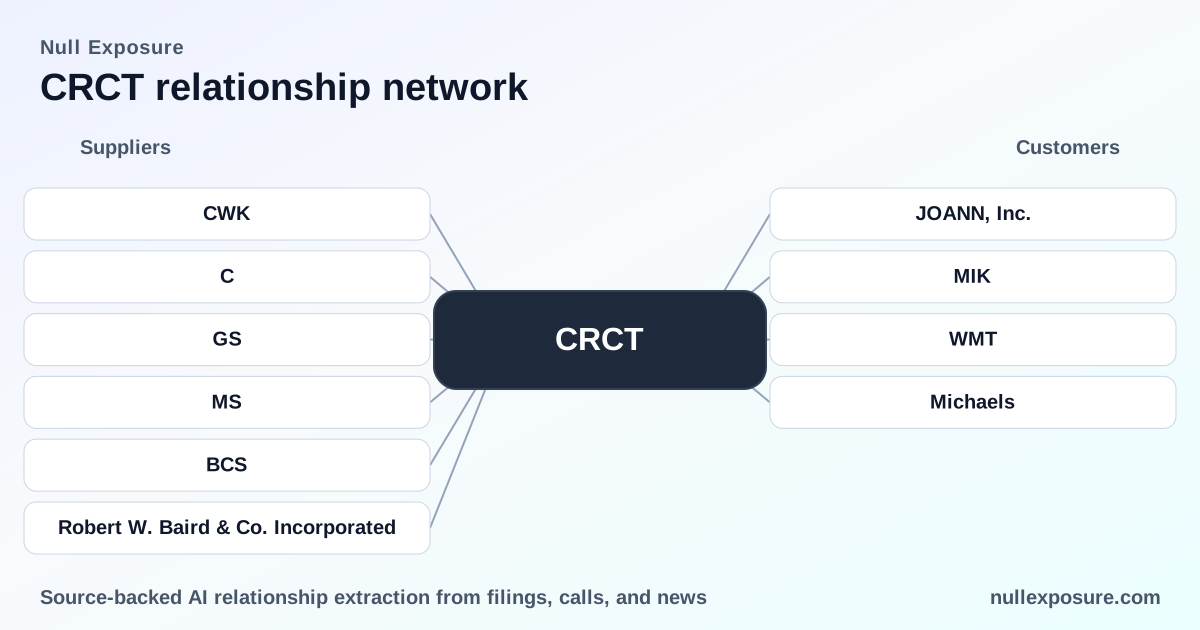
Cricut (CRCT): Customer relationships that define distribution and risk
Cricut monetizes a two-sided creativity platform: hardware sales of connected cutting machines and accessories, and recurring platform revenue from subscriptions and digital content (Cricut Access). Retail partnerships and direct-to-consumer channels drive machine and materials distribution, while subscription economics and content sales lift gross margins and recurring revenue. For deeper visibility into counterparty flows and disclosure-backed customer signals, visit https://nullexposure.com/.
Executive snapshot: where revenue flows and what to watch
Cricut’s revenue mix splits into point-in-time product sales (machines, materials, accessories) and high-margin recurring platform revenue from subscriptions and digital content. Retail partners—national chains and online marketplaces—amplify reach but also create operational dependencies: supply interruptions or sudden partner decisions can compress near-term sales. The customer base is broad, with no single reported customer exceeding 10% of consolidated revenue, but management flags insolvency of a significant partner as a potential material shock.
JOANN, Inc.
Cricut disclosed that JOANN filed for Chapter 11 in January 2025 and announced liquidation in February 2025, a post-year event called out in the company’s FY2024 10‑K. This is an executed counterparty failure that removes a retail channel and illustrates the company’s exposure to retail partner insolvency as a realized risk (Cricut 10‑K, FY2024).
Michaels (MIK)
Cricut is collaborating with Michaels on product launches and exclusive colorways—news releases in early 2026 report that new Cricut machines and the EasyPress SE were launched with exclusive color options and distribution at Michaels, and that certain products became available at Michaels beginning February 6, 2026. Multiple press reports in February–March 2026 describe colorway exclusives and channel availability at Michaels, underscoring Michaels’ role as a strategic retail partner (Sahm Capital press release, 2026‑02‑26; QuiverQuant news, 2026‑03‑09).
Walmart (WMT)
Press coverage for product launches in March 2026 highlights Walmart as an exclusive channel for a specific colorway of the EasyPress SE 12x10 (the “Daybreak” color), indicating targeted retail exclusives to amplify demand and channel differentiation. Walmart is explicitly called out as the exclusive retailer for that variant in the product launch coverage (QuiverQuant news, 2026‑03‑09).
What the disclosed constraints reveal about Cricut’s operating model
Cricut’s own disclosures paint a coherent operating and commercial posture:
-
Contracting posture — subscription plus spot: The company deliberately combines recurring subscription revenue (Cricut Access, billed monthly or annually) with spot sales of hardware and consumables. This hybrid model creates cash-flow stability from subscriptions while keeping product promotions and seasonal inventory-driven spikes from hardware revenue (10‑K subscription excerpts).
-
Counterparty mix — large enterprise channels plus direct consumers: Management lists large national retailers and marketplaces—Amazon, Best Buy, Costco, Hobby Lobby, HSN, Michaels, Target, and Walmart—as distribution partners, confirming reliance on large-enterprise channels for scale, alongside direct-to-consumer sales via Cricut.com and Design Space (10‑K distribution excerpt).
-
Geographic footprint — North America‑centric but global presence: North America drives the bulk of revenue (North America: $555.1M vs. International: $157.5M for year ended Dec. 31, 2024), yet Cricut signals active expansion and exposure to regulatory and market risks in international markets (10‑K geography table, FY2024).
-
Materiality signal — diversified customers but concentrated channel risk: The company reports no single customer represented ≥10% of consolidated revenue as of year-end 2024, which supports a view of customer-level diversification; however, management also warns that insolvency or failure of significant partners would be materially adverse—an operational caveat that played out with JOANN’s bankruptcy disclosure (10‑K FY2024).
-
Distribution role and maturity: Cricut sells through a network of distributors in 50+ countries and maintains three contract manufacturers; any interruption in manufacturing or distribution has direct revenue consequences, reflecting moderate operational concentration in supply chain and channel partners (10‑K distributor/manufacturing excerpts).
-
Business segments — hardware drives footprint, software drives margins: Products revenue comes from connected machines and accessories, while platform revenue—subscriptions and digital content—is explicitly where recurring, high-margin economics reside. That segmentation defines growth strategy and margin upside potential as subscription penetration increases (10‑K segment excerpts).
For dedicated access to the underlying relationship catalog and disclosure excerpts, see https://nullexposure.com/.
What each disclosed relationship implies for investors (quick takeaways)
-
JOANN, Inc. — realized channel loss: The FY2024 10‑K discloses JOANN’s Chapter 11 filing and liquidation in early 2025, removing a retail outlet and providing a direct test of Cricut’s ability to reallocate inventory and preserve sales through other channels (Cricut 10‑K, FY2024). Takeaway: channel loss is manageable given no single customer >10%, but it demonstrates vulnerability to retail insolvency.
-
Michaels (MIK) — strategic retail partner for exclusives: Early‑2026 press materials show Michaels carrying exclusive colorways and being named as a primary U.S. retail channel for new machine launches and EasyPress SE availability starting Feb 6, 2026 (Sahm Capital 2026‑02‑26; QuiverQuant 2026‑03‑09). Takeaway: Michaels provides promotional heft and differentiated SKUs that support product desirability and full‑price sell‑through.
-
Walmart (WMT) — mass‑market distribution and exclusivity: News from March 2026 indicates Walmart received an exclusive color variant of the EasyPress SE 12x10 (“Daybreak”), signaling prioritized mass-retail placement for certain SKUs (QuiverQuant 2026‑03‑09). Takeaway: Walmart access accelerates volume but can compress margins through scale promotions; exclusives support channel segmentation.
Investment implications and risk checklist
- Recurring revenue is a structural advantage. Platform/subscription revenue increases predictability and valuation multiple support as it scales.
- Retail concentration risk persists despite customer diversification. No single customer >10% reduces counterparty concentration on paper, but distribution dependence on national chains creates correlated channel risk—evidenced by JOANN’s liquidation.
- Product exclusives are a distribution lever. Michaels and Walmart exclusives show management using channel-specific SKUs to manage inventory and demand.
- Supply-chain and contract manufacturing exposure. Three contract manufacturers and a global distributor network create operational concentration that can affect machine supply and holiday season sales.
- Geographic expansion requires capital and introduces regulatory execution risk. International revenue is a minority but a target for growth—and an execution risk.
- Valuation context. With ~ $708.8M revenue TTM and an EV/EBITDA around 4.8 (company disclosures), Cricut’s multiple reflects a business with profitable core operations and growth optionality tied to subscription penetration and channel execution.
Final read
Cricut’s customer fabric mixes retail partnerships that scale hardware distribution and subscription economics that improve margin resilience. The JOANN bankruptcy is a concrete example of retail risk, while Michaels and Walmart demonstrate the value of curated retail relationships and exclusives for product rollouts. Investors should underweight one‑off retail shocks but monitor subscription growth, gross margins, and manufacturing continuity as the principal levers that convert product reach into durable profitability.
For a consolidated view of Cricut’s customer disclosures and relationship excerpts, visit https://nullexposure.com/.