Crawford & Company (CRD-A): customer relationships that underpin a steady services franchise
Thesis: Crawford & Company monetizes a global claims-management and outsourcing franchise by selling a mix of fixed-fee lifetime claim-handling arrangements, short-term fixed-fee contracts, and time-and-materials administration services to insurers, brokers and large corporates; the company converts scale and geographic breadth into recurring revenue streams, deferred revenue protection on long-duration work, and cross-sell opportunities across Loss Adjusting, Broadspire third‑party administration and Platform Solutions. For institutional access to relationship intelligence visit https://nullexposure.com/.
Understanding how Crawford structures and prices its client work is the investor’s key to valuing revenue durability, margin leverage, and downside risk. The company’s core commercial model is service provision: Crawford is paid either upfront for lifetime claim handling, on fixed multi‑year arrangements, or on a per-claim/time‑and‑materials basis — and it recognizes revenue over time as claims are managed and performance obligations are satisfied.
Business model and operating posture: contracts, criticality and concentration
- Crawford operates as a service provider to large insurance-sector counterparties and self‑insured entities, delivering claims handling, loss adjusting, third‑party administration and platform services that are operationally critical to a client’s claims lifecycle. The company’s disclosures identify Broadspire as the vehicle for third‑party administration to corporations, brokers and insurers in the U.S., reinforcing the outsourced-operations positioning that underpins recurring fees.
- Contracting posture mixes long-term and short-term commitments. Crawford reports material deferred revenues tied to lifetime claim-handling arrangements and explicitly recognizes those revenues over the life of the claim; at December 31, 2024 the company disclosed deferred revenues related to lifetime claim handling of $39,600,000 and described upfront-fee economics for lifetime arrangements. That same filing also confirms one‑ and two‑year fixed-fee contracts, typically in the Broadspire segment, and time‑and‑materials billing where appropriate (company filing, year-end December 31, 2024).
- Concentration is mixed but manageable. No single client accounted for 10% or more of consolidated revenues for 2024, 2023 or 2022, yet the Platform Solutions segment reported three customers that each represented in excess of 10% of that segment’s revenue. That pattern creates company-level exposure to a handful of large buyers within a sub‑segment while keeping overall single-customer concentration below typical materiality thresholds (company annual report, 2024).
- Operational maturity and global scale are competitive advantages. Headquartered in Atlanta and founded in 1941, Crawford reports operations in more than 70 countries; the firm explicitly separates North America, International/EMEA, APAC and LATAM reporting, signaling geographic diversification of both revenue and operational footprint.
Where Crawford works: geography and revenue mix Crawford’s revenue footprint is global and disclosed by region in the FY2024 reporting: North America loss adjusting revenues include U.S. and Canada ($221,279 and $90,879 respectively in the company’s revenue table for the year ended December 31, 2024), while International Operations lists material revenue from the U.K. ($157,806), Europe ($100,702), Australia ($77,219), Asia ($24,466) and Latin America ($32,924). These figures illustrate that North America and EMEA represent the largest pools, with APAC and LATAM providing diversification and growth optionality (company filing, revenue tables, year-end 2024).
Customer relationships: what the available evidence shows Crawford’s live book is operational — the firm’s role as a claims service provider is active across segments and geographies, and public records show use in settlement and compensation workflows.
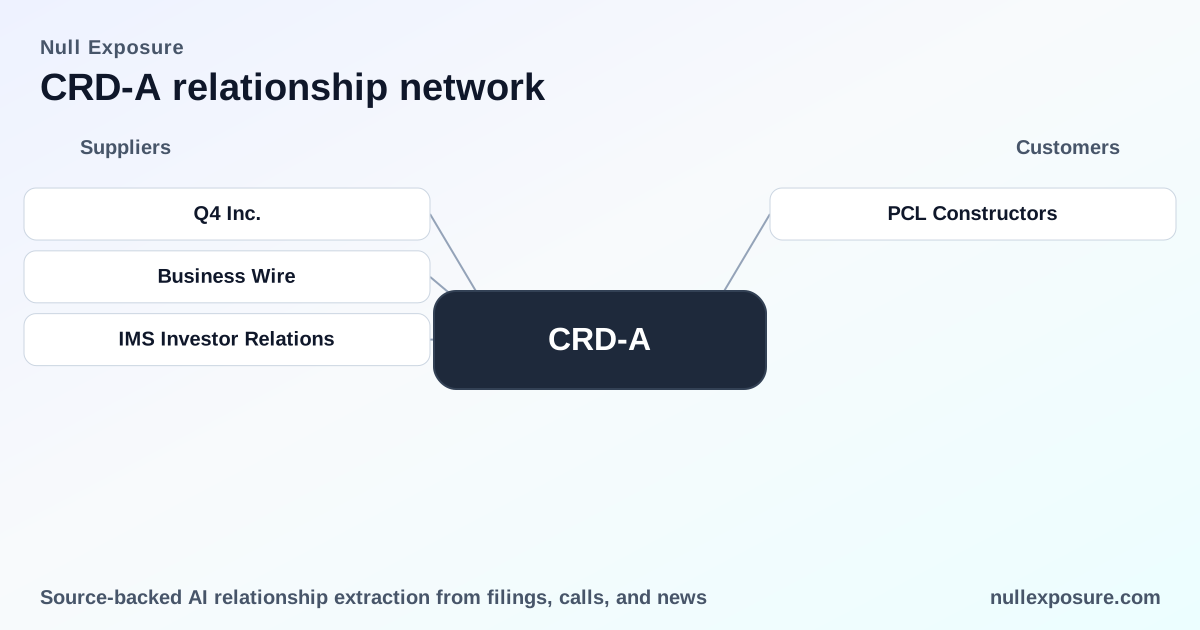
- PCL Constructors: PCL engaged Crawford & Company as a third party to manage an online compensation process related to a power‑outage settlement, demonstrating Crawford’s role as a practical claims operations partner in contractor and infrastructure disputes. A local news report from the Ocracoke Observer covering the settlement noted that PCL quickly set up an online compensation process through Crawford & Co. (Ocracoke Observer, May 2018).
Operating constraints and what they imply for investors Treat these constraints as company-level signals that shape risk/reward rather than as attributes of any single relationship unless the underlying excerpt names the counterparty.
- Contract-term mix drives revenue durability and cash timing. Upfront paid lifetime-claim arrangements create a deferred revenue buffer that reduces near-term volatility, but those contracts lock in fee schedules and create long-duration service obligations that limit immediate margin expansion (company filing, Dec 31, 2024).
- Client scale and segment concentration create asymmetric risk. Platform Solutions contains customers that represent >10% of that segment’s revenue, which concentrates downside risk on platform wins/losses even while consolidated exposure remains below single-customer materiality thresholds (company annual report, 2024).
- Geographic diversification reduces market-specific exposure but raises operational complexity. A truly global footprint (U.K., Europe, Australia, Asia, Latin America and North America) spreads underwriting cycles but requires localized capabilities and regulatory compliance across jurisdictions (company filings).
- The firm’s role is mission‑critical to clients. As an outsourced claims manager and TPA, Crawford’s services are operationally essential for many carriers and self‑insureds, giving the company leverage in renewal negotiations but also creating reputational and execution risk if service levels slip (company disclosures).
- Contracting modes are heterogeneous. Time-and-materials billing sits alongside fixed-fee and lifetime arrangements, which moderates revenue visibility (fixed-fee/lifetime) but injects service‑delivery volatility through T&M workstreams (company filing).
Implications for investors and operators
- Revenue durability is enhanced by lifetime fee arrangements and deferred revenue balances, which cushion near-term cash flows; however, margin expansion depends on pricing power and operational efficiency across loss adjusting and Broadspire administration services.
- Customer concentration in Platform Solutions is a watch item for investors: wins or losses among a few large platform clients will disproportionately affect that segment even as consolidated revenue remains diversified.
- Geographic breadth is a strength for revenue diversification but requires disciplined capital allocation and consistent operational controls to prevent margin leakage and regulatory missteps in multiple jurisdictions.
- Public evidence of active client engagements — such as the PCL case — illustrates the firm’s on-the-ground role in claims workflows, reinforcing the company’s positioning as an operational partner rather than a commodity vendor.
Key takeaways
- Crawford monetizes a mixed contract book: upfront lifetime fees, short-term fixed-fee engagements and T&M work that together deliver recurring, service-based revenue streams (company filings, 2024).
- Deferred revenue ($39.6M at 12/31/2024) provides a near-term cash buffer while Platform Solutions concentration requires monitoring at the segment level (company filing, Dec 31, 2024).
- Global scale and mission-critical services provide resilience and cross-sell potential, balanced by execution complexity across jurisdictions.
If you want a structured counterparty view or a deeper breakdown of segment-level customer risk, start with a focused review at https://nullexposure.com/.