Cardiol Therapeutics (CRDL): Financing relationships that define a clinical-stage balance sheet
Cardiol Therapeutics is a clinical‑stage biotechnology company developing anti‑inflammatory therapies for cardiovascular disease. The company has no product revenue and funds operations through equity markets and partnership transactions; its recent activity shows a clear reliance on bought‑deal equity placement as the primary near‑term monetization mechanism. For investors evaluating CRDL customer/partner relationships, the critical signal is not recurring commercial customers but financial counterparties executing capital raises and the implications of single‑party underwriting for concentration and execution risk. For a concise signal product and continuous monitoring, see Null Exposure’s coverage at https://nullexposure.com/.
A financing relationship drives the visible customer footprint
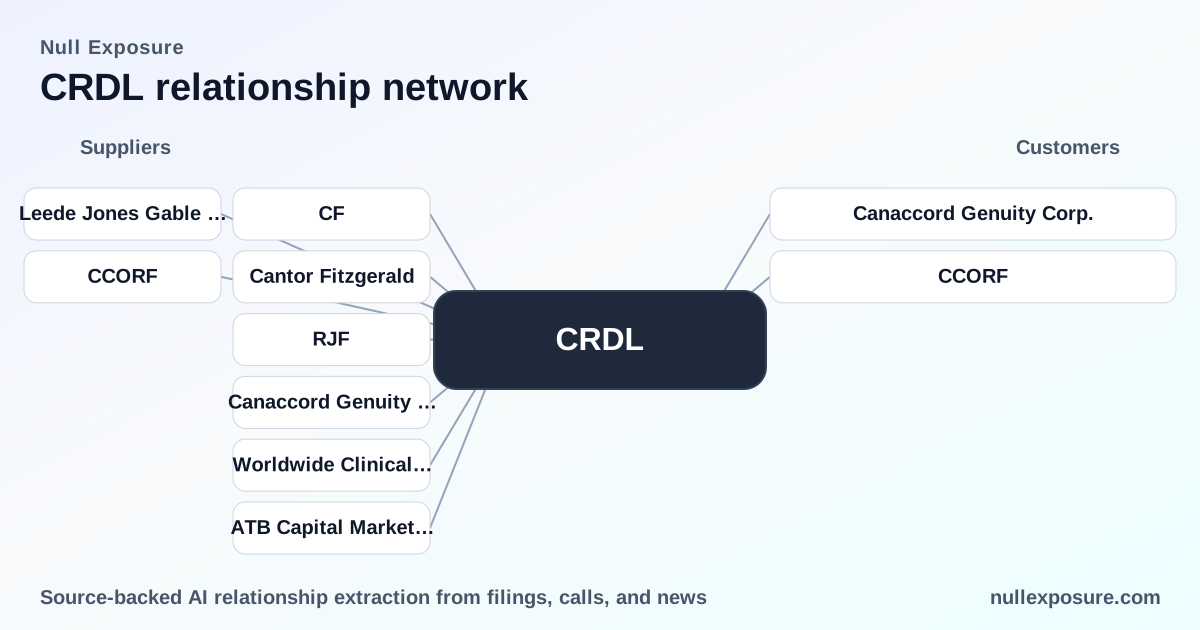
Cardiol’s public relationship data for FY2026 centers exclusively on a single financing engagement with Canaccord (listed variously as Canaccord Genuity Corp., Canaccord, and CCORF in sources). The economic relationship is an underwriting agreement for a bought‑deal private placement: 10,384,616 units at $1.30 per unit for gross proceeds of $13.5 million, with an additional 10% overallotment option disclosed in media coverage. This is not a commercial supply or licensing contract; it is a capital markets transaction that directly funds R&D and runway. According to company communications picked up by market outlets, Canaccord acted as the sole underwriter and bookrunner for the placement (InvestingNews, March 9, 2026; TipRanks, May 2, 2026).
Relationship-by-relationship inventory (each entry in the public results)
-
Canaccord Genuity Corp. — InvestingNews reported on March 9, 2026 that Cardiol entered into a bought‑deal agreement with Canaccord Genuity as sole underwriter and sole bookrunner to purchase 10,384,616 units at $1.30 per unit for gross proceeds of $13.5 million. This is the primary documented counterparty relationship in the results and represents an immediate capital infusion. (InvestingNews, March 9, 2026)
-
Canaccord Genuity Corp. (TipRanks coverage) — A TipRanks article dated May 2, 2026 reiterated the bought‑deal structure and added that the deal carried a 10% over‑allotment option that could raise an additional $1.35 million, underscoring the underwriter’s role in deal execution and potential extension of proceeds. The TipRanks write‑up frames this as a financing to advance Cardiol’s heart disease programs. (TipRanks, May 2, 2026)
-
Canaccord (InvestingNews duplicate mention) — InvestingNews’ second link on March 9, 2026 runs the same bought‑deal announcement and cites the agreement with Canaccord; the outlet’s coverage confirms the single‑underwriter structure that underpins the transaction. This entry is an independent media echo of the same underwriting relationship. (InvestingNews, March 9, 2026)
-
CCORF (InvestingNews minor mention) — A further InvestingNews record lists CCORF as an inferred security identifier for Canaccord coverage; the article text repeats that Cardiol entered into an agreement with Canaccord for the bought‑deal financing. The duplication across identifiers highlights how the underwriting relationship is the only substantive counterparty footprint in the captured results. (InvestingNews, March 9, 2026)
What investors should read into these relationships
-
Primary relationship type: financial counterparty, not commercial customer. The visible counterparties are investment bank underwriters executing equity placement. Cardiol’s business model is still development‑stage R&D, so the commercial customer base remains absent and financing partners are the operationally critical counterparts today.
-
Concentration risk is material. The deal was executed as a bought‑deal with a single sole underwriter. That structure concentrates execution and distribution risk into one financial counterparty for this material raise, which is a company‑level concentration signal rather than a contractual limitation disclosed as an explicit constraint.
-
Contracting posture: short‑term, transactional. Bought‑deal placements reflect short‑interval, capital‑markets‑driven contracting rather than long‑term strategic joint ventures or licensing agreements that would provide durable non‑dilutive funding.
-
Maturity and criticality: pre‑commercial, funding‑dependent. Cardiol’s public financials show no revenue, negative EBITDA, and a small cash runway extended by equity raises; the underwriting relationship is therefore critical for near‑term operations but not a commercial revenue source.
No explicit third‑party constraints were reported in the relationship dataset for CRDL; this absence is itself a company‑level signal that no multi‑year supplier/customer covenants or strategic licensing constraints are disclosed in these results.
Key financial context that frames the relationships
Cardiol is a pre‑revenue clinical biotech with a market capitalization around $148.5 million and negative operating results (latest indicated EBITDA and EPS are losses). The company’s Price‑to‑Sales and Price‑to‑Book multiples are elevated relative to operating performance because revenue is zero and valuation is driven by pipeline expectations. Under these conditions, equity underwriting relationships dominate the company’s counterparty landscape and are the practical levers for funding development milestones.
Risk and upside — distilled for portfolio decisions
-
Upside: Bought‑deal financing provides immediate liquidity to advance clinical programs; the presence of institutional underwriters can facilitate future capital access and signal market interest. If clinical readouts progress, the financing runway supports value‑creating milestones.
-
Risk: Reliance on one underwriter in a bought‑deal introduces concentration and execution risk; adverse market conditions or distribution limits could force further dilutive raises or delay programs. Absence of commercial customers means operating progress is binary and dependent on trial success and continued access to capital markets.
-
Governance/ownership: Institutional holders account for ~22% of shares outstanding and insiders ~2.4%, indicating a dispersed shareholder base that increases sensitivity to public market sentiment and underwriting cycles.
Bottom line and next steps for analysts
Cardiol’s publicly visible customer/partner footprint for FY2026 is exclusively a bought‑deal equity financing arranged by Canaccord. For investors, the essential takeaway is that Cardiol is funded through capital markets partnerships, and underwriting terms and counterparty concentration are the primary relationship risks to monitor. Track subsequent filings for use of proceeds, the exercise of the over‑allotment option, and any shift from financing to licensing or strategic collaborations that would diversify counterparties.
For continuous monitoring of relationship signals and concentrated counterparties in life sciences portfolios, visit Null Exposure at https://nullexposure.com/ for expanded coverage and alerts.