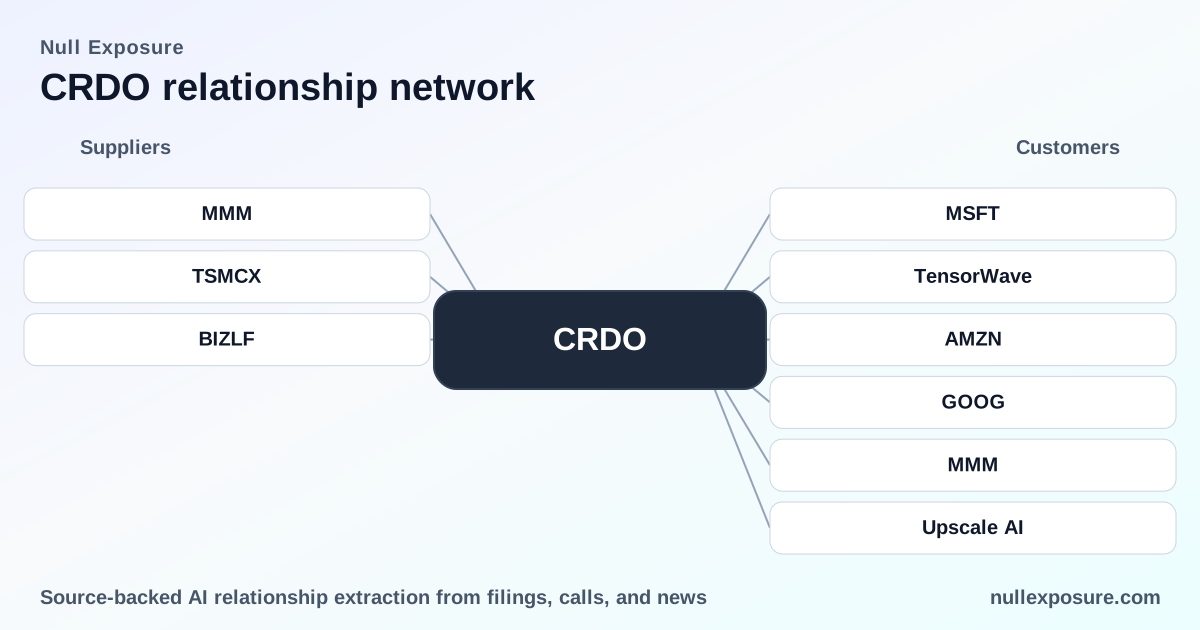
Credo (CRDO) — Hyperscaler customers power an interconnect growth franchise
Credo Technology Group sells high‑speed electrical and optical connectivity products, software telemetry and semiconductor IP to hyperscalers, cloud infrastructure builders and OEMs; it monetizes through product sales, perpetual IP licensing fees and short‑term purchase‑order transactions. Revenue is concentrated, product‑driven and tightly coupled to the capital and operational cycles of a small set of very large customers — a dynamic that amplifies upside in AI infrastructure rollouts and exposure to demand swings. For a concise hub of related research and signals, visit https://nullexposure.com/.
Why customer relationships determine Credo’s risk/reward
Credo’s business model is product and IP centric: hardware sales (retimers, active cables, optics), software telemetry (PILOT) and perpetual IP licenses. The firm transacts principally on standard purchase orders and license agreements rather than long‑term supply contracts, which creates high revenue volatility but rapid scalability when hyperscaler demand re-accelerates. Company disclosures show an unusually high concentration: the top 10 customers represented roughly 90% of fiscal 2025 revenue, with one customer accounting for 67% of that year’s sales — a structural concentration that defines Credo’s contracting posture and counterparty exposure.
Key company‑level signals:
- Contracting posture: Predominantly short‑term purchase orders; perpetual IP licensing exists as a revenue pillar but product sales are order‑by‑order.
- Counterparty profile: Large and very large enterprises (hyperscalers, OEMs, ODMs, optical module manufacturers).
- Geographic mix: Heavy exposure to Asia/APAC by revenue share, with a presence in North America and EMEA.
- Materiality: Customer relationships are critical — top clients drive margins and cash flow, and shifting spend by a single hyperscaler has previously compressed the share price.
- Business composition: Core product/hardware focus complemented by software telemetry and licensing revenue.
Customer relationships — what the record shows
The public reporting and market commentary offers multiple discrete relationship signals. Below I list every recorded relationship item from our collection with a one‑to‑two‑sentence plain‑English summary and its source.
GOOG (Markets.FinancialContent / Finterra, FY2026)
FinancialContent’s Finterra feature (Feb 2026) lists Google among the hyperscalers that dominate Credo’s customer base, underlining that hyperscaler demand drives much of Credo’s AI interconnect revenue (https://markets.financialcontent.com/stocks/article/finterra-2026-2-10-the-backbone-of-ai-a-comprehensive-research-feature-on-credo-technology-group-crdo).
TensorWave (InsiderMonkey, FY2026)
InsiderMonkey reported (Mar 2026) that Credo will work with TensorWave to deploy the ZeroFlap family of electrical cables and optics across TensorWave’s AI cluster infrastructure, indicating a commercial deployment outside the major hyperscalers (https://www.insidermonkey.com/blog/stifel-lowers-credo-crdo-price-target-despite-tensorwave-ai-infrastructure-collaboration-1707165/).
Amazon (Markets.FinancialContent / Finterra, FY2026)
Finterra on FinancialContent (Feb 2026) identifies Amazon as another core hyperscaler customer, noting Credo’s positioning as indispensable to hyperscalers seeking high‑speed, low‑power connectivity (https://markets.financialcontent.com/stocks/article/finterra-2026-2-10-the-backbone-of-ai-a-comprehensive-research-feature-on-credo-technology-group-crdo).
Google (Markets.FinancialContent / Finterra, FY2026) — duplicate entry
The same Finterra piece repeats Google’s placement within the hyperscaler cohort and emphasizes hyperscalers’ prioritization of energy efficiency and reliability when selecting interconnect partners (https://markets.financialcontent.com/stocks/article/finterra-2026-2-10-the-backbone-of-ai-a-comprehensive-research-feature-on-credo-technology-group-crdo).
Microsoft (Markets.FinancialContent / Finterra, FY2026)
Finterra notes that Microsoft was the major customer whose changed spending in 2023 precipitated a sharp share‑price correction, demonstrating how single‑customer spending shifts directly affect Credo’s valuation (https://markets.financialcontent.com/stocks/article/finterra-2026-2-10-the-backbone-of-ai-a-comprehensive-research-feature-on-credo-technology-group-crdo).
MSFT (Markets.FinancialContent / Finterra, FY2026) — duplicate entry
The MSFT entry reinforces the same point: Credo’s fortunes are correlated with Microsoft’s infrastructure investment cadence, as described in the Finterra feature (https://markets.financialcontent.com/stocks/article/finterra-2026-2-10-the-backbone-of-ai-a-comprehensive-research-feature-on-credo-technology-group-crdo).
TensorWave (SimplyWall.st, FY2026)
Simply Wall St covered Credo’s collaboration with AMD‑only AI cloud provider TensorWave, stating Credo will deploy ZeroFlap Active Electrical Cables and Optics and the PILOT telemetry platform to improve cluster reliability and deployment speed (https://simplywall.st/stocks/us/semiconductors/nasdaq-crdo/credo-technology-group-holding/news/is-credo-crdo-quietly-building-a-moat-in-ai-cloud-interconne).
TensorWave (SimplyWall.st AMP, FY2026) — duplicate entry
An AMP mirror of the Simply Wall St piece reiterates the same collaboration details and the operational benefits TensorWave expects from Credo’s solutions (https://simplywall.st/stocks/us/semiconductors/nasdaq-crdo/credo-technology-group-holding/news/is-credo-crdo-quietly-building-a-moat-in-ai-cloud-interconne/amp).
AMZN (Markets.FinancialContent / Finterra, FY2026) — duplicate entry
The AMZN entry in the dataset reproduces earlier Finterra commentary about Amazon’s role among hyperscalers that drive Credo’s product adoption (https://markets.financialcontent.com/stocks/article/finterra-2026-2-10-the-backbone-of-ai-a-comprehensive-research-feature-on-credo-technology-group-crdo).
3M (StocksToTrade, FY2026)
StocksToTrade reported (Feb 2026) that Credo executed a patent licensing agreement with 3M for advanced electrical technology, a deal the article frames as confidence‑building for Credo’s strategic direction (https://stockstotrade.com/news/credo-technology-group-holding-ltd-crdo-news-2026_02_09-2/).
MMM (StocksToTrade, FY2026) — duplicate entry
The MMM listing is the same 3M patent licensing report and reiterates the market’s positive sentiment tied to that licensing event (https://stockstotrade.com/news/credo-technology-group-holding-ltd-crdo-news-2026_02_09-2/).
Upscale AI (StockTitan, FY2026)
StockTitan covered the role of Credo’s Blue Heron 224G retimer in Upscale AI’s SkyHammer solutions, positioning Credo’s silicon as a critical building block for large heterogeneous scale‑up AI clusters (https://www.stocktitan.net/news/CRDO/credo-introduces-industry-s-first-224g-multiprotocol-ai-scale-up-c5542y90zbc5.html).
TensorWave (SimplyWall.st, FY2026) — additional entry
Another Simply Wall St entry reiterates Credo’s TensorWave collaboration and frames it alongside fiscal results as evidence of commercial traction in AI cloud interconnects (https://simplywall.st/stocks/us/semiconductors/nasdaq-crdo/credo-technology-group-holding/news/will-record-ai-revenue-and-tensorwave-pact-change-credo-tech/amp).
TensorWave (StocksToTrade news, FY2026)
StocksToTrade (Mar 2026) also documents the TensorWave collaboration, underscoring the deal’s message of Credo’s applicability across different AI cloud operators (https://stockstotrade.com/news/credo-technology-group-holding-ltd-crdo-news-2026_03_05-2/).
MMM (MarketBeat, FY2026)
MarketBeat’s alert (Feb 2026) characterizes market sentiment as positive around Credo’s AI traction, Blue Heron product and a 3M‑related licensing deal that could lift revenue and margins over time (https://www.marketbeat.com/instant-alerts/credo-technology-group-nasdaqcrdo-trading-down-72-following-insider-selling-2026-02-03/).
3M (MarketBeat, FY2026) — duplicate entry
A duplicate MarketBeat entry echoes the same positive sentiment linking Credo’s product developments and the 3M licensing item (https://www.marketbeat.com/instant-alerts/credo-technology-group-nasdaqcrdo-trading-down-72-following-insider-selling-2026-02-03/).
Investment implications: concentration is the defining risk — partnerships nudge diversification
Credo’s fiscal profile shows meaningful scale in an AI growth vertical (TTM revenue ~$1.07B; gross margin and operating margin metrics are strong), yet the company’s top‑customer concentration and short‑term purchase‑order contracting create binary outcomes: outsized upside when hyperscalers or large AI cloud customers accelerate deployments, and rapid revenue compression when a major buyer pauses purchases. Partnerships with TensorWave, Upscale AI and a 3M license provide evidence of market diversification beyond the largest hyperscalers, but material dependency on a handful of very large customers remains the core counterparty risk.
- Positive: Credo’s products (Blue Heron, ZeroFlap, PILOT) are being adopted beyond the marquee hyperscalers, validating product fit for next‑generation AI clusters and expanding addressable markets.
- Negative: Short‑term order flows and a single customer historically accounting for two‑thirds of revenue make revenue visibility limited and earnings sensitive to large‑customer spending cycles.
For research teams modeling upside from AI infrastructure adoption, treat Credo’s growth as high‑beta exposure to hyperscaler and large AI cloud capex cycles, offset by nascent but meaningful diversification signals from licensing deals and smaller cloud providers. For operators and supply‑chain managers, Credo’s commercial posture demands active monitoring of purchase‑order momentum from hyperscaler accounts and public disclosures for signs of customer spend changes.
If you want an organized feed of these customer signals and how they track to Credo’s commercial progress, visit https://nullexposure.com/ for consolidated coverage.