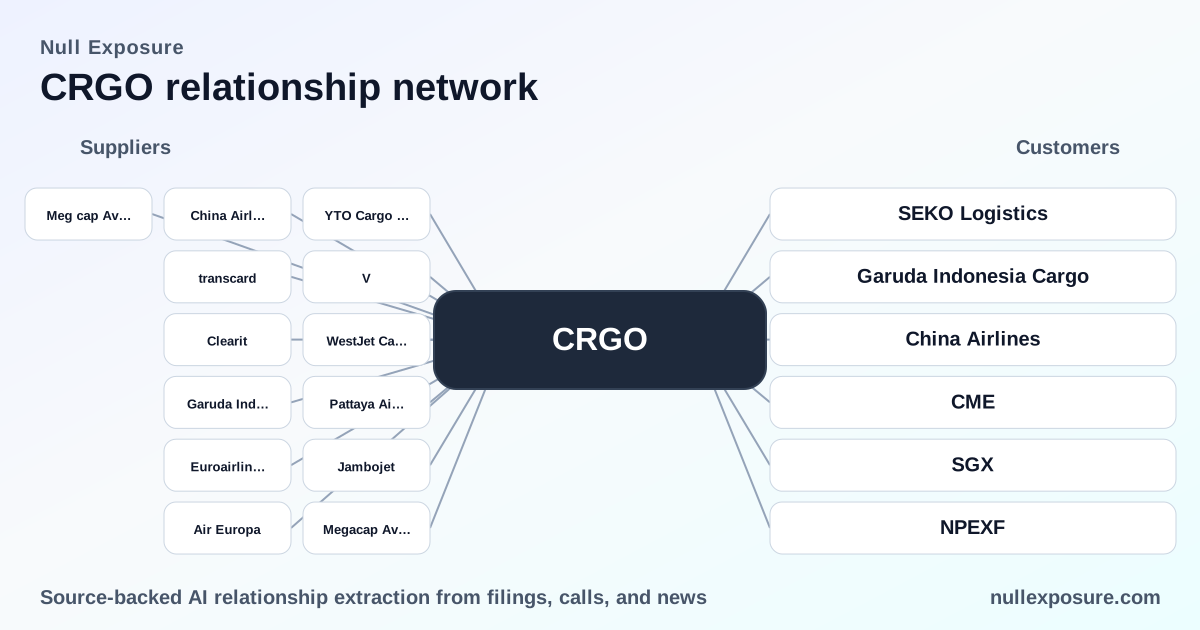
Freightos (CRGO): How customer wins are driving a platform play in global freight
Freightos operates a digital freight marketplace and SaaS stack that connects carriers, freight forwarders and shippers for real-time pricing, booking and settlement; the company monetizes through subscription SaaS for forwarders and carriers, transaction and booking fees on its marketplace, and products tied to its FBX freight index and futures. For investors and operators evaluating CRGO customer relationships, the critical question is whether these partnerships deepen network effects and produce durable, scalable revenue streams while the company transitions to profitability. For a focused look at the customer evidence and operating constraints, see NullExposure for ongoing tracking: https://nullexposure.com/.
Executive view: customer mix drives product leverage and revenue optionality
Freightos' recent customer disclosures indicate two strategic vectors: (1) continued onboarding of major airlines and national carriers to widen supply-side liquidity for air freight, and (2) expanded enterprise SaaS deployments with global forwarders that convert one-off bookings into recurring contract revenue. These moves increase the value of Freightos' marketplace and its pricing products (including FBX), which in turn support higher take rates and SaaS retention. However, company financials show modest scale today — Revenue TTM roughly $29.5M, negative operating margins and EBITDA — so customer wins must translate into faster SaaS penetration and transaction density to sustain growth. If you monitor CRGO, prioritize customer retention metrics, average revenue per forwarder, and FBX adoption velocity.
The relationship evidence — who Freightos is signing and what it means
Below are every customer relationship referenced in public coverage, each with a concise plain-English summary and source reference.
Air Serbia
Air Serbia will integrate with Freightos’ cargo booking platform to enable digital bookings and payments across Europe and the Americas, expanding Freightos’ airline supply on key transcontinental lanes. Reported by Investing.com (May 2, 2026) in coverage of Freightos’ workforce reduction announcement.
Ethiopian Cargo
Ethiopian Cargo is scheduled to join Freightos’ platform to provide digital rate access and electronic booking capabilities, broadening Freightos’ reach in Africa–global trade lanes. This was noted in the same Investing.com report (May 2, 2026).
China Airlines
China Airlines announced launch on Freightos’ WebCargo and 7LFreight platforms, adding a top-15 air cargo carrier to Freightos’ airline network and strengthening air capacity coverage in Asia–Pacific corridors. Announcement published via PR Newswire (March 9, 2026).
SEKO Logistics
SEKO Logistics expanded its partnership with Freightos, scaling use of 7LFreight and WebCargo to unify air and ground rate management and booking across its global operations, signaling deeper enterprise SaaS adoption by a multi-country forwarder. Reported on PR Newswire (March 9, 2026).
Garuda Indonesia Cargo
Garuda Indonesia Cargo joined WebCargo by Freightos, increasing airline participation on the platform and supporting Freightos’ air-market liquidity in Southeast Asia. Noted in a press release aggregated by The Globe and Mail (March 9, 2026).
SGX (Singapore Exchange)
Freightos disclosed that FBX futures are traded on SGX, which provides institutional venues for price discovery and monetization of the company’s freight index product outside the core booking stack. This detail was included in Freightos’ fourth-quarter and full-year 2025 results release (PR Newswire, March 9, 2026).
CME (Chicago Mercantile Exchange)
FBX futures also trade on CME, giving Freightos institutional distribution for its benchmark freight pricing and expanding derivative liquidity for shippers and carriers hedging freight cost exposure. Mentioned in the same Q4/2025 results release (PR Newswire, March 9, 2026).
Nippon Express (NPEXF)
Nippon Express, a top-five global freight forwarder, expanded from initial usage to a multimodal deployment across much of its network, representing a strategic forwarder customer migrating to Freightos’ broader SaaS and booking product set. This expansion was described in an earnings-call transcript and coverage of Q3/2025 implementations (InsiderMonkey, Q3 2025) and is also captured in industry reporting on platform deployments (SimplyWall.st, fiscal note).
(Note: Nippon Express appears across multiple public reports confirming a staged expansion from pilot to multimodal deployment; both the InsiderMonkey transcript and SimplyWall.st references document that progression.)
What these relationships collectively imply for the business model
- Network effects are strengthening on both supply and demand sides. Airline integrations (China Airlines, Garuda, Air Serbia, Ethiopian Cargo) expand available capacity and routes, while forwarder enterprise deals (Nippon Express, SEKO) increase buyer-side booking volume and SaaS lock-in.
- FBX futures distribution on CME and SGX turns a pricing product into a tradable revenue stream, creating optionality beyond pure booking fees and subscriptions.
- Enterprise SaaS traction is the lever for repeatable revenue; marketplace wins are path-to-scale. Large forwarders converting to multimodal deployments reduce churn risk and raise lifetime value.
Company-level operating constraints and risk signals
These constraints are company-level signals that investors should factor into any customer-upside thesis:
- Profitability focus and cost discipline. Freightos announced a 15% workforce reduction in early May 2026 to accelerate the path to profitability; this shows active cost control while the company scales customer deployments (Investing.com, May 2, 2026).
- Scale and margin pressure. Financials show modest scale today — revenue near $29.5M TTM with negative operating margin and EBITDA — which means customer deployments must break through to materially improve unit economics.
- Ownership and governance profile. Insider ownership is elevated (~45.5%) with institutions at ~28.6%, creating concentrated internal alignment but potential liquidity considerations for public investors.
- Dependence on platform adoption. The business model’s criticality to customers increases as forwarders and airlines migrate to SaaS and booking workflows; failure to convert pilots into enterprise contracts would impede margin improvement.
Bottom line and next steps for investors and operators
Freightos is executing a classic platform expansion play: airline integrations supply capacity, forwarder SaaS contracts drive recurring revenue, and FBX futures create a financialized layer for pricing monetization. The customer roster reported over 2025–2026 shows substantive, strategically relevant wins that validate product-market fit across air and forwarder segments; conversion of these relationships into durable ARR and higher transaction density is the key valuation hinge.
For ongoing coverage, methodology and deal-tracking on CRGO customer developments, visit NullExposure: https://nullexposure.com/.