Crescent Energy (CRGY) — Customer Concentration and Commercial Posture
Crescent Energy monetizes by producing and selling onshore U.S. crude oil, natural gas and NGLs to a mix of large trading houses and integrated oil companies, extracting margin through capital-efficient development of high-yield shale acreage and midstream service integration. Revenue is materially concentrated among a small number of large buyers, with indexed short‑term pricing for spot volumes complemented by multi‑year delivery commitments that provide both cash flow visibility and price exposure. For a deeper, interactive read of Crescent’s customer signals, visit https://nullexposure.com/.
Investment thesis in one paragraph
Crescent Energy is an upstream operator that captures value through disciplined development of U.S. shale assets and monetizes production predominantly through a small set of large, credit‑worthy buyers. The business combines predictable contracted delivery obligations with routine spot sales tied to local indices, creating a hybrid revenue stream that supports leverage reduction and steady free cash flow when commodity prices cooperate. Customer concentration boosts near‑term revenue certainty but also increases counterparty concentration risk; investors should underwrite both the upside from operational leverage and the downside from abrupt shifts in offtaker behavior.
What the customer roster looks like today
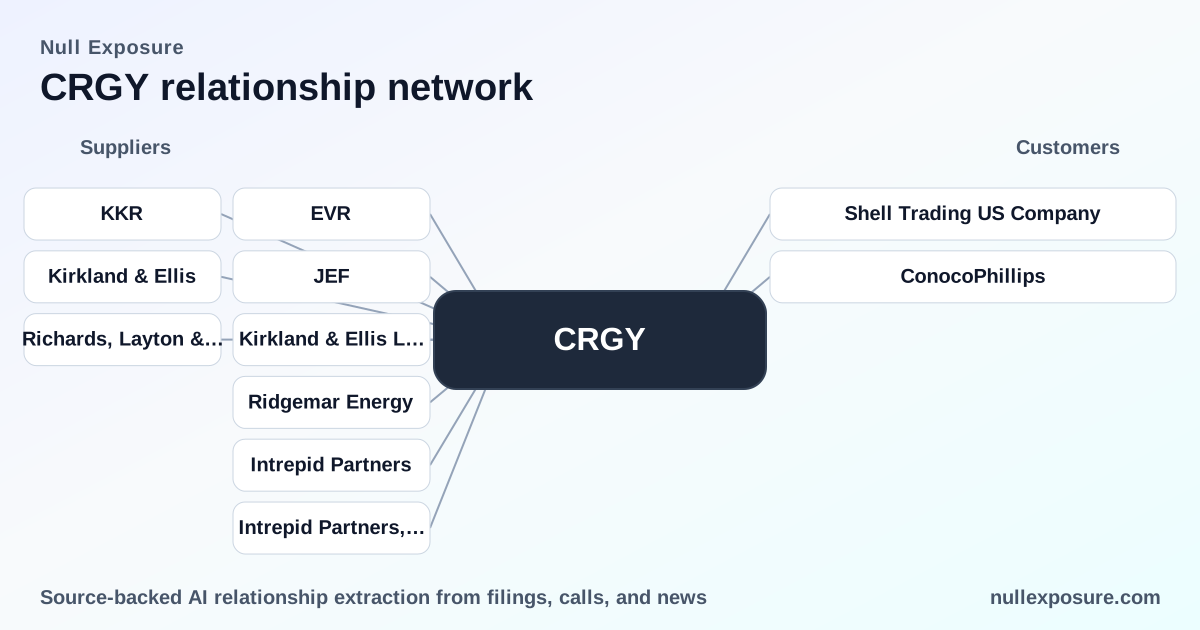
Crescent’s 2024 Form 10‑K discloses two counterparties that each accounted for greater than 10% of revenues in recent years: Shell Trading US Company and ConocoPhillips. These are large, investment‑grade counterparties that anchor Crescent’s sales book but simultaneously create single‑counterparty sensitivity. The following entries summarize the public disclosures.
Shell Trading US Company — large anchor purchaser
Crescent sold 23.7% of its 2024 revenues to Shell Trading US Company, up from 18.3% in 2023 and 20.8% in 2022, making Shell the company’s largest disclosed purchaser in the period covered by the 2024 Form 10‑K. According to Crescent’s 2024 Form 10‑K, Shell represented 23.7% of total revenues in 2024. This concentration provides meaningful volume certainty but concentrates price and counterparty exposure with a major trading house.
ConocoPhillips — material strategic buyer
ConocoPhillips accounted for 16.5% of Crescent’s 2024 revenues and 15.1% in 2022, per the 2024 Form 10‑K; the 2023 disclosure does not list ConocoPhillips above the 10% threshold. As an integrated producer, ConocoPhillips provides a complementary offtake profile to trading houses, anchoring a sizable share of Crescent’s sold production and offering an alternative route to market compared with purely merchant trading counterparties.
What these relationships mean for revenue quality and risk
Crescent’s customers are large enterprises with deep market reach; that is positive for counterparty credit and settlement reliability, but it concentrates economic exposure. From the public filing:
- The 10‑K explicitly lists purchasers that exceeded 10% of revenues for 2022‑2024, confirming material customer concentration.
- Contracts vary by structure: Crescent maintains long‑term delivery commitments (fixed, determinable volumes booked out several years) while also executing short‑term, index‑linked sales that expose realized revenue to local market spreads and monthly price movements.
- Crescent operates midstream assets and executes Master Service Agreements with affiliates of KKR Funds for certain service allocations, pointing to vertical integration and framework arrangements that support operational control but increase intercompany and contractual complexity.
Taken together, these facts create a revenue model that is both resilient and concentrated: resilient through committed, contracted deliveries and large counterparties; concentrated through a small number of buyers that collectively drive a substantial share of sales.
Contracting posture, concentration and maturity — an integrated read
The filings deliver several company‑level signals that shape how investors should model Crescent’s commercial profile:
- Contracting posture: Crescent runs a mixed contracting book. The company discloses long‑term delivery commitments requiring the physical delivery of millions of barrels (e.g., a stated commitment for 6,181 MMBoe in 2025 and further volumes thereafter), and it also executes short‑term sales where pricing is set monthly against local indices. This mix provides volume certainty but preserves market‑price exposure on a substantial portion of sales.
- Commercial framework agreements: Crescent’s subsidiaries enter Master Service Agreements with KKR‑owned entities for allocation of production and services, indicating recurring framework relationships that standardize service delivery and revenue allocation across assets.
- Concentration and counterparty profile: Public disclosures categorize major purchasers as large enterprises and show multiple buyers contributing more than 10% of revenues, signaling concentrated yet creditworthy counterparty risk.
- Geography and operational footprint: Crescent’s activity is focused on onshore U.S. shale (Texas and Rocky Mountain regions), and substantially all revenues derive from U.S. customers — a geographically concentrated revenue base that reduces FX and cross‑border execution risk but concentrates exposure to U.S. midstream and pricing dynamics.
- Relationship maturity and role: These buyer relationships are active, form part of Crescent’s core product commercialization (selling oil, gas and NGLs), and the company itself acts as both seller and service provider via midstream assets; this dual role supports margin capture but raises intersegment transfer pricing considerations.
Implications for investors and operators
- Revenue predictability is elevated but not absolute. Long‑term delivery commitments increase near‑term volume visibility; however, short‑term index pricing and a concentrated buyer base leave realized cash flows exposed to abrupt price or contracting shifts.
- Counterparty concentration is a material risk factor. Two counterparties representing double‑digit shares of revenue highlight the need to stress test scenarios where either trading flows or offtake appetite changes materially.
- Operational control and midstream ownership are strategic positives. Owning midstream assets and maintaining MSAs with affiliated funds reduces third‑party bottlenecks and preserves capture of midstream margins.
- Geographic concentration reduces complexity but adds single‑market exposure. U.S. onshore focus simplifies regulatory and logistical modeling but ties performance to North American differentials and regional pipeline capacity.
Relationship summaries and sources
- Shell Trading US Company accounted for 23.7% of Crescent’s 2024 revenues (18.3% in 2023; 20.8% in 2022), establishing Shell as the largest disclosed purchaser in the 2022–2024 window, per Crescent Energy’s 2024 Form 10‑K.
- ConocoPhillips represented 16.5% of revenues in 2024 and 15.1% in 2022, with no 2023 figure listed above the 10% threshold, per Crescent Energy’s 2024 Form 10‑K.
Final takeaways for portfolio managers
Crescent’s commercial model delivers a balanced mix of contracted volume certainty and market‑sensitive pricing exposure, anchored by large, creditworthy counterparties that also create concentration risk. Active monitoring of counterparty composition, changes in offtake volumes and any shifts in long‑term delivery commitments should be central to due diligence and scenario analysis. For a consolidated view of customer signals across energy issuers and to track future changes in Crescent’s counterparty profile, visit https://nullexposure.com/.